A civil divorce decree can feel final, but it does not answer every question a Christian must face. The Orthodox view on divorce begins with a harder and more hopeful truth: marriage is not merely a contract between two individuals. It is a holy mystery in which a man and woman are called to become one flesh and to image Christ's faithful love for His Church. That conviction means the Church does not treat divorce lightly, casually, or as an expected solution to marital pain. Yet the Church also ministers to people living in the wreckage of real sin, betrayal, abandonment, abuse, addiction, and human weakness. Orthodox pastoral care must speak truthfully about the permanence of marriage … [Read more...]
An Orthodox Prayer Book Review for Daily Use
A prayer book should not become another religious purchase that gathers dust beside the Bible. It places the words of the Church on your lips, teaches the heart how to stand before God, and gives shape to prayer when your own words are weak. This Orthodox prayer book review considers what a faithful prayer book should contain, which differences matter, and how to begin using one without turning prayer into a private spiritual project. For many inquirers, the first encounter with an Orthodox prayer book can feel both rich and intimidating. The language is formal. The prayers are direct about sin, death, judgment, mercy, and the saints. They assume that salvation is not merely an idea one … [Read more...]
Are Icons Idolatry? An Orthodox Christian Answer
A visitor may enter an Orthodox church, see Christ, the Theotokos, and the saints painted on every side, and ask a serious question: are icons idolatry? The question deserves more than a quick reassurance. Scripture condemns idolatry with absolute force, and Orthodox Christians condemn it too. We worship no creature, no object, no image, and no saint. We worship the Holy Trinity alone: Father, Son, and Holy Spirit. Yet the Orthodox Church also receives and venerates holy icons. This is not a contradiction. It rests on the central confession of Christianity: the eternal Son of God truly became man. Jesus Christ took visible flesh, lived among us, and was seen by human eyes. The God whom no … [Read more...]
Old Calendar, New Calendar: What Orthodox Mean
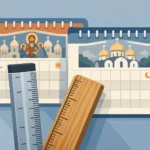
A feast day appears on one Orthodox calendar, while another parish observes it thirteen days later. For many newcomers, the old calendar new calendar question can seem like proof that Orthodox Christians cannot agree on something basic. It is not. The calendar matters because the Church sanctifies time through worship, fasting, and feasting. Yet the calendar itself is not the Faith, and it must never become a weapon against fellow Orthodox Christians. The truth is that the difference between calendars is like the difference between English and Metric rulers. They both measure, and that is the key. The Orthodox Church receives the same apostolic faith, confesses the same Creed, celebrates … [Read more...]
An Orthodox Prayer Rule That Lasts
An Orthodox prayer rule is not a spiritual fitness plan, a private project in self-improvement, or a way to prove that you are serious about God. Choosing an Orthodox prayer rule means receiving a small, concrete pattern of repentance and praise that can be offered faithfully before Christ. Its purpose is not to make us feel impressive. Its purpose is to make room for God, day after day, in the actual conditions of our lives. For many inquirers, catechumens, and newly received Orthodox Christians, this question arrives with urgency. They have discovered the depth of the Church's prayers and want to begin well. That desire is good. Yet zeal without guidance can quickly become discouragement. … [Read more...]
Orthodox Home Blessing Guide for Your Family
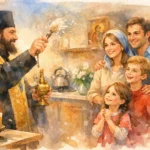
A home can be clean, well furnished, and busy with family life while still needing to be claimed afresh for Christ. An Orthodox home blessing guide begins there: not with superstition, nor with a religious decoration for a new house, but with the Church's prayer that the peace of God may dwell where you sleep, eat, work, repent, and raise your children. The blessing of a home brings the priest, holy water, prayer, and the confession of Christ's lordship into the ordinary rooms of life. It is a pastoral act of the Church. Whether you have just moved to Surprise or Peoria, entered a new season of family life, or simply recognize that your household needs renewed prayer, this blessing gives … [Read more...]
Do Orthodox Use Rosaries? The Prayer Rope Explained
A small strand of knotted wool can raise a large question for Christians entering the Orthodox Church: do Orthodox use rosaries? The short answer is that Orthodox Christians commonly use prayer ropes, which serve a purpose similar to prayer beads, but they do not ordinarily use the Roman Catholic rosary devotion. The difference is not merely a matter of materials or counting prayers. It reflects the distinct prayer life that the Orthodox Church has received and guarded. An Orthodox prayer rope is not a decoration, a religious accessory, or a shortcut to holiness. It is a simple aid for attention, repentance, and perseverance before God. Used humbly and with guidance, it can become a quiet … [Read more...]
How to Read an Orthodox Feast Day Calendar
An Orthodox feast day calendar is not merely a religious datebook. It is the Church’s way of teaching time to speak the Gospel. Day by day, the calendar sets before us Christ, His Mother, the saints, the martyrs, the fasts, and the saving events by which the world has been redeemed. It calls us out of a life governed only by appointments, entertainment, and anxiety, and into the life of the Kingdom. For someone new to Orthodoxy, the number of commemorations can seem overwhelming. For a lifelong Orthodox Christian, a calendar can become so familiar that it is easy to glance at it without praying. In both cases, the goal is the same: do not treat the feasts as information to collect. Receive … [Read more...]
How Orthodox Traditions Shape Christian Life
A visitor may first notice candles, icons, chanting, incense, or the sign of the cross. But Orthodox traditions are not a collection of religious accessories added to ordinary Christian life. They are the Church’s received way of living the Gospel: a pattern of worship, repentance, prayer, fasting, feasting, and sacramental communion that forms the whole person in Christ. For many people, especially those weary of shallow teaching or constantly changing church culture, this can be both compelling and unfamiliar. Orthodoxy does not ask us to invent a private spirituality. It calls us into the apostolic faith as it has been prayed, taught, and embodied through the centuries. These traditions … [Read more...]
Participating in Orthodox Vespers for the First Time
The first thing many visitors notice when participating in Orthodox Vespers is that no one is trying to fill every quiet moment. Lamps burn before the icons. Incense rises. Psalms and hymns carry the congregation into prayer. The Church does not gather merely to hear about God. She gathers to stand before Him. For Christians formed in a setting where worship is centered on a sermon, Vespers can feel unfamiliar at first. That is not a defect. It is an invitation to receive the Church's ancient rhythm of prayer with patience, attention, and humility. You do not need to understand every word on your first visit in order to pray. You only need to come honestly, listen carefully, and let the … [Read more...]
- « Previous Page
- 1
- …
- 7
- 8
- 9
- 10
- 11
- …
- 14
- Next Page »