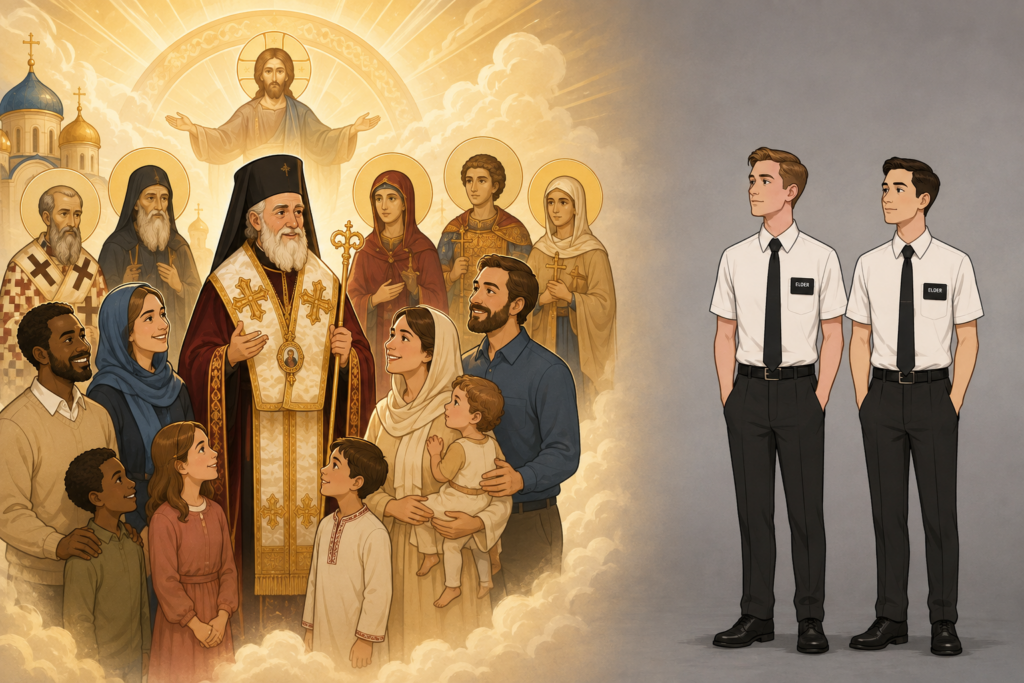
A conversation about Orthodox versus Mormon beliefs cannot be settled by noting that both communities use Christian language. Both speak of Jesus Christ, repentance, prayer, Scripture, baptism, family, and eternal life. Yet the words often carry very different meanings. These differences are not minor denominational preferences. They concern who God is, who Jesus Christ is, what the Church is, and how human beings are saved.
The Church of Jesus Christ of Latter-day Saints is often called Mormonism because of its use of the Book of Mormon, though many members prefer the terms Latter-day Saint or LDS. Orthodox Christians should speak truthfully and charitably about our neighbors. We do not need caricatures to see that the Orthodox Church and LDS teaching offer fundamentally different accounts of the Christian faith.
Orthodox versus Mormon beliefs about God
The central difference concerns God Himself. Orthodox Christianity confesses the one God revealed in Holy Scripture and proclaimed in the Nicene Creed: Father, Son, and Holy Spirit. God is one in essence and three in Persons. The Father is uncreated, the Son is eternally begotten of the Father, and the Holy Spirit eternally proceeds from the Father. The Holy Trinity is not three gods cooperating together. He is the one eternal, uncreated, incorporeal God.
LDS teaching uses the word “Godhead” for the Father, Son, and Holy Spirit, but understands them as three distinct beings united in purpose rather than one God in essence. LDS teaching also holds that God the Father has a glorified physical body and that human beings may ultimately attain exaltation in a manner that differs sharply from the Orthodox understanding of salvation.
Orthodoxy does teach that man is called to become “partakers of the divine nature.” This is the doctrine of theosis, or deification. But it never means that creatures become gods by nature, become independent divine beings, or join a plurality of gods. God alone is uncreated. By grace, we share in God’s life while always remaining His creatures. The distinction protects both God’s absolute holiness and the astonishing promise of communion with Him.
Who is Jesus Christ?
For the Orthodox Church, Jesus Christ is the eternal Son and Word of God, fully God and fully man. He did not become divine at some point. He is eternally divine, one in essence with the Father, and took flesh from the Virgin Mary for our salvation. The same Jesus who was born in Bethlehem, was crucified, rose bodily from the dead, and ascended into heaven is the uncreated Lord whom Christians worship.
Latter-day Saint teaching honors Jesus as Savior and Redeemer, but places Him within a very different account of divine beings, pre-mortal existence, and the Godhead. The difference is not simply vocabulary. When Orthodox Christians confess that Christ is “true God of true God,” we are confessing what the early Church defended at great cost: Jesus Christ is not a separate god, a created heavenly being, or merely a uniquely exalted man. He is the one Lord through whom all things were made.
This matters because salvation depends on who saves us. A created being cannot unite us to the uncreated God. Only the incarnate Son can conquer death, heal human nature, and bring us into the life of the Father.
Scripture, revelation, and the apostolic Church
Orthodox Christians receive the Bible as Holy Scripture within Holy Tradition. Tradition does not mean human customs added alongside the Bible. It is the living faith handed down from the apostles: the worship of the Church, the decisions of the ecumenical councils, the writings of the saints, the Creed, and the sacramental life through which the Bible is proclaimed and understood.
The LDS tradition accepts the Bible, generally with a qualification regarding translation, alongside the Book of Mormon, Doctrine and Covenants, and Pearl of Great Price. It also believes that the original Church fell into a broad apostasy after the apostles and required restoration through Joseph Smith in the nineteenth century.
Orthodoxy rejects the claim of a total apostasy. Christ promised that the gates of Hades would not prevail against His Church. The Church has endured through persecution, internal conflict, heresy, repentance, councils, missionaries, martyrs, and saints. She has not always been outwardly powerful or morally impressive in every member, but she has never ceased to be the Body of Christ.
This is why the question is not merely, “Which book feels more compelling to me?” The deeper question is: Did Christ preserve the Church He founded? Orthodox Christians answer yes. We receive the faith not as a later reconstruction but as a living inheritance.
Priesthood, sacraments, and worship
LDS worship and temple practice stand outside the sacramental life of the historic Church. Latter-day Saints have ordinances, priesthood offices, temple rites, and a strong emphasis on eternal family relationships. These practices are meaningful within their own system, but they are not the mysteries received by the Orthodox Church from the apostles.
In Orthodoxy, baptism is burial and resurrection with Christ. Chrismation is the gift of the Holy Spirit. Confession is reconciliation with God in the presence of His Church. The Eucharist is not a symbolic reminder alone but true communion in the Body and Blood of Christ. These mysteries do not function as private spiritual milestones. They form a person into the Church and sustain a life of repentance.
The contrast in worship is equally revealing. Orthodox worship is directed toward the Holy Trinity and ordered around the Eucharist. It joins the worship of heaven and earth with Scripture, psalmody, incense, fasting, feasting, silence, icons, and reverence. It does not offer religious entertainment. It trains the whole person to stand before God.
Salvation is more than a future destination
Both Orthodox Christians and Mormons speak about obedience, moral effort, family life, and eternal hope. Still, their frameworks differ. Mormon belief teaches often describes a pre-earth life, mortal testing, postmortem progress, temple ordinances, and degrees of glory. It places eternal family sealing at the center of its vision of exaltation.
The Orthodox Church begins elsewhere: humanity is created in the image of God, wounded by sin and death, and rescued by Christ. Salvation is not primarily a ladder of advancement into a higher spiritual status. It is union with God through Christ in the Holy Spirit. We repent, fast, forgive, pray, receive the mysteries, and practice mercy not to earn a place in God’s household, but because Christ is healing us and making us alive.
Marriage is holy in Orthodoxy, and families are called to become small churches. But eternal life is not grounded in a temple sealing or in biological descent. Christ teaches that the resurrection transforms even our earthly relationships. Our final hope is communion with God and all the saints in His Kingdom.
How to examine these claims honestly
If you are LDS, formerly LDS, or simply comparing the two traditions, do not settle for a superficial comparison of terminology. Ask whether the Trinity confessed by the Orthodox Church is true. Ask whether Christ preserved His apostolic Church. Ask whether the Eucharist is truly the Lord’s Body and Blood. Ask whether the saints, martyrs, bishops, and councils of the early centuries reflect a restored faith or the continuing life of the Church.
Give these questions time. Read the Gospels carefully. Pray with honesty. Visit Orthodox Vespers or the Divine Liturgy, not as a consumer evaluating a service, but as a seeker asking whether this is the worship of the historic Church. At All Saints of North America Orthodox Church, inquirers are welcome to ask direct questions and to enter a serious path of catechism rather than being rushed into a decision.
Christ does not call us to invent a faith that suits our preferences. He calls us to receive the truth, repent, and follow Him. That path can be costly, but it is also the path home.