A catechumen journey into Orthodoxy is not an academic course that ends with a certificate. It is the Church’s careful preparation of a person to confess Christ, renounce the devil, receive the holy mysteries, and live under the lordship of Jesus Christ. It asks more than intellectual agreement. It asks for the surrender and healing of the whole life.
For many inquirers, this is a relief. After years of fragmented teaching, shifting moral standards, or isolated Christian practice, they find that the Orthodox Church does not offer a quick religious experience. She offers a life of repentance, worship, truth, and communion. That life is received patiently.
The Catechumen Journey Into Orthodoxy Begins With Worship
Most people first encounter Orthodoxy through the Divine Liturgy, Vespers, or another service of the Church. The chanting, icons, incense, Scripture, and repeated prayers can feel unfamiliar. Do not mistake unfamiliarity for emptiness. Orthodox worship is saturated with the Bible and shaped by the Church’s confession that Christ is truly God and truly man, crucified and risen for the life of the world.
Before anyone is received as a catechumen, he or she should spend meaningful time attending services and getting to know parish life. This is not a period of passive observation. Come faithfully. Listen carefully. Learn when to stand, cross yourself, and venerate the icons. Ask honest questions at appropriate times. Begin to see that Orthodoxy is not merely a set of historical claims. It is the worshiping life of the Church.
At All Saints of North America Orthodox Church, those from Surprise, Peoria, Glendale, Sun City, Buckeye, and surrounding communities are invited to begin simply: attend, pray, speak with the clergy, and allow time for serious discernment. No one needs to pretend to understand everything on the first visit.
Catechumens Are Received Into a Period of Formation
A catechumen is someone formally enrolled by the Church as one preparing for baptism and full entrance into Orthodox life. This enrollment is marked by prayers of the Church, including prayers of exorcism and the renunciation of Satan. These prayers are direct because baptism is not a cultural milestone. It is deliverance from the dominion of sin and death and union with Christ.
The length of catechumenate is not identical for every person. The priest, acting within the order of the Church and under the bishop’s authority, discerns readiness with each catechumen. A person with little Christian background may need more time than someone who has long practiced the Christian faith. Yet previous knowledge alone does not determine readiness. The question is whether a person is being formed into faithful Orthodox life.
This can be difficult for Americans accustomed to immediate access and self-directed choices. The Church does not rush a soul toward baptism simply because he is eager, nor does she delay for arbitrary reasons. Patience is an act of pastoral care. The goal is not to create a hurdle. The goal is to prepare a person to make vows that must be kept.
Learning the Faith Is More Than Learning Information
Catechism instruction gives catechumens a coherent account of what the Church believes. They learn the Holy Trinity, the person and work of Christ, the Holy Spirit, the Church, the Scriptures, the saints, the Mother of God, the sacraments, prayer, fasting, and the last things. They also learn why Orthodox Christians reject teachings that contradict the apostolic faith.
Those coming from Protestant or evangelical communities may need to reconsider assumptions about authority, Scripture, tradition, the Eucharist, and salvation. Roman Catholics may find much that is familiar while also confronting meaningful differences concerning papal claims and certain later Western doctrines. Those without a Christian background must begin with the Gospel itself: who Christ is, what sin has done to humanity, and why the resurrection changes everything.
Questions are welcome. Catechism should not produce shallow answers or mere argument. It should establish conviction. A catechumen needs to know what the Church teaches and why, but must also learn to receive the faith with humility rather than treating doctrine as material to edit according to personal preference.
The Work of Repentance Cannot Be Avoided
The catechumen journey includes a moral turning. Christ calls every person to repentance, and the Church cannot bless what God calls sin. This is not harshness. A physician who refuses to name a wound cannot offer healing.
Catechumens begin to order their lives around prayer, worship, chastity, forgiveness, generosity, sobriety, and truthfulness. Some changes may be immediate. Others may require patient counsel, practical accountability, and time. A couple living together, a person entangled in habitual sins, or someone carrying unresolved anger should not assume these matters are private exceptions to discipleship. Bring them honestly to the priest. Pastoral guidance is meant to lead toward freedom, not shame.
Prayer at home also becomes essential. A simple morning and evening rule, given with discretion, establishes a rhythm of turning toward God. Read the Gospels. Keep the fasts as you are able and as you are instructed. Do not begin with dramatic spiritual projects that cannot be sustained. Faithfulness in small, concrete obediences is better than religious enthusiasm that burns out quickly.
Presence in the Parish Matters
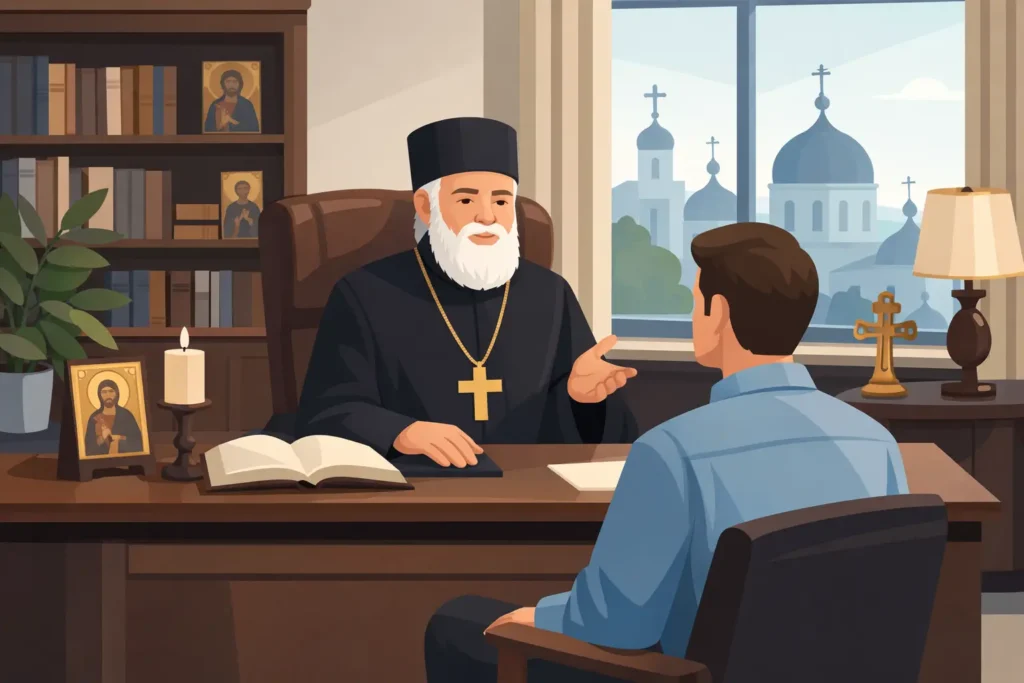
A catechumen is not preparing to join an idea called Orthodoxy. He is preparing to enter a visible body, with real people, real obligations, and a shared sacramental life. Regular attendance at services is therefore part of the formation, not an optional addition to classwork.
The parish will not be perfect because its members are not yet perfect. You may encounter personalities unlike your own, practical inconveniences, long services, and moments when you do not understand what is happening. These are not necessarily signs that you are in the wrong place. Often they expose the consumer habits that make modern religious life so thin.
Learn the names of fellow parishioners. Receive hospitality. Serve where it is appropriate. If a sponsor or godparent is being considered, seek someone who practices the faith faithfully and can support your life after baptism. A godparent is not a ceremonial accessory. He or she bears a serious responsibility of prayer, example, and encouragement.
Preparing for Baptism or Chrismation
The normal entrance into the Orthodox Church is through baptism, followed by chrismation and first Holy Communion. Baptism unites a person to Christ’s death and resurrection. Chrismation seals the gift of the Holy Spirit. The Eucharist completes the person’s sacramental reception into the Church’s communion.
How a person is received can depend on his or her prior baptism and the pastoral direction of the bishop and priest. This is not a matter for online debate or personal demand. The Church receives people according to her order, with care for both truth and souls. Catechumens should speak openly with their priest about their history and follow the guidance they receive.
As baptism approaches, preparation becomes more focused. The catechumen learns the Creed, reviews the baptismal vows, receives instructions for the service, and prepares inwardly through prayer and repentance. The renunciations and confession of faith at baptism are not sentimental words. They are a public declaration of allegiance to Christ.
Baptism Is a Beginning, Not Graduation
One of the most dangerous misunderstandings is to treat reception into the Church as the finish line. Baptism is a true new birth, but the newly illumined Christian must now grow into the life he has received. This continuing formation is often called Mystagogy: learning to live from the mysteries of the Church.
After baptism or chrismation, continue attending services, receiving instruction, praying at home, fasting with discernment, giving alms, and going to confession as directed. The first months can bring joy, temptation, fatigue, or all three. Do not be surprised by the struggle. The Christian life is not sustained by emotional intensity. It is sustained by grace, repentance, and steadfast participation in the life of the Church.
If you are considering becoming Orthodox, do not wait until every question has disappeared or every part of your life feels resolved. Come before God truthfully. Attend the services. Ask for guidance. The Church has received seekers for centuries, and she still knows how to lead willing souls, step by step, toward the font and into a life that belongs wholly to Christ.