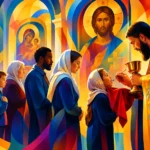
The Chalice is not a religious accessory or a private moment of spiritual encouragement. In the Holy Eucharist, the Church receives the true Body and Blood of Jesus Christ. That reality gives Orthodox communion rules their seriousness, their beauty, and their pastoral care. They are not designed to push people away. They guard the sacred gift Christ has given and call every person toward the full unity of faith, repentance, and life in His Church. For visitors, especially those who come from Evangelical, Roman Catholic, or non-denominational backgrounds, the practice can feel unfamiliar. You may see nearly everyone approach the Chalice while others remain in prayer. You may wonder whether … [Read more...]
How to Join a Parish and Begin Orthodox Life

A parish is not a religious service you select from a menu. It is a local body of Christ: a people gathered around the Holy Eucharist, entrusted to a bishop, shepherded by clergy, and called to bear one another’s burdens. That changes how to join a parish. You are not simply adding an activity to your week. You are beginning, or deepening, a life of worship, repentance, formation, and communion. For some, the first step comes after years of searching through fragmented Christian teaching. For others, it comes after moving to a new city, leaving a shallow church culture behind, or recognizing that they need a more disciplined life in Christ. Whatever brings you to the door, come honestly. … [Read more...]
What Is Orthodox Mystagogy? Life After Baptism

Baptism is not graduation day. It is birth into the life of Christ. That is why the question, what is Orthodox mystagogy, matters so much for anyone preparing to enter the Church or seeking to live faithfully after entering her. Mystagogy is the Church's patient, deliberate work of helping the newly illumined grow into the Holy Mysteries they have received. A person may spend months or years learning the Orthodox faith before baptism or chrismation. He learns the Creed, the Scriptures, the commandments, the shape of Orthodox worship, and the claims of the Church. Yet receiving this instruction is different from living it. After baptism, the Christian must learn how to pray as one united to … [Read more...]
Orthodox Anxiety Saints and the Peace of Christ
An anxious mind does not need a spiritual slogan. It needs Christ, the patient care of the Church, and a life ordered toward communion with God. When people search for Orthodox anxiety saints, they are often carrying something real: racing thoughts, dread about the future, panic, sleeplessness, grief, or the exhausting sense that danger is always near. The Orthodox Church does not shame a person for this burden. Nor does she reduce anxiety to a simple lack of faith. We are embodied souls. Our thoughts, habits, relationships, physical health, past wounds, and spiritual condition affect one another. The saints help us not by offering a technique that instantly removes distress, but by showing … [Read more...]
Why Orthodox Venerate Saints, Not Worship Them
A visitor may see an Orthodox Christian kiss an icon, light a candle before a saint, or ask the Theotokos to pray for him and wonder: why Orthodox venerate saints? The honest answer begins with a distinction many modern Christians have never been taught. Orthodox Christians worship God alone. We honor the saints because Christ has glorified them, and because death does not sever the Church from those who belong to Him. This is not a side practice added to the Gospel. It flows from what the Church confesses every time she proclaims Christ's resurrection: Jesus Christ has trampled down death. If death cannot separate us from the love of God in Christ, it cannot turn faithful Christians who … [Read more...]
Choosing Orthodox Godparents With Prayerful Care
A baptismal sponsor does not simply stand beside the font for photographs, hold a candle, and then return to ordinary life. In the Orthodox Church, choosing Orthodox godparents means entrusting your child to fellow believers who will help them learn to confess Christ, pray, repent, worship, and remain faithful to the Church. That makes the decision both joyful and weighty. Many parents begin with understandable questions: Should we choose a close relative? What if the person we love is not Orthodox? How spiritually mature must a godparent be? The Church gives clear boundaries, but she also calls parents to discernment, prayer, and honest conversation. Godparenting Is a Spiritual … [Read more...]
Orthodox Confession Versus Counseling Explained
A person may leave confession with real peace and still need to call a counselor on Monday morning. Another may spend months in therapy and realize that he has never named his sin before God. These are not contradictions. Orthodox confession versus counseling is not a contest between two rival forms of help. They address the human person at different levels, and, when rightly ordered, they may serve one another. The Orthodox Church does not reduce the soul to a set of symptoms, nor does she treat every emotional wound as a medical problem. At the same time, she does not pretend that sacramental confession makes professional care unnecessary in every circumstance. Christ heals the whole … [Read more...]
How to Use a Prayer Rope in Orthodox Prayer

A prayer rope is not jewelry, a lucky object, or a way to measure spiritual achievement. It is a humble tool for gathering a wandering mind before God. Learning how to use a prayer rope begins not with counting knots perfectly, but with standing honestly before Christ and asking for mercy. In Orthodox Christianity, the prayer rope accompanies the Jesus Prayer: Lord Jesus Christ, Son of God, have mercy on me, a sinner. This short prayer carries the confession of the Gospel. Jesus is Lord. He is the Christ, the Son of God. We need His mercy. Repeated quietly and attentively, it can become a steady thread running through the day. What a prayer rope is for A traditional Orthodox prayer rope … [Read more...]
Orthodox Forgiveness Testimony Stories That Teach Us
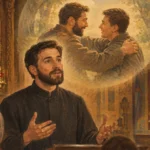
A real Christian testimony of forgiveness does not begin with a polished ending. It begins where the wound still has a name: betrayal in a marriage, a parent’s cruelty, a brother’s silence, a friend’s deception, a long-held resentment that has become part of the soul’s furniture. Orthodox forgiveness testimony stories matter because they speak honestly about this battlefield. They also refuse to leave us there. The Church does not treat forgiveness as a sentimental feeling or a religious way to avoid conflict. We forgive because Christ forgave us while we were still enemies of God. That truth is demanding. It reaches beyond the moment when someone finally says, “I feel better,” and calls us … [Read more...]
Orthodox Infant Baptism: What Parents Should Know
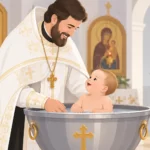
A newborn cannot explain the Creed, choose a patron saint, or profess faith with mature words. Yet an infant can truly receive the mercy of God. In Orthodox infant baptism, the Church does not wait for a child to become spiritually independent before welcoming him or her into Christ. She receives the child as a person made in God’s image, in need of healing, grace, and a life rooted in the Church. Parents need to know what to expect! For parents, this is not a sentimental family ceremony or a religious milestone arranged for photographs. Baptism is the beginning of a child’s sacramental life in Christ. It calls parents, godparents, and the whole parish to a serious and joyful task: helping … [Read more...]
- 1
- 2
- 3
- …
- 13
- Next Page »