Feast days are an integral part of an Orthodox child’s life. A child who hears, “Christ is risen!” sung with a full church on Pascha does not merely learn a religious fact. He receives a memory of the Kingdom. A child who helps prepare a small feast at home, lights a candle before an icon, or hears the Gospel read on a holy day begins to understand that time itself belongs to Christ.
To teach children Orthodox feast days is not primarily to give them a calendar lesson. It is to bring them into the living rhythm of the Church: fast and feast, expectation and fulfillment, repentance and resurrection. The feasts announce what God has done for our salvation. Children should meet those truths not only in explanations, but in worship, prayer, food, song, and the faithful habits of their family.
Begin With the Church’s Worship
The Divine Liturgy and the services of the Church are the first and greatest school of the feast. A feast day is not fully understood at the kitchen table if it has never been encountered in the prayers, hymns, icons, and Gospel proclamation of the parish.
Bring children to services as consistently as you can, especially for the great feasts. This does not mean demanding perfect stillness from a toddler or treating the temple as a test of parental competence. It means teaching, patiently and firmly, that our family comes before God because He is worthy of our worship. Children learn reverence over time by standing among adults who reverence Christ.
Before a major feast, tell them one sentence about what they will see. Before Theophany, explain that Christ entered the waters of the Jordan to sanctify creation. Before Pentecost, tell them that the Holy Spirit came upon the apostles and gives the Church life. Before Pascha, tell them plainly that Christ trampled down death by death.
After the service, ask a simple question: “What did you notice?” A young child may remember candles, flowers, a procession, or a particular hymn. An older child may notice the Gospel reading or the color of the vestments. Receive the answer gladly, then connect it to Christ. The goal is attention, not a quiz.
Teach the Story Before the Details
Orthodox children do not need to memorize every feast immediately. They need to know the great story of salvation. The feast days make that story visible across the year.
Start with the feasts closest to the heart of the Church’s life: Pascha, Nativity, Theophany, Palm Sunday, Ascension, and Pentecost. Then add the feasts of the Theotokos, particularly her Nativity, Entrance into the Temple, Annunciation, and Dormition. As children mature, they can learn the historical setting, the scriptural readings, the hymns, and the theological meaning with greater precision.
Keep the language clear. At Nativity, do not reduce the feast to a sentimental story about a baby. Say that the eternal Son of God became man for us and for our salvation. At Annunciation, teach that the Virgin Mary freely answered God with faith and obedience. At Pascha, say that Jesus truly died and truly rose, opening the way of life for those who belong to Him.
Children can bear more theological truth than many adults assume, provided we speak plainly. Avoid vague language that makes the feasts sound like moral symbols. Christ’s birth, baptism, death, resurrection, ascension, and sending of the Holy Spirit are not ideas we invent to inspire ourselves. They are the saving acts of God in history.
Use Scripture at the Center
Read the Gospel passage connected to the feast, even if it is only a few verses. For younger children, retell it in your own words after reading. For older children, let them follow along and ask what the passage reveals about Christ.
A family does not need a complicated program. Read the account of the Nativity from Luke, Christ’s baptism from the Gospels, the Triumphal Entry, the Passion narratives during Holy Week, and the resurrection accounts at Pascha. The Church’s feast days are biblical. Let children hear the Bible in the home as well as in church.
Let the Home Keep the Feast Day
The home should echo the worship of the Church without attempting to replace it. A modest family observance gives children something tangible to remember and anticipate.
On the eve of a feast, gather briefly before the family icon corner. Sing the troparion if your family knows it, read a short portion of Scripture, and offer a prayer of thanksgiving. If singing feels awkward at first, begin by listening carefully to the hymn at church and learning one refrain together. Orthodox formation grows through repetition, not novelty.
A special meal can also serve the feast well. On a fast-free feast, prepare something joyful and share it with gratitude. During a fasting season, choose a simpler food with intention rather than complaint. The point is not to make every feast expensive, elaborate, or Pinterest-worthy. The point is to mark the day as different because the Church has called us to remember God’s work.
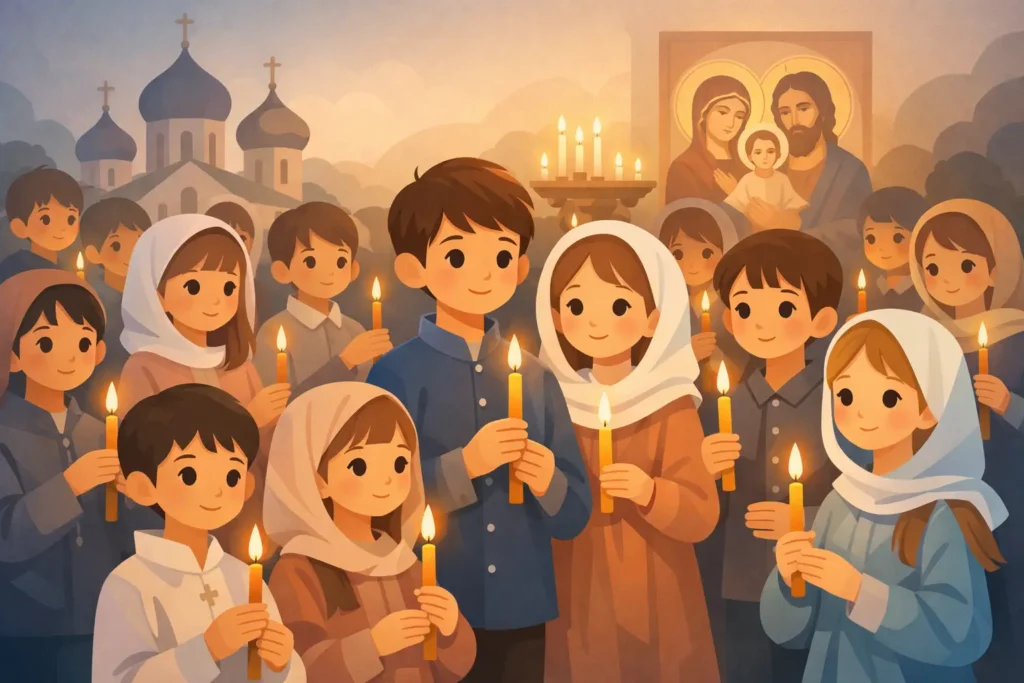
Visual practices help, especially for smaller children. Place an icon of the feast where the family can see it. Light a lamp or candle during family prayer, with appropriate adult supervision. Use a calendar that shows the major feasts and let children help identify what is coming next. These practices teach that Orthodox Christianity is embodied. We see, hear, smell, taste, and touch the faith because the Word truly became flesh.
Be careful, however, not to turn feast days into a stream of crafts and treats. A craft may help a child remember an event, but it cannot carry the weight of the feast. If activity replaces prayer, worship, and Scripture, the child may remember the project while missing Christ. Use creativity in service of worship, not as a substitute for it.
Teach Fasting and Feasting With Wisdom
Children should know that the Church fasts because she trains us to hunger for God, not because food is evil. They should also know that the Church feasts because creation is good and because Christ has redeemed it. Fasting and feasting belong together.
Parents must apply fasting with discernment. Young children, children with medical needs, and children who are still learning the faith should not carry adult burdens. Speak with your priest about what is appropriate for your family. A child may begin by giving up one preferred food, avoiding unnecessary treats, helping prepare a simple meal, or adding a prayer and act of mercy during a fasting season.
Never present fasting as a way to earn God’s love. We fast because we are learning to love God with our bodies and choices. Never use fasting to produce anxiety, pride, or comparison between families. Quiet faithfulness forms the heart far better than dramatic rules.
At the same time, do not apologize for the Church’s discipline. Children need to see that Christian life includes self-denial. They also need to see its joy. The cheese, eggs, and meat blessed and shared after the Paschal services mean more when the family has traveled through Lent with prayerful restraint.
Make Room for Questions and Resistance
A child may ask why a feast matters, why a service is long, or why the family cannot do what friends do on a particular day. These are not failures. They are opportunities for honest teaching.
Do not answer every question with, “Because that is what we do.” Explain the reason according to the child’s age. “We come to the Bridegroom service because we are preparing our hearts for Christ.” “We do not treat Pascha like an ordinary Sunday because the resurrection is the center of everything.” “We fast before Christmas so that we learn to receive Christ’s birth with gratitude.”
Some seasons will feel difficult. A baby may need to leave the service repeatedly. A teenager may resist what once delighted him. A family working long hours may not attend every service. Do not surrender to guilt or abandon the rhythm altogether. Keep returning. Attend what you can, pray at home when necessary, confess when you have grown careless, and begin again.
Let Children See Your Own Repentance
The deepest lesson is not parental expertise. It is a mother or father who repents, prays, forgives, and returns to the Church. When children see their parents prepare for confession, ask forgiveness after speaking harshly, and receive the feast with humility, they learn that Orthodoxy is a way of life rather than family decoration.
This matters especially in a culture that treats religious observance as optional entertainment. Our children need more than religious information. They need a people, a pattern of worship, and a home in which Christ is named with reverence. At All Saints of North America Orthodox Church, families do not have to form their children alone. The parish worships, teaches, fasts, and rejoices together.
Choose the next feast on the calendar and prepare for it simply. Read its Gospel, attend the service, set aside a few minutes for prayer at home, and speak of Christ with joy. Over years, those small acts become a holy memory. By God’s mercy, they may become the foundation from which your children learn to love the Church and remain steadfast in her life.