All Saints of North America Orthodox Church · Phoenix, Arizona

Orthodox Church on the west side of Phoenix Arizona including Sun City, Surprise, Peoria, Glendale, Litchfield Park, Buckeye, Tonopah, and more

  • Home
  • About
    • Clergy & Leadership
    • ASONA Mission Statement
    • New Visitor Information
    • How to Become Orthodox
    • For Orthodox Visitors
    • List of Activities for Orthodox Christians Desiring to Transfer to ASONA
    • Saints of North America
  • Faith
    • Statement of Faith
    • The Correct Understanding of Being Born Again with Fr. Josiah Trenham
    • Orthodox View of Salvation by Steve Robinson
    • Welcome Home! Evangelicals Come Home to Orthodoxy
    • What happens to those who have never heard of Jesus?
    • To Sincere Converts to the Orthodox Faith, and those who are Seeking
  • Catechesis
    • New Member Class
    • List of Activities to Complete Prior to Baptism
    • The Jewish Roots of Ancient Christian Worship
    • Online Catechism Lessons
    • Audio Lectures
    • Bible Survey Lessons
    • The Mystery of Confession
  • Education
    • Mystagogy
    • The Faith
    • Eucharist: Sacrament or Symbol?
    • Eucharistic Bread: Leavened or Unleavened?
    • Welcome to the Orthodox Church! (Videos)
    • Christian Names and Patron Saints
  • Directions
  • Calendar
    • ASONA Calendar
    • Paschal Greetings from Around the World
    • When Someone Dies
  • Articles
  • Contact
    • Donate Now
    • GIVING Page
    • The Book of Needs
    • ASONA Legacy Society
      • New
  • ASONA Capital Campaign
  • New Member Class
    • Examination of Conscience
    • Prologue of Ohrid
  • Calendar of Services
    • Ready
      • Ecclesioclasm
  • Weekly Bulletin
  • Merchloop Store

About Orthodox Divine Services

August 8, 2023 By Fr. John Peck [edit]

by Metropolitan Hilarion (Alfeyev)

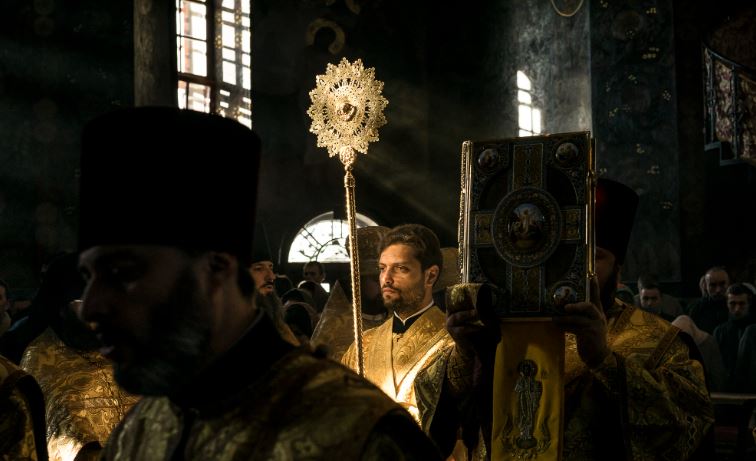
Orthodox Divine Services are an enormous treasure, one which we must carefully keep. Whether in the Liturgy, Vespers, Matins, the Hours, Midnight Office, or Compline, from the very opening exclamation we immerse ourselves into our element, into prayer, that nothing is capable of interrupting. One after another, psalms, litanies, sticherae, troparia, prayers and exclamations by the priest: the entire service moves like a single, constant, unfolding mystery, breathing as one, everything in one rhythm, nothing distracting from prayer.

Byzantine liturgical texts, filled with the most profound theological and mystical content, alternate with the prayerful singing of the Psalms, whose every word finds a response in the heart of one who is praying. Even those elements of the “choreography” characteristic to Orthodox Divine Services—solemn entrances and exits, prostrations, and censings—are not intended to distract the attention of the faithful, but rather, to pre-dispose them toward prayer, to attract them into that Service in which, according to the teachings of the Church, not only the Earthly Church, but also the Church in Heaven, not only people, but also the Angels, are taking part.

For Orthodox Christians, the texts of the Divine Services are of indisputable theological and educational authority. In dogmatic irreproachability, they come right after the Sacred Scriptures.

I would propose that, as the texts of the Divine Services are not merely compositions of accomplished theologians and poets, but rather, part of the experience in prayer of those who have attained sanctity and theosis, they occupy a loftier position in theological authority than do the works of the Fathers of the Church. Not everything in the works of the Fathers is of equal value, and not everything in those works received the recognition of the entire Church.

To the contrary, the texts of the Divine Services are recognized by the entire Church as “rules of faith,” for over the course of many centuries they have been read and sung everywhere in Orthodox churches: anything erroneous and alien that could have crept into them through misunderstanding or carelessness was filtered out by Church Tradition. What remained was pure, irreproachable theology, vested in the poetic forms of liturgical hymns.

For Orthodox Christians, the texts of Divine Services are of exceptional significance. Thanks to them, participation in Orthodox Divine Services becomes not merely a school of prayer, but a school of theology, of raising the mind toward contemplation of God, and of abiding under the authority of God.

Source

Share the post "About Orthodox Divine Services"

  • LinkedIn
  • Pinterest
  • Email
  • Bookmark
  • Bluesky

Filed Under: General [post-edit]

All Saints of North America Orthodox Church

18700 N. 107th Ave Unit#5
Sun City, AZ 85373

(928) 910-2186

RSS Orthochristian.com

  • OCA and ROCOR bishops concelebrate feast of Tikhvin Icon
  • The Slavery That Sets Us Free
  • First Liturgy in 100 years in Nizhny Novgorod village church
  • Schismatics cover icons with Ukrainian flags after brutal church seizure

RSS LifeSite News

  • Restorative Reproductive Medicine, a Real Way to Help Couples With Infertility
  • World’s Most Premature Quadruplets Celebrate Their 2nd Birthday
  • Two Florida Abortion Businesses Close Down, Will No Longer Kill Babies

Official Telegram Channel of the W American Diocese
Official Instagram account of the W American Diocese
Official Facebook page of the Western American Diocese

RSS Journey to Orthodoxy

  • Group Baptism in DR Congo—125+ united to Christ
  • Wave of Baptisms and Chrismations across America on Lazarus and Holy Saturdays
  • Mass Conversions Around the World
  • Six young Colombians baptized in mountain parish
  • “To My Protestant Friends”

RSS Good Guys Wear Black

  • Regarding the Priest’s Clothing
  • Midwest OCA Program Aims to Expand Clergy Formation
  • Cassock
  • A Young Man wrote me today asking about the Priesthood
  • A High Priest, a King, and… a Rabbit

A Directory of Arizona Orthodox Churches

Find what you’re looking for

Weekly Bulletin for Sunday, June 28, 2026

Orthodox Calendar


Copyright © 2026 All Saints of North America Orthodox Church · All Rights Reserved
Designed by Fr. John A. Peck · Log in