Suffering: A diagnosis can change a family’s life in one afternoon. A child leaves the faith. A marriage fractures. Work disappears just when bills rise. These are not abstract questions. The Orthodox view of suffering speaks to people standing in hospital corridors, sitting awake with grief, or wondering whether God has turned away.
Orthodoxy does not offer a shallow explanation or ask suffering people to pretend that evil is good. The Church calls death an enemy, mourns with those who mourn, and prays earnestly for healing. Yet she also proclaims something stronger than optimism: Jesus Christ entered our wounded condition, bore death itself, and rose again. Suffering does not have the final word because Christ does.
The Orthodox View of Suffering Begins With the Fall
God did not create man for sickness, violence, alienation, and death. He created humanity for communion with Him. In the beginning, Adam and Eve were called to receive life as a gift and grow into holiness through trustful obedience. Their rebellion brought corruption and death into human life. The world we inhabit now is beautiful, but it is also disordered. Our bodies weaken, relationships break, natural forces harm, and every heart bears the consequences of sin.
This means that not every painful event has a simple, personal explanation. A person may suffer because of another person’s sin, because of his own choices, because of the frailty of a fallen body, or for reasons hidden from him. Often, several of these are true at once. Orthodox Christians should resist the urge to assign blame when someone is suffering.
Christ directly corrects that impulse. When His disciples saw a man born blind, they wanted a clean answer: whose sin caused this? The Lord refused their narrow framework. Likewise, the book of Job warns us not to treat another person’s affliction as evidence that we understand God’s judgment. The suffering person needs presence, prayer, practical help, and truth, not accusations disguised as theology.
God Is Not the Author of Evil
The Orthodox faith confesses God as good. He does not delight in disease, abuse, betrayal, or death. He is not morally divided, sending evil with one hand while asking us to call it love with the other. Evil is a corruption of the good, not a substance created by God or a rival power equal to Him.
But God’s goodness does not mean that He stands helpless before evil. In His providence, He can bring repentance from failure, courage from persecution, humility from weakness, and compassion from grief. This is not the same as saying that the evil itself was good. The Cross makes the distinction clear. The betrayal, mockery, injustice, suffering, and crucifixion of Christ were truly wicked acts. God nevertheless used what men intended for evil to accomplish the salvation of the world.
For this reason, Christians may say that God can work in suffering without calling suffering a gift in itself. Sometimes a trial exposes what we have trusted more than God. Sometimes it teaches us to receive help rather than maintain the illusion of self-sufficiency. Sometimes its meaning remains hidden until the age to come. Faith does not require a complete explanation before it permits prayer.
Christ Did Not Explain Pain From a Distance
The heart of the Christian answer is not a theory. It is the Incarnation. The Son of God took a real human body from the Virgin Mary. He knew hunger, exhaustion, rejection, tears, and the grief of standing at a friend’s tomb. He was tempted, though without sin. He accepted the Cross freely and descended into death to destroy death from within.
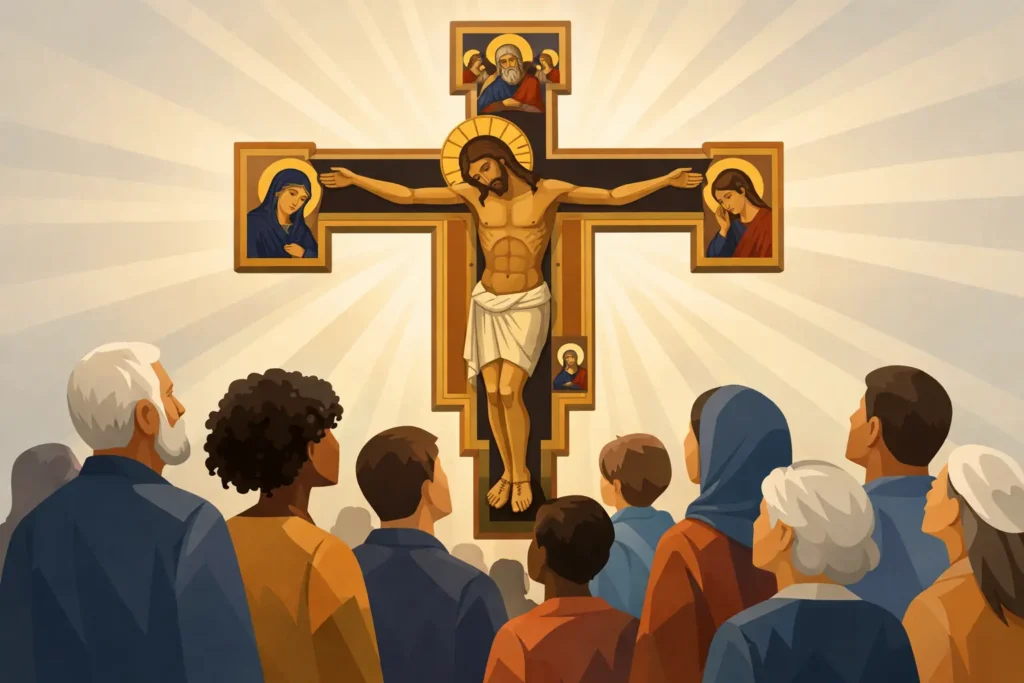
When an Orthodox Christian prays before an icon of Christ crucified, he does not pray to a distant observer of human pain. He prays to the Lord who has entered suffering. When he venerates the Resurrection, he does not deny the Cross. He confesses that the Cross has become the path through which death is overthrown.
This is why Christian hope is neither denial of suffering nor mere positive thinking. We do not say that everything feels fine. We say that Christ is risen, even when tears are real. The Church sings of the Resurrection while still conducting funerals, anointing the sick, and pleading for mercy. That tension is not a contradiction. It is life between Christ’s victory and its final revelation.
Suffering Is Not Automatically Saving
Suffering by itself does not make a person holy. Bitterness, despair, resentment, and self-pity can grow in pain just as easily as patience and faith. A difficult life is not the same thing as a transformed life. Nor should anyone remain in an abusive situation because he has been told to “carry his cross.” The Church never commands a victim to enable violence, conceal criminal wrongdoing, or refuse needed protection.
The cross we carry is not a romantic attachment to misery. It is faithful obedience to Christ in the actual circumstances of life. It may mean seeking medical care, telling the truth about abuse, accepting counseling, reconciling where repentance is real, forgiving without pretending that evil did not occur, or enduring an illness that cannot yet be cured. Wisdom matters. Pastoral guidance matters. In urgent danger, safety must be pursued without delay.
Voluntary ascetic struggle also differs from suffering forced upon us. Fasting, prayer, almsgiving, and self-denial train the heart to love God above appetite and comfort. They do not purchase salvation or prove spiritual toughness. Properly practiced, they prepare us to meet involuntary trials with greater freedom, humility, and dependence on God.
How the Church Meets Us in Pain
Orthodox Christianity is not designed for isolated spiritual heroics. When suffering narrows a person’s world, the Church gathers him back into the communion of Christ. We bring names to prayer. We light candles. We ask the saints for their intercessions. We receive the Scriptures not as slogans but as the living word of God. We come to confession because sin adds weight to an already burdened heart, and Christ offers forgiveness.
The sacraments place us before the Physician of our souls and bodies. Holy Unction asks God for healing and mercy. The Eucharist gives us the Body and Blood of the risen Lord. Neither sacrament is magic, and faithful people may still endure illness or die. Yet the Church does not abandon them to a private battle. She teaches us to receive every moment, including weakness, within the life of Christ.
A practical response to suffering begins small. Keep a prayer rule that you can honestly sustain, even if it is only the Jesus Prayer repeated with attention: “Lord Jesus Christ, Son of God, have mercy on me.” Attend the Divine Liturgy when you are able. Tell your priest what is happening rather than disappearing in shame. Let trusted members of the parish know concrete needs, whether that means meals, transportation, child care, or simply someone who will sit quietly with you.
When Prayer Feels Empty
There are seasons when prayer brings no immediate relief. The Psalms give the Church language for those hours. They contain praise, but they also contain fear, confusion, grief, and the cry, “How long?” God does not require us to perform emotional certainty before Him. Honest prayer is still prayer.
Do not measure God’s nearness solely by your feelings. A person can feel abandoned while being held by grace. The saints teach perseverance, not because God is reluctant to hear us, but because suffering can make the heart scattered and exhausted. Continue to turn toward Him. Ask others to pray when you cannot find words. Receive the prayers of the Church as a shelter until strength returns.
For families in Surprise, Peoria, Glendale, Sun City, and the wider west Phoenix area, a parish home can become a place where grief is named without being allowed to rule. All Saints of North America Orthodox Church welcomes those who are carrying questions, wounds, and a desire to know the historic faith more deeply.
Christ does not promise a life untouched by sorrow. He promises Himself. Bring Him the pain and suffering you can explain and the pain and suffering you cannot. Bring Him your anger, your fear, your unfinished questions, and your loved ones. Then remain near the Church, where the Crucified and Risen Lord continues to meet His people with mercy.