A prayer book should not become another religious purchase that gathers dust beside the Bible. It places the words of the Church on your lips, teaches the heart how to stand before God, and gives shape to prayer when your own words are weak. This Orthodox prayer book review considers what a faithful prayer book should contain, which differences matter, and how to begin using one without turning prayer into a private spiritual project.
For many inquirers, the first encounter with an Orthodox prayer book can feel both rich and intimidating. The language is formal. The prayers are direct about sin, death, judgment, mercy, and the saints. They assume that salvation is not merely an idea one accepts, but a life of repentance and communion with the Holy Trinity. That is precisely their strength.
What an Orthodox Prayer Book Is For
An Orthodox prayer book is not designed to replace the services of the Church. It does not make a person self-sufficient, nor does it offer a menu of spiritual techniques. Its purpose is to extend the Church’s worship into the home, the car before work, the hospital room, and the quiet hours before sleep.
The prayers have been received, tested, and handed down. They teach us to begin with thanksgiving, confession, and praise rather than with a list of immediate needs. They teach us to ask for mercy, not because God is reluctant to give it, but because we need to see our lives truthfully. Over time, these prayers correct the tendency to make God serve our preferences.
This matters especially for converts from traditions where prayer has been almost entirely spontaneous. Personal prayer has a rightful place. Speak honestly to God. Ask plainly for help. Intercede for those entrusted to you. But the Church also gives us words when emotion is absent, grief is too deep, or self-will has narrowed our vision. Written prayers train freedom; they do not extinguish it.
Orthodox Prayer Book Review: What to Look For
A good prayer book should be recognizably Orthodox before it is attractive, compact, or modern in language. The best edition for you depends partly on your parish’s jurisdiction, the blessing and guidance of your priest, and your actual stage of life. A large, comprehensive volume may serve an experienced Orthodox Christian well, while a simpler book may help a catechumen establish a faithful beginning.
A sound core of daily prayers
Look first for the foundational prayers used across Orthodox life: the Trisagion prayers, the Lord’s Prayer, the Creed, Psalm 50, morning prayers, evening prayers, prayers before and after meals, and prayers for the departed. A book need not contain every possible devotion to be useful, but it should give you a stable daily rule rooted in the Church’s worship.
The presence of prayers to the Mother of God and the saints is also essential. Orthodox Christians do not pray in isolation from the communion of saints. We ask for their intercessions because Christ has conquered death and because His holy ones are alive in Him. A prayer book that avoids this reality in order to seem more familiar to modern Protestants is not presenting the full Orthodox faith.
Clear preparation for the Mysteries
Many prayer books include prayers before Holy Communion, thanksgiving after Communion, and prayers before confession. These are valuable, but they require pastoral sobriety. No book can tell every person exactly how to prepare for Communion. Fasting, confession, reconciliation with others, health concerns, family obligations, and a bishop’s or priest’s direction all matter.
Do not treat the printed prayers as a checklist that earns access to the Chalice. We receive Holy Communion by repentance and mercy, within the ordered life of the Church. A good book supports that preparation; it does not replace confession, obedience, or participation in Vespers and the Divine Liturgy.
Scripture and the Psalms
A prayer book becomes especially useful when it draws generously from Scripture. The Psalms give the Church language for joy, fear, repentance, confusion, hope, and praise. They do not flatter us, and they do not leave suffering outside the presence of God.
Some editions include the full Psalter or selected psalms. Others include the daily Epistle and Gospel readings or a calendar of saints. These additions can be a genuine gift, particularly for families building a Christian rhythm at home. Yet a smaller book may be the wiser choice if its size means you will actually carry and use it.
Translation that serves prayer
Translation is one of the real trade-offs. Older English can carry a certain gravity and familiarity, especially for those formed by traditional liturgical language. Contemporary English may be more immediately understandable to a newcomer, a teenager, or someone praying aloud with children.
Neither choice automatically makes a prayer book better. What matters is whether the translation is reverent, doctrinally sound, and clear enough to pray attentively. If you regularly stumble over every sentence, you may need a different edition. If modern language makes the prayers casual or vague, it has not served you well either. Read several pages aloud before deciding.
What a Prayer Book Cannot Do
A prayer book cannot give you an Orthodox life apart from the Orthodox Church. It cannot baptize you, hear your confession, teach you to forgive a difficult neighbor, or unite you to the Eucharistic assembly. It cannot resolve doctrinal questions by itself, particularly when you are reading prayers that assume an entire Christian worldview.
This is why a newcomer should resist building a home prayer rule from internet fragments, devotional preferences, and strong feelings. The Orthodox life is received in community under spiritual care. Begin modestly, attend the services, learn the faith, and ask questions. The goal is not to perform an impressive amount of prayer. The goal is to become a person who repents, gives thanks, and remains with Christ.
The same caution applies to long prayer rules. It is better to pray a small rule faithfully than to attempt an hour of prayers for three days and then abandon prayer for three weeks. A priest may bless a fuller rule at the right time. Until then, consistency, attention, and humility are better than spiritual ambition.
A Simple Way to Begin
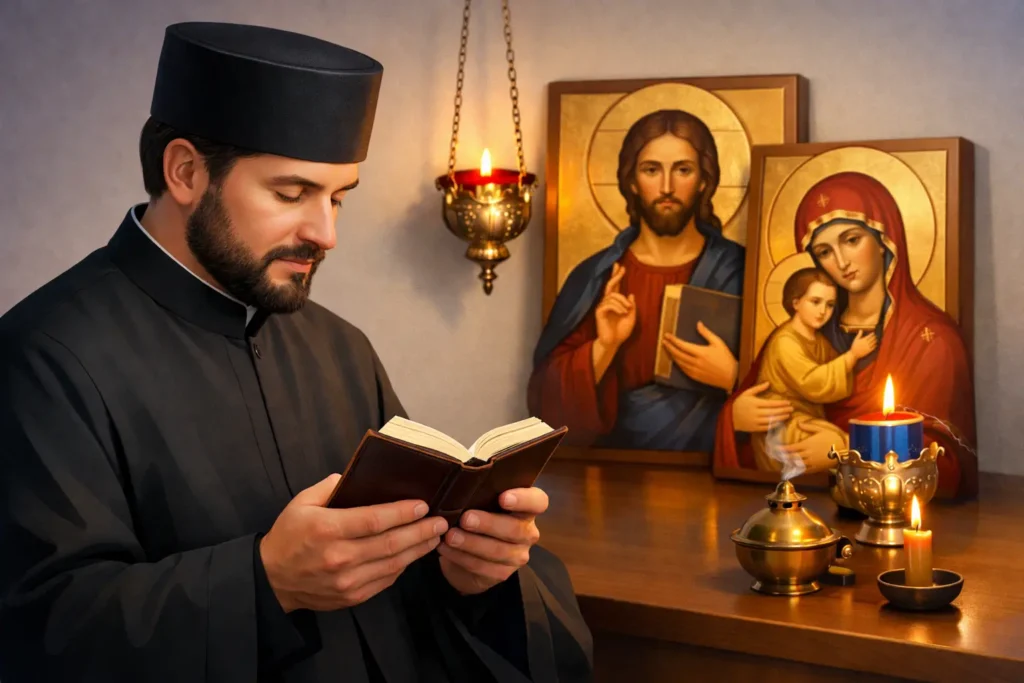
If you are new to Orthodox prayer, begin by making a small place for prayer in your home. An icon of Christ, a candle or lamp if it can be used safely, and your prayer book are enough. Stand if you are able. Make the sign of the Cross carefully. Put away the phone.
Start with the Trisagion prayers, the Creed, Psalm 50, the Lord’s Prayer, and a short prayer in your own words for those in need. In the evening, add a brief examination of conscience: where did you sin, whom did you wound, what mercy did God show you? Ask forgiveness and give thanks. This may take ten minutes. Ten attentive minutes offered daily can begin to reorder a life.
Parents should not wait for a perfect family routine. Pray a short portion aloud with your children. Let them hear the names of grandparents, godparents, friends, and the departed brought before God. The home becomes more than a place where Orthodox people sleep between services. It becomes a small domestic church, marked by repentance and peace.
Choosing With Your Parish
Before settling on an edition, bring the question to your priest or catechist. Ask which prayer books are commonly used in your parish and whether there is a particular translation that will help you follow the services and pray with others. This is not unnecessary gate-keeping. It is practical pastoral care.
At All Saints of North America Orthodox Church, inquirers and catechumens are encouraged to take prayer seriously from the beginning, but never as a detached religious exercise. The Christian life grows through worship, instruction, confession, fasting, almsgiving, and fellowship in the parish. A prayer book belongs within that whole life.
Choose a book that is faithful, readable, and suited to your present rule. Then use it tomorrow morning, even if you feel distracted. Return to it tomorrow evening, even if the day has gone badly. The prayer book will not make you holy by magic, but it will keep placing you before the God who is merciful, patient, and able to save.