A visitor may enter an Orthodox church, see Christ, the Theotokos, and the saints painted on every side, and ask a serious question: are icons idolatry? The question deserves more than a quick reassurance. Scripture condemns idolatry with absolute force, and Orthodox Christians condemn it too. We worship no creature, no object, no image, and no saint. We worship the Holy Trinity alone: Father, Son, and Holy Spirit.
Yet the Orthodox Church also receives and venerates holy icons. This is not a contradiction. It rests on the central confession of Christianity: the eternal Son of God truly became man. Jesus Christ took visible flesh, lived among us, and was seen by human eyes. The God whom no one had seen was made known in the face of Christ.
Are Icons Idolatry? The Crucial Distinction
Idolatry gives to a creature the worship owed to God alone. It treats something made as though it were the Creator, seeks salvation or ultimate security apart from God, and offers divine honor where divine honor does not belong.
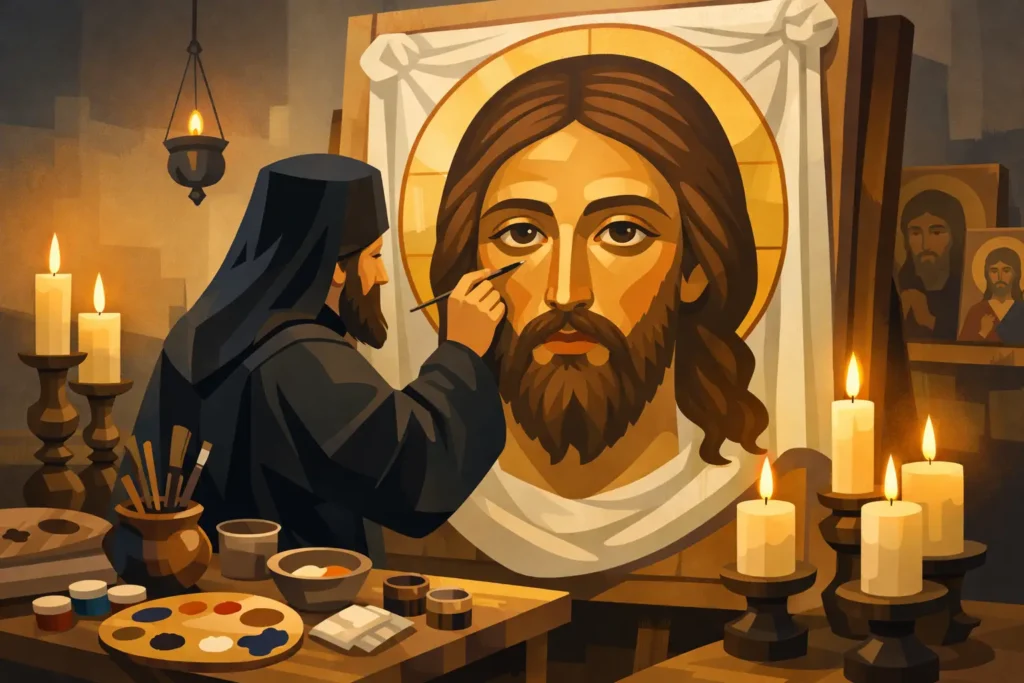
An Orthodox Christian does not look at a wooden panel and believe the wood is God. An icon is not a divine being, a charm, or a spiritual tool that works by magic. It is a holy image that points beyond itself to the person depicted. When a Christian kisses an icon of Christ, he does not kiss paint. He offers love and reverence to Christ Himself. When she venerates an icon of the Mother of God or a saint, she honors a servant and friend of God, asking that saint to pray for her.
The distinction is not wordplay. Worship belongs to God alone. The Church calls this adoration. Veneration is honor given to those whom God has glorified and to things set apart for His service. Americans already understand the basic difference in ordinary life. A person may kiss a photograph of a departed parent without believing the photograph is his parent. A citizen may salute a flag without believing that cloth possesses divinity. The outward action receives its meaning from its object, purpose, and context.
Of course, no analogy is perfect. Icons are not mere family photographs or religious decorations. They belong to the Church’s worship because they proclaim the Gospel in color. But they do help expose a common mistake: confusing honor directed through an image with worship offered to an image.
The Second Commandment and Sacred Images
Many Christians object by citing the commandment: “You shall not make for yourself a carved image” and “you shall not bow down to them or serve them.” Orthodox Christians receive this commandment as God’s word. We must ask, however, what God forbids.
The commandment forbids making images as gods and serving them. Israel had just come out of Egypt, surrounded by pagan nations that represented false gods through idols and offered them worship. The golden calf was not sinful because it involved art. It was sinful because the people turned from the living God to a created object.
God Himself later commanded the Israelites to make sacred images. He instructed Moses to place golden cherubim upon the Ark of the Covenant. The Temple contained carved cherubim, palm trees, flowers, oxen, and other visible forms. When Israel looked upon the bronze serpent God commanded Moses to make, they did not worship bronze. God used a material sign to bring healing to those who looked in faith.
This does not mean every religious image is automatically good. The bronze serpent itself had to be destroyed centuries later when people began burning incense to it. That episode makes the Orthodox position clearer, not weaker. A sacred object must never replace God. If someone treats an icon as a lucky object, imagines that it guarantees an answer to prayer, or gives it the worship due to God, that person has fallen into superstition and must repent.
The answer to abuse, however, is not the rejection of every proper use. We do not reject prayer because people can pray selfishly. We do not reject Scripture because people can twist it. We correct the misuse and receive God’s gifts rightly.
The Incarnation Makes a Difference
Before the Incarnation, God had not revealed Himself in a visible human form. “No one has ever seen God,” Scripture says. But then Christ came. The Apostle John declares that the Word became flesh, that the disciples heard Him, saw Him with their eyes, looked upon Him, and touched Him.
This is why the Church insists that an icon of Jesus Christ matters. To deny that Christ can be depicted in His humanity can unintentionally weaken the confession that He truly became man. Christ was not an idea, an apparition, or a temporary mask worn by God. He took real human flesh from the Virgin Mary. He had a visible face. The disciples recognized Him after His Resurrection. He ascended bodily into heaven. The Bible says that Christ Himself is an icon (image): “He is the image (ikon) of the invisible God…” (Col. 1:15), and “He is the radiance of the glory of God and the exact representation of his being (nature), and he upholds the universe by the word of his power.” Heb. 1:3. Christ is THE icon!
An icon of Christ does not attempt to contain His divine nature. No image could do that. In fact, it is forbidden to try and make an image of divinity. Instead, it depicts the one Person of the Word made flesh, according to His humanity. The image bears witness to the same Lord whom the apostles saw and proclaimed.
Icons of the saints follow from this truth. The saints are not rival mediators who compete with Christ. They are members of His Body, saved by His grace and made alive in Him. To honor them is to honor the work of Christ in them. Their icons remind us that holiness is not an abstract concept. Men, women, children, martyrs, pastors, mothers, monks, and repentant sinners have actually followed Christ to the end.
Why Orthodox Christians Venerate Icons
Orthodox worship engages the whole person. We hear Scripture read and sung. We smell incense. We taste the holy gifts. We stand, bow, make the sign of the cross, and behold the beauty of the Church. God made us embodied creatures, and He saves us as embodied creatures.
An icon calls the wandering mind back to prayer. Before an icon of Christ, we remember that prayer is not self-reflection. We stand before a Person. Before an icon of the Theotokos, we remember that God truly took flesh from her and entered our human condition. Before an icon of a martyr, we remember that faithfulness may demand courage, sacrifice, and endurance.
This is also why Orthodox iconography is not simply religious portraiture. Its purpose is not to create a sentimental scene or satisfy curiosity about ancient clothing. Icons show the world transfigured by the Kingdom of God. Their visual language teaches that the saints live in the light of Christ and that death does not have the final word.
The Seventh Ecumenical Council, held in 787, defended this confession against those who rejected icons. The council did not invent a new devotion. It articulated the Church’s ancient faith: the honor shown to the image passes to the person represented. It also guarded the boundary that must never be crossed. Icons receive veneration, while God alone receives worship.
A Pastoral Warning Against Superstition
A person can misuse almost anything holy. A cross can become jewelry with no confession of Christ behind it. A Bible can sit unopened on a shelf. An icon can become home decor, a political symbol, or a talisman. None of these uses reflects the Church’s intention.
Use icons with reverence and sobriety. Do not demand signs. Do not measure God’s love by whether a particular prayer receives the answer you want. Do not treat a saint as a shortcut around repentance, confession, forgiveness, and obedience to Christ.
Instead, let an icon lead you into a real rule of prayer. Light a candle if you are able. Stand quietly. Make the sign of the cross. Thank God, confess your sins, ask for mercy, and pray for those entrusted to your care. If you ask a saint’s prayers, do so with confidence in Christ, who alone saves.
For Those Still Wrestling With the Question
If icons feel unfamiliar, do not pretend that they do not. Bring the question into the light. Many Christians were taught that every bow, kiss, or sacred image must be idolatry. The Orthodox Church asks you to look more carefully at what she actually teaches and does.
Visit a Divine Liturgy. Watch how the prayers consistently address the Triune God. Listen for the name of Jesus Christ. Notice that the Church does not preach the greatness of paint and wood, but the greatness of the God who became man, conquered death, and glorifies His saints.
At All Saints of North America Orthodox Church, inquirers do not need to arrive with every question settled. Come with honesty. Ask what the Church means by worship, veneration, salvation, the saints, and the Incarnation. A serious answer to icons begins and ends not with an argument about art, but with the living Christ whom the icons proclaim.