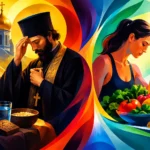
A grocery list can make Orthodox fasting versus dieting appear almost identical. Both may involve eating less, avoiding certain foods, planning meals, and resisting appetites. But the resemblance is only outward. A diet asks, “What will this do for my body?” Orthodox fasting asks a more searching question: “What is ruling my heart, and how can I offer my whole life to Christ?” The Church does not give us fasting as a religious version of meal planning. She gives it as an ascetic discipline: a concrete way of learning repentance, self-command, prayer, generosity, and dependence on God. Food matters because we are embodied persons. Yet fasting is never finally about food. Orthodox Fasting … [Read more...]
Why Orthodox Christians Cross Themselves
A visitor may notice it before the first hymn begins: Orthodox Christians quietly make the sign of the Cross as they enter the church, approach an icon, hear the Holy Trinity named, or begin to pray. Why Orthodox Christians cross themselves is not a question about religious choreography. It is a question about how Christians confess Christ with the whole person - mind, voice, heart, and body. The sign of the Cross is a brief but weighty prayer. It declares the central realities of the Christian faith: the Holy Trinity, the incarnation of the Son of God, Christ's saving death, and His victory over death. It does not replace faith, repentance, or a life of obedience. Rather, it gives those … [Read more...]
Catechumen Formation Success Stories That Last
A person can attend a few beautiful services, agree with Orthodox teaching, and still remain unprepared for the demands and joy of Christian life. The most encouraging catechumen formation success stories are not tales of quick religious excitement. They show something steadier: people learning to pray, repent, worship, receive correction, and belong to the Church with their whole lives. This is why the catechumenate must be more than a short course before baptism or chrismation. The Church receives people into a sacramental life that asks for faithfulness long after the first bright day of entry. A serious process gives inquirers time to hear the Gospel clearly, test their assumptions, ask … [Read more...]
A Church Visitor Guide for Orthodox Worship
The first time you enter an Orthodox church, you may notice that almost everything asks you to slow down. The icons, candles, chanting, incense, and moments of silence are not religious decoration. They proclaim that worship is an encounter with the living God. This church visitor guide will help you arrive prepared, participate with peace, and recognize what you are seeing without pretending to know more than you do. You do not need to be Orthodox to visit. You do not need to have every question settled. Come honestly, come reverently, and give yourself permission to observe. The Church receives seekers as persons, not as projects. Before You Arrive Check the service time carefully and … [Read more...]
Orthodox vs Catholic Papacy and the Church
A question about the Orthodox vs Catholic papacy is never merely a question about church administration. It reaches into the Church's confession of Christ, the authority of bishops, the meaning of unity, and the way Christians receive the apostolic faith across generations. Roman Catholics and Orthodox Christians share far more than many people realize, but the papacy remains one of the clearest and most consequential divisions between us. For a seeker, this can feel technical at first. It is not. If Christ founded one Church, then the question of who may speak and act for the whole Church matters deeply. Orthodox Christians do not reject Rome because we oppose order, honor, or visible … [Read more...]
When Do Orthodox Children Commune in Church?
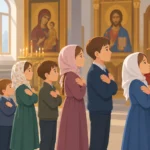
A baby is baptized, receives Holy Chrismation, and then is brought forward to receive the Body and Blood of Christ. For many visitors, this moment raises an immediate question: when do Orthodox children receive communion? The answer is simple, though its meaning is profound: Orthodox children commune from the time they are baptized and chrismated into the Church. This is not a sentimental custom or a shortcut around serious faith. It expresses what the Church believes about salvation, baptism, the Eucharist, and the place of children in the household of God. Children do not stand outside the life of grace until they can explain it. They are received into Christ's Church and nourished at His … [Read more...]
10 Best Orthodox Books for Inquirers Today
A first visit to an Orthodox service can leave a serious Christian with a dozen good questions before the final blessing: Why do we pray this way? What do icons mean? Where does this teaching come from? Why does the Church speak so often of salvation as healing and union with God? The best Orthodox books for inquirers do not merely answer isolated questions. They begin to show the coherent life of the Church - her worship, doctrine, prayer, Scripture, and sacramental life. Books are valuable servants, but they are not a replacement for standing in the services, asking questions of a priest, and getting to know an actual Orthodox parish. Orthodoxy is not a theory to master from a distance. … [Read more...]
Can Orthodox Divorcees Remarry? A Pastoral Answer
A civil divorce decree may settle legal questions, but it does not by itself answer the spiritual question. Can Orthodox divorcees remarry? Sometimes, yes. But the Orthodox Church never treats remarriage as automatic, casual, or merely a matter of personal preference. Marriage is a holy mystery, a lifelong union in Christ. When that union has been torn apart, the Church meets the people involved with both truth and mercy. For someone carrying the grief, confusion, anger, or shame of divorce, this answer should not feel like a cold rule book. The Church does not deny the real wounds that can make a marriage collapse. She also refuses to say that vows no longer matter. Her pastoral work holds … [Read more...]
What an Orthodox Parish Is Meant to Form
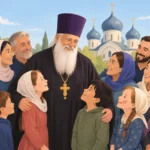
A parish is not a place one samples once a week for inspiration. It is a people gathered around Christ, His altar, His sacraments, and the apostolic faith He entrusted to the Church. An Orthodox parish exists to form whole human beings: men, women, and children who learn to repent, pray, love, endure, and live in communion with God. That may sound demanding because it is. The Christian life cannot be reduced to agreeing with ideas about Jesus, attending a religious event, or collecting spiritual content. Christ calls His people into a life of worship and obedience. The parish is where that life becomes concrete: where names are known, sins are confessed, children are baptized, the departed … [Read more...]
Orthodox Spirituality for a Life with Christ
A person can know a great deal about Christianity and still remain restless, distracted, and divided within. Orthodox spirituality begins precisely there: not with religious information alone, but with the healing and transfiguration of the whole person in communion with Jesus Christ. It is the life of the Holy Spirit in the Church, received through worship, prayer, repentance, sacramental life, and concrete obedience. This is not a spiritual technique for achieving inner calm. It is not self-improvement dressed in religious language. The Orthodox Christian life calls us to die and rise with Christ, to put away the passions that enslave us, and to become by grace what humanity was created … [Read more...]
- « Previous Page
- 1
- 2
- 3
- 4
- …
- 13
- Next Page »