A search for a Peoria Orthodox church often begins with a hunger that is difficult to name. Perhaps you are weary of churches built around personalities, passing trends, or vague statements of belief. Perhaps you have encountered the early Church Fathers, the ancient liturgy, or the witness of the saints and want to know whether this faith can truly be lived in Arizona with your family, your work schedule, and your real burdens.
Orthodoxy, whether in Peoria or anywhere else, does not offer a religious experience tailored to the preferences of the moment. It offers the Church established by Christ, confessed by the apostles, guarded by the martyrs, and handed down through worship, doctrine, repentance, and sacramental life. That can feel unfamiliar at first. It can also feel like coming home.
What Makes an Orthodox Church Different in Peoria?
An Orthodox parish is not primarily a Sunday event. It is a local expression of the one, holy, catholic, and apostolic Church. The goal is not to collect religious information or attend an inspiring service once a week. The goal is communion with God through Jesus Christ, a life of repentance, and transformation within the Body of Christ.
This changes what you will find when you visit. Orthodox worship is ancient, ordered, and full of Scripture. We stand, sing, pray, bow, make the sign of the cross, and hear the Gospel proclaimed. Icons surround us, not as decoration, but as witnesses to the Incarnation: the eternal Son of God truly took flesh, sanctified human nature, and calls men and women into His life.
The service may seem full at first because it is full. The Church does not reduce worship to a lecture with music before and after. She gives praise to the Holy Trinity with her whole voice, body, memory, and heart. This is not entertainment. It is participation in the worship of heaven.
Your First Visit to a Peoria Orthodox Church
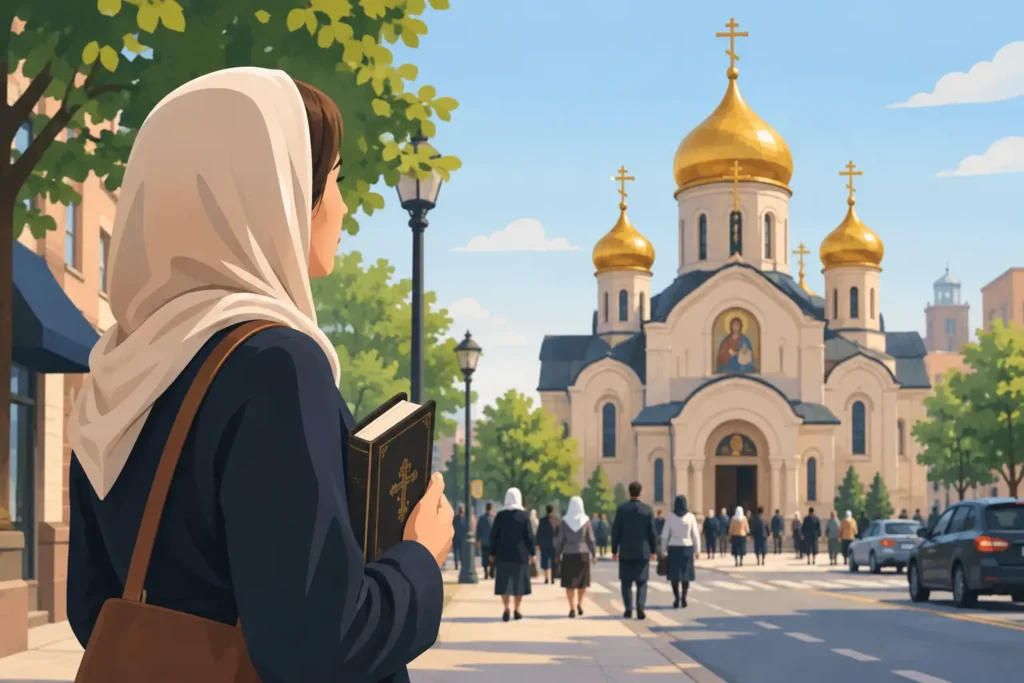
If you have never attended an Orthodox service, you do not need to arrive as an expert. Come prayerfully. Observe what is happening. Use the service book if one is available, or simply listen and pray with the words you can follow. No one expects a first-time visitor to know every response or custom.
Dress respectfully, as you would for a serious act of worship. Families with children are welcome. Children make normal child noises, and parents are not expected to disappear until their children become perfectly still. At the same time, Orthodox worship teaches all of us, young and old, to grow in reverence. A parish should welcome children without pretending that worship is centered on their entertainment.
You may notice that not everyone receives Holy Communion. This is deliberate. Orthodox Christians receive the Eucharist as the sacramental sign and reality of full unity in faith and life with the Church. Visitors and non-Orthodox Christians are warmly invited to attend, pray, speak with the priest, and begin the path of learning. But receiving Communion comes through being received into the Orthodox Church and preparing through confession, prayer, fasting, and reconciliation with others.
That boundary is not meant as a rejection. It protects the holiness of the Mysteries and speaks honestly about what Communion means. Real welcome is not pretending that differences do not exist. Real welcome offers a clear path toward unity in the truth.
What to Do After the Service
Stay for fellowship if it is offered. Introduce yourself and let someone know that you are visiting. You do not need to make a decision on your first day, but you should not carry your questions alone.
Speak with the priest when possible, especially if you are coming from another Christian tradition, are considering baptism or chrismation, or are returning to church after a long absence. A good first conversation can help distinguish between curiosity and a genuine call to enter the Orthodox life.
Orthodoxy Is Learned Through a Way of Life
Many people first approach Orthodoxy through books, podcasts, online debates, or beautiful images of ancient churches. These can be useful beginnings. They cannot replace parish life.
The Orthodox faith is taught in the services, in Scripture, in the saints, in the fasting calendar, in confession, in the prayers of the home, and in faithful relationships with other Christians. Theology is not merely a subject to master. It is knowledge of God that reshapes the person who receives it humbly.
For that reason, serious Orthodox parishes provide catechism for inquirers. Catechism is not a sales presentation or a quick membership class. It is a careful introduction to what the Church believes and how the Church lives. It addresses the Holy Trinity, the person of Christ, salvation, the Scriptures, the sacraments, the saints, prayer, moral life, death, and the resurrection of the body.
People arrive with different questions. An evangelical may wonder about Tradition, baptism, and the saints. A Roman Catholic may ask about papal authority and the difference between Orthodox and Catholic teaching. Someone raised without religion may need to begin with the basic Christian confession that Jesus Christ is Lord. Someone from a Latter-day Saint or Muslim background may need patient, direct teaching about the Triune God and the full divinity of Christ.
The Church should not flatten those questions into easy slogans. Yet she does answer them with confidence. Orthodox Christianity is not a collection of private opinions. It is the apostolic faith received, preserved, and proclaimed.
Do Not Rush the Journey Into the Church
There is a proper urgency in turning toward Christ, but there is no virtue in treating baptism or chrismation as a casual milestone. Entering the Church involves repentance, instruction, prayer, and a willingness to be formed over time.
Catechumens prepare for baptism through regular worship, doctrinal teaching, pastoral conversation, and practical changes in life. This may involve addressing a prior baptism, marriage questions, unresolved conflicts, habits of sin, or the challenge of building a disciplined prayer life. Each situation requires care. The Church does not use one mechanical timeline for every person.
After baptism or chrismation, formation continues. The ancient Church called this mystagogy: learning to live from the mysteries one has received. New Orthodox Christians need more than a welcome and a schedule. They need ongoing teaching, confession, spiritual direction, and a parish community that helps them endure when initial enthusiasm gives way to the slower work of faithfulness. Start with Vespers!
This is why a church’s depth matters. You need a parish that can walk with you beyond your first questions and beyond your first year.
Building a Faithful Life at Home in Peoria
The Christian life is not confined to the temple. Worship on Sunday should shape Monday morning, family meals, work conversations, financial decisions, and private struggles. Begin simply and honestly.
Set aside a place for prayer in your home, even if it is small. Read a portion of Scripture consistently. Learn the Trisagion prayers. Keep the fasts as you are able and with pastoral guidance. Come to confession not as a performance of shame, but as medicine for the soul. Teach your children that Christianity is not an optional activity added to an already busy life. It is the life by which every other part of life is ordered.
There will be adjustments. Orthodoxy asks more of us than occasional attendance because Christ asks for our whole selves. Yet His commandments are not arbitrary burdens. They heal what sin has scattered and teach us to love God and neighbor with a united heart.
A Parish Home for Peoria/the West Valley
For those living in Peoria and nearby West Valley communities, All Saints of North America Orthodox Church offers more than a place to visit once. It offers a serious parish life of liturgical worship, clear teaching, pastoral care, catechism, and continued formation for those seeking to become Orthodox and those already living in the faith.
If you are transferring from another Orthodox parish, you also deserve a community where confession, spiritual growth, and service are treated seriously. If you are an inquirer, you deserve direct answers without pressure or manipulation. If your family needs a stable Christian home, you deserve more than religious programming. You need the Church’s prayer, truth, and shared life.
Come as you are, but come ready to listen, pray, and be changed. The first step may be as simple as standing quietly through Vespers or the Divine Liturgy. God often begins His deepest work not by giving us a quick answer, but by bringing us faithfully into His presence.