A Christian who wants to know what the Church believed before denominations multiplied will eventually meet the church fathers. Their writings do not offer a nostalgic escape into an imagined golden age. They place us before real bishops, pastors, monks, martyrs, theologians, and repentant sinners who received the apostolic faith, defended it under pressure, and taught their people how to live it.
For many seekers, this encounter is bracing. The Church fathers speak with confidence about baptism, the Eucharist, the saints, repentance, fasting, the authority of the Church, and the divinity of Christ. They do not treat Christianity as a set of private opinions drawn from isolated verses. They proclaim a life received in the Church, prayed in worship, and guarded across generations.
Who Are the Church Fathers?
The Church Fathers are recognized teachers and holy bishops whose writings helped preserve, explain, and defend the apostolic faith. Most lived in the first centuries after Christ, especially from the late first century through the eighth century, though the Church’s patristic mind continues in later saints who faithfully express the same received faith.
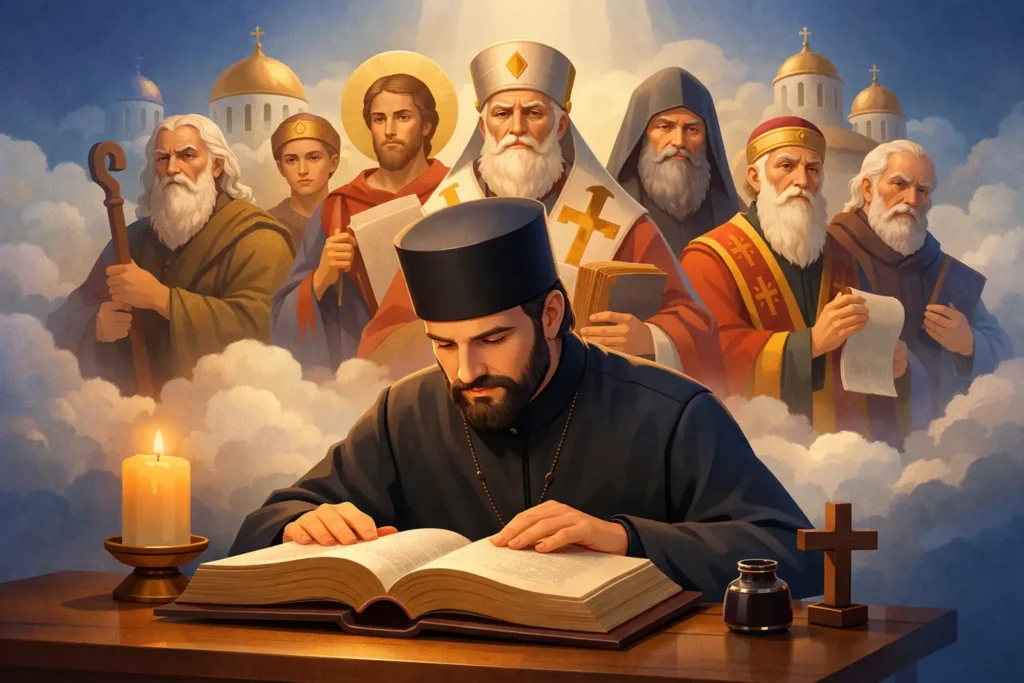
They were not a committee that invented Christianity after the apostles died. They were witnesses to what the Church had received. St. Ignatius of Antioch, who likely knew the Apostle John, wrote about the Eucharist and the bishop early in the second century. St. Irenaeus answered Gnostic distortions by appealing to the public teaching handed down from the apostles through the churches they founded. St. Athanasius suffered exile rather than compromise the confession that Jesus Christ is fully God.
The fathers differ in style, emphasis, and historical circumstance. Some wrote sermons for ordinary Christians. Some answered heresies. Some interpreted Scripture line by line. Some gave spiritual counsel to monks and families. The Church does not treat every sentence from every Church father as infallible. A saint may speculate, speak imprecisely, or address a problem particular to his time. What matters is the shared witness of the fathers as it accords with Holy Scripture, the Ecumenical Councils, and the worshiping life of the Church.
This is not a weakness. It is how living memory works. The faith is not secured by finding one impressive quotation and making it carry more weight than it can bear. The Church listens for the harmony of the apostolic voice.
Why the Church Fathers Matter Now
Modern Christians often inherit a difficult choice: trust one’s own interpretation, or trust a recent teacher, movement, or denomination. The fathers present a different question: How did the Christians closest to the apostles understand the faith they received?
That question does not solve every controversy with a single paragraph. It does expose claims that would have sounded foreign in the early Church. When someone says that baptism is only an outward symbol, that the Eucharist is merely a mental remembrance, or that the visible Church has no necessary role in salvation, the fathers give us historical evidence that these ideas do not represent the ancient Christian mainstream.
Their witness also corrects a common misunderstanding about tradition. Holy Tradition is not an extra collection of human customs added beside the Bible. It is the apostolic faith in its fullness: proclaimed, written in Scripture, prayed in the services, confessed in the Creeds, enacted in the sacraments, and lived by the saints. Scripture stands at the heart of this Tradition. The fathers teach us to read it as the Church’s book rather than as raw material for private religious construction.
This matters especially to those wounded by doctrinal confusion. A Christianity remade every generation to fit the preferences of its teachers cannot provide stable ground. The fathers do not flatter our modern instincts. They call us to repentance, humility, chastity, mercy, prayer, and union with Christ. Yet their firmness is pastoral. They write because souls matter.
The Church Fathers and the Bible
Some people fear that honoring the fathers must diminish the authority of Scripture. The fathers themselves would reject that opposition. Their sermons and treatises are saturated with Scripture. They did not approach the Bible as a distant historical artifact. They heard the living voice of God addressing His people in the Church.
St. John Chrysostom preached through books of the Bible with remarkable care for the text. St. Basil the Great drew deeply from Scripture while defending the Church’s confession of the Holy Spirit. St. Cyril of Jerusalem formed catechumens by grounding them in the biblical faith they would confess at baptism. St. Ephrem the Syrian wrote hymns whose poetry carried biblical truth into the memory and prayer of the faithful.
The difference is not that Orthodox Christians honor Scripture while others do not. The difference concerns how Scripture is interpreted. No reader comes to the Bible without assumptions. The question is whether those assumptions come from the Church that received and preserved the Scriptures, or from a more recent framework.
The Church fathers teach us to read the Old Testament in the light of Christ and the New Testament within the sacramental life of His Body. The Exodus is not only ancient history; it prepares us to understand deliverance through baptism. Manna in the wilderness prepares us to recognize Christ as the true Bread of Life. The Church is not a side topic in the Bible. She is Christ’s Body, His household, and the people being made ready for His Kingdom.
How to Read the Church Fathers Without Misusing Them
Reading the fathers can become another form of argument collecting if we are not careful. A short quote may be genuine and still be misunderstood when detached from its setting. A statement from one father may reflect a question he is answering, while another father provides needed balance. The goal is not to win debates online. The goal is to be formed in the mind of the Church.
Begin with the Church fathers whose works were written for the ordinary life of faith. St. Ignatius of Antioch’s letters reveal the texture of early Christian worship and unity. St. Athanasius’s On the Incarnation gives a clear account of why the Son of God became man. St. Cyril of Jerusalem’s catechetical lectures show how the ancient Church prepared people for baptism and the mysteries. St. John Chrysostom’s homilies bring Scripture close to daily repentance, marriage, work, generosity, and prayer.
Read slowly. Keep the Bible open. Notice what the father assumes about the Church, worship, and Christian obedience. If a passage unsettles you, do not rush to explain it away. Ask why it feels strange. Sometimes the difficulty comes from an unclear translation or a historical question. Sometimes it reveals that modern Christianity has trained us to treat an ancient Christian belief as unfamiliar.
It also helps to read with guidance. The fathers belong in the Church, not merely on a bookshelf. A priest, a catechism class, and the rhythm of the services give their words their proper home. At All Saints of North America Orthodox Church, inquirers and catechumens are encouraged to ask hard questions and to receive answers within a deliberate path of formation, not in isolation.
They Call Us to a Whole Life
The deepest gift of the fathers is not information. They show that doctrine and discipleship cannot be separated. To confess that Christ is truly God and truly man is to worship Him, obey Him, receive His gifts, and allow Him to heal the passions that deform us.
Their world was not easier than ours. They faced persecution, political pressure, false teachers, moral collapse, division, and personal suffering. They did not answer these trials by making Christianity smaller or less demanding. They called the faithful to stand firm, forgive enemies, care for the poor, keep watch over the heart, and return quickly through repentance when they fell.
That is why the fathers remain so necessary. They do not offer religious novelty. They offer the steady, costly, joyful faith of the saints. If you are seeking the historic Church, let their witness move you beyond curiosity. Come and see how this faith is still prayed, taught, confessed, and lived.