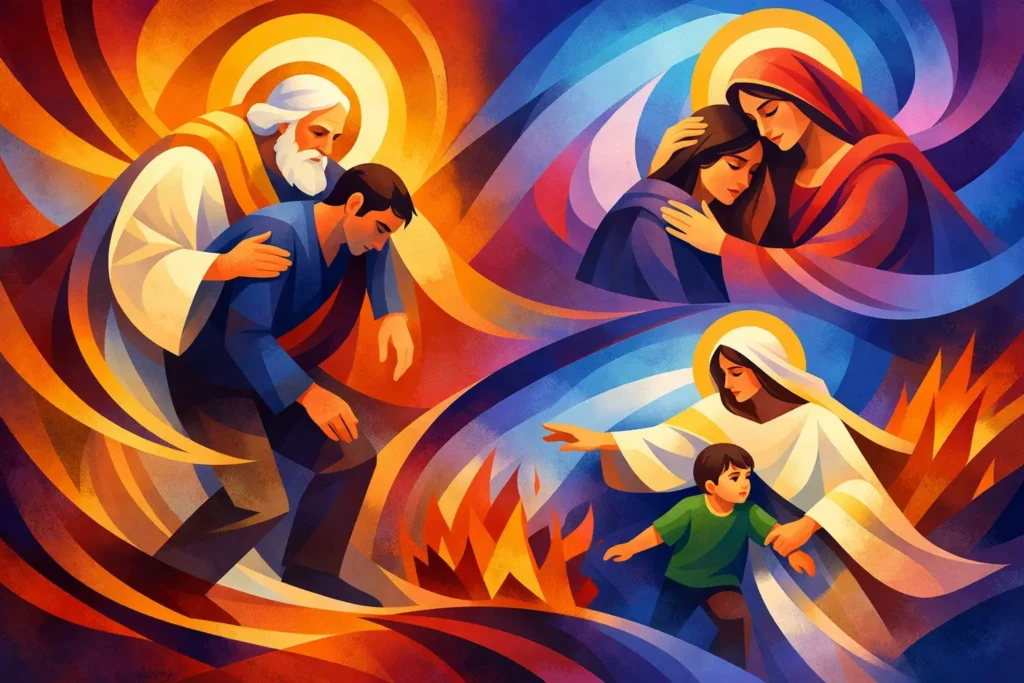
What are saints? A Christian does not stop belonging to Christ at death. That conviction stands at the heart of the Orthodox view of saints. The saints are not religious celebrities from a distant past, nor are they alternative saviors placed between us and Jesus Christ. They are living members of His Body, made holy by His grace, who now behold Him more clearly and pray for the Church still struggling on earth.
For many Christians, especially those formed in Protestant or evangelical settings, asking a saint for prayer can feel unfamiliar or even alarming. Orthodoxy does not ask anyone to set aside Scripture or replace a direct relationship with Christ. It asks us to take seriously what Christ has accomplished: He has defeated death, joined heaven and earth in Himself, and made His Church one family.
The Saints Are Alive in Christ
When the Lord speaks of Abraham, Isaac, and Jacob, He declares that God is “not the God of the dead, but of the living.” The Church hears those words plainly. Those who die in faith are not erased, unconscious, or separated from Christ’s love. They are alive to God.
This does not mean that every departed person has entered the fullness of holiness. The Church prays for the departed precisely because judgment belongs to God and because love does not abandon the dead. But the saints are those whose lives have shown the fruit of deep union with Christ and whom the Church recognizes as faithful witnesses to His saving work.
Their holiness is never self-made. A saint is not someone who needed less mercy than everyone else. A saint is someone who received, trusted, and cooperated with the mercy of God. St. Peter failed Christ and was restored. St. Mary of Egypt came from a life of grave sin and became a great ascetic. The saints reveal what repentance can become when a human being refuses to despair and keeps turning toward the Lord.
The Orthodox View of Saints Is Christ-Centered
Orthodox Christians worship God alone: Father, Son, and Holy Spirit. Worship belongs to the Creator, never to a creature. We worship Christ because He is the eternal Son of God, crucified and risen for the salvation of the world.
We honor the saints because God honored them with His grace. This honor is not competition with Christ. It is praise for His work in human lives. When a parent rejoices that a child has become wise, courageous, or compassionate, the parent is not diminished. In a far greater way, Christ is glorified when His saints display His mercy, purity, courage, and love.
The Mother of God receives a singular honor because she freely received the Word of God in her womb and gave birth to Jesus Christ. Orthodox Christians call her blessed because Scripture does. Yet even her prayer points wholly toward her Son. Her enduring command at Cana remains the right instruction for every Christian: “Do whatever He tells you.”
Why Orthodox Christians Ask Saints to Pray
Christians regularly ask one another for prayer. A parishioner facing illness asks friends to pray. Parents ask the Church to pray for their children. No faithful Christian hears this request as an insult to Christ’s unique mediation. We ask others to pray because we belong to one Body and because God delights to work through the love and intercession of His people.
Asking a saint for prayer follows the same logic, though it reaches beyond the visible congregation. If the saints are alive in Christ, if they remain members of His Body, and if the prayers of the righteous are powerful, then it is fitting to ask their prayers. We do not command saints. We do not treat them as spiritual vending machines. We ask for their intercession with humility, just as we ask a godly Christian friend to pray for us.
The Church’s prayers often speak directly and simply: “Holy Saint Nicholas, pray to God for us.” The saint does not replace Christ. The saint prays to Christ with us and for us.
A common objection is that this resembles forbidden attempts to contact the dead. It does not. Necromancy seeks hidden knowledge, control, or power apart from God. Christian intercession is public, Christ-centered prayer within the communion of His Church. It asks no secret knowledge and seeks no power over another person. Its whole purpose is to glorify God and ask mercy.
Icons Teach the Same Confession
An Orthodox church is filled with icons because Christianity is an incarnational faith. The Son of God truly took flesh. He became visible, touchable, and present among us. Because God entered the material world, matter can serve the proclamation of His salvation.
An icon is not a god, a charm, or a piece of religious decoration. It is a theological confession in color. Before an icon of Christ, we confess that the invisible God has made Himself known in the flesh. Before an icon of a saint, we remember that the grace of Christ can truly transfigure a human person.
Orthodox Christians kiss icons of saints as a gesture of honor, much as someone might kiss a family photograph or the Bible used in worship. The honor passes to the person depicted, and finally to God, who is the source of every holiness. If that practice feels foreign at first, it helps to remember that Orthodoxy engages the whole person. We stand, bow, sing, fast, touch, smell incense, and pray because we are not disembodied minds. We worship God with body and soul.
Canonization Does Not Manufacture Saints
The Church does not make a person holy by canonizing him or her. God alone sanctifies. Canonization is the Church’s careful recognition that a person has borne clear witness to Christ and may be publicly honored and invoked in the Church’s prayer.
That recognition takes time. It considers the person’s life, teaching, faithfulness, local veneration, and, in many cases, signs of God’s grace connected with the saint’s intercession. Miracles may confirm holiness, but the Church does not treat unusual stories as a substitute for discernment. A saint’s enduring confession of Christ matters more than religious excitement.
This patience protects the Church from turning holiness into popularity. Some saints were bishops, theologians, martyrs, and missionaries. Others were mothers, laborers, monks, physicians, or repentant sinners whose hidden faithfulness became known only gradually. The Church honors many kinds of lives because Christ sanctifies people in many callings.
Saints Give Us a Concrete Pattern for Repentance
A saint does more than receive our requests for prayer. They show us how to live. A martyr saint teaches courage when faith has a cost. A confessor saint teaches steadfastness under pressure. A holy spouse saint teaches that marriage can become a path of salvation. A monk or nun saint teaches watchfulness, prayer, and self-denial. A merciful saint teaches us to notice the person in front of us who needs help.
This is why Orthodox Christians keep feast days and read the lives of saints. We are not escaping into nostalgia. We are receiving examples of what fidelity looks like in actual human circumstances. Their lives correct the false belief that holiness belongs only to exceptional personalities. Most saints began where we begin: with sins to confess, habits to change, neighbors to love, and a need for daily prayer.
There is also a needed warning. Devotion to saints should never become superstition. We should not reduce a saint to a narrow problem-solving role or use prayers as if correct words force God to act. The purpose of every saint’s intercession is our deeper communion with Christ, repentance, and growth in love. When a practice feeds fear, pride, or spiritual curiosity detached from obedience, it needs pastoral guidance.
Begin With the Church’s Prayer
If you are new to Orthodox Christianity, begin simply. Attend the services. Listen to the hymns. Notice how often they proclaim Christ’s incarnation, Cross, Resurrection, and return in glory. Ask a priest about the saints who appear in the Church calendar and about the patron saint connected with your own baptismal name.
Do not feel pressure to imitate every devotion immediately. The Orthodox life is learned through worship, confession, Scripture, fasting, and patient participation in a parish community. At All Saints of North America Orthodox Church, seekers and catechumens can receive careful instruction rather than being left to sort through difficult questions alone.
The saints are not a distraction from Jesus Christ. They are His victory made visible in human lives. Their witness invites us to stop treating holiness as someone else’s calling and to bring our own life, without excuse or despair, before the mercy of God.