A Christian can hold the Bible in his hands and still face a serious question: who has the authority to tell us what it means? The difference between Orthodox and Protestant authority begins there. It is not chiefly a debate about whether Christians should honor Scripture. Orthodox Christians confess Scripture as the inspired Word of God, which is where Protestantism gets it from! The question is whether Scripture stands as an isolated authority, or whether it lives within the Church that wrote, received, preserved, proclaimed, and interpreted it.
This question reaches far beyond theological vocabulary. It shapes how a Christian understands baptism, the Eucharist, salvation, church government, the saints, moral teaching, and even what books belong in the Bible. For someone leaving a fragmented Christian background, it can be one of the most decisive questions on the road toward Orthodoxy.
Orthodox and Protestant Authority at the Root
Most Protestants, though they differ widely among themselves, affirm some form of sola Scriptura – Scripture alone as the final infallible rule for faith and practice. This does not necessarily mean that Protestants reject pastors, councils, creeds, or the wisdom of earlier Christians. Many deeply value them. It means that these authorities remain subject to the Bible and cannot bind the conscience in the same way Scripture does.
The Orthodox Church does not set Scripture against Tradition, as though one were divine and the other merely human. Scripture is at the heart of Holy Tradition. The Bible was written in the Church, received by the Church, read in the Church’s worship, and guarded by the Church through the centuries. Holy Tradition is the living continuity of apostolic faith: the Scriptures, the Church’s worship, the Ecumenical Councils, the Fathers, the creeds, the sacramental life, and the faithful confession of the saints.
For Orthodoxy, the final authority is not an abstract principle or a religious institution separated from Christ. Authority belongs to Jesus Christ, the risen Lord and Head of His Body. He gave the apostolic faith to His apostles and promised that the Holy Spirit would guide the Church into all truth. The Church does not invent truth. She receives it, protects it, and hands it on.
The Bible Did Not Arrive Without a Church
The New Testament itself assumes a Church already gathered around the preaching of the apostles. Before Christians possessed a completed New Testament canon, they heard the Gospel proclaimed, received baptism, celebrated the Eucharist, and learned the faith as a shared life in Christ Jesus.
The books of the New Testament were written to particular churches and believers. They were copied, read aloud in worship, and recognized over time as apostolic Scripture. The Church did not create God’s Word, but she did recognize the canon. That recognition matters. A Christian who says, “The Bible alone is my authority,” still relies on the Church’s historical reception of the Bible to know which books are Scripture.
This is not an argument against the Bible. It is an argument for receiving the Bible as God gave it: in the communion of the Church. The Orthodox Christian does not approach Scripture as private property, open to any interpretation that feels persuasive. He reads with the saints, within the worshiping body that has prayed these words for generations.
Interpretation Is Never Neutral
Every Christian interprets Scripture. The question is whether that interpretation is accountable to the historic faith.
Two sincere readers may appeal to the same verses and arrive at opposing conclusions about baptism, predestination, women in ministry, divorce, the Eucharist, or whether Christ is truly God. Protestant history shows that an appeal to Scripture alone does not by itself produce visible unity. Denominations often share a love for the Bible while disagreeing sharply about what the Bible teaches.
The Orthodox answer is not that every Orthodox person interprets perfectly. Orthodox Christians can be mistaken, poorly formed, or careless readers. The answer is that Christ has not left each believer alone with a text. He has given the Church a received rule of faith. When novel interpretations arise, the Church tests them against what has been believed, worshiped, and confessed from the beginning.
What Holy Tradition Is, and Is Not
Many inquirers hear “Tradition” and think of later customs added on top of Scripture. That concern deserves a direct answer. Not every old practice has the same weight, and not every local custom is Holy Tradition. Orthodox Christians distinguish between the apostolic Tradition of the Church and changeable customs that may differ from place to place.
Holy Tradition is not a second Bible, nor is it a collection of opinions from ancient writers. It is the one apostolic faith expressed in the life of the Church. The Nicene Creed, for example, did not add a new religion to Scripture. It defended the biblical confession that the Son is truly God when false teachers distorted the meaning of biblical language.
The Ecumenical Councils function in this same way. Bishops gathered not to manufacture doctrine, but to confess the faith delivered by the apostles against heresy. Their authority is recognized because they faithfully express the Church’s enduring faith, not because a committee vote can make some error true.
This requires humility. Orthodoxy does not invite us to choose whichever teaching best fits our preferences. It calls us to submit our thoughts, assumptions, and desires to the mind of Christ as the Church has received it.
Why Protestant Authority Often Fragments
It would be unfair to speak about Protestantism as if every Protestant church were identical. Some are confessional, historically rooted, and disciplined. Others are independent, personality-driven, or constantly changing. Some preserve much of the ancient Christian inheritance; others reject nearly all of it.
Yet the underlying difficulty remains. If there is no visible, Spirit-guided Church capable of authoritatively settling disputed doctrine, final judgment eventually rests with an individual, a pastor, a congregation, a denomination, or a school of interpretation. Even a confession of faith must finally be accepted because someone judges it to be the best reading of Scripture.
That can produce sincere biblical study for a protestant, but it cannot finally resolve competing claims. When Christians disagree, each side may say, “The Bible clearly teaches my position.” The result is often separation rather than a shared confession. We see this all over the world in thousands of protestant denominations.
The Orthodox Church makes a stronger claim: the faith is not recreated by each generation. It is received. This does not remove every hard question or make every pastoral decision simple. It does provide a stable center. The Church can distinguish between doctrine that must be confessed, theological questions that require patience, and customs that may vary without breaking communion.
Authority Is Meant for Communion, Not Control
Modern Americans often hear authority as a threat. We have seen spiritual abuse, manipulative leaders, and institutions protecting themselves rather than serving the flock. Those wounds are real. A person should not ignore them or surrender discernment to a charismatic religious figure.
But the abuse of authority does not mean Christ gave no authority to His Church. A shepherd who harms sheep is a false shepherd, not proof that the flock needs no shepherd. Orthodox authority is accountable to the apostolic faith, the sacramental life, the bishops in communion with one another, and the whole Church’s enduring witness.
This is also why Orthodoxy is personal rather than merely theoretical. The Christian life is not built by collecting correct opinions. We are formed through worship, confession, fasting, prayer, counsel, repentance, and the Eucharist. Authority has a healing purpose: to lead us away from self-rule and into communion with God and His people.
A Question Worth Bringing to Prayer
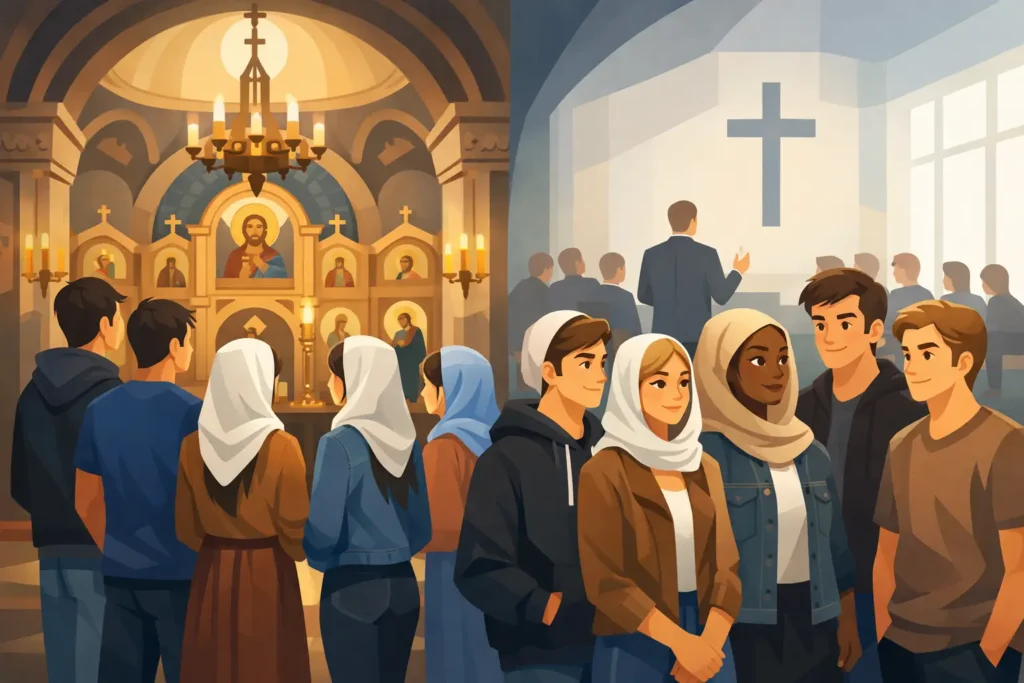
If you come from an evangelical or Protestant background, do not treat this subject as a debating point to win online. Read the Scriptures carefully. Read the early Christians. Pay attention to the Church’s worship. Ask whether the faith you see in the earliest centuries resembles a collection of independent Bible studies or a sacramental, episcopal Church gathered around one confession.
At All Saints of North America Orthodox Church, inquirers are invited to ask these questions openly and patiently. Catechism is not a sales pitch, and conversion should never be rushed. The Church asks for a real response because Christ asks for the whole person.
Bring this question before God with honesty: did Christ leave His Church only a book to interpret, or did He establish a living Body to guard the faith? That prayer, offered with humility and a willingness to follow the truth, can become the beginning of a far deeper homecoming.