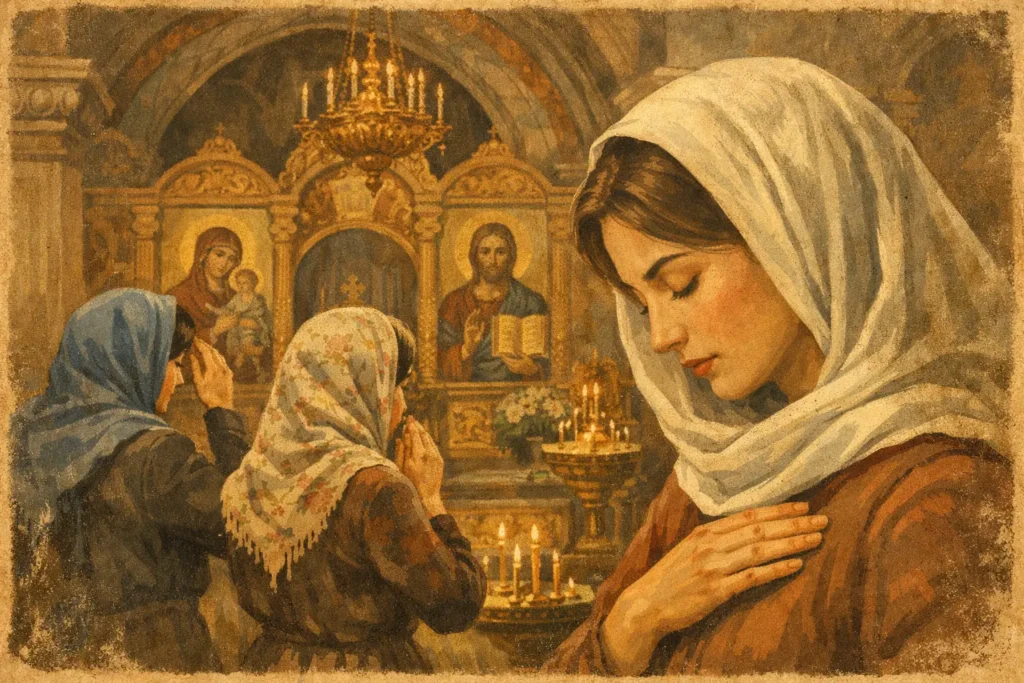
A visitor may first notice candles, icons, chanting, incense, or the sign of the cross. But Orthodox traditions are not a collection of religious accessories added to ordinary Christian life. They are the Church’s received way of living the Gospel: a pattern of worship, repentance, prayer, fasting, feasting, and sacramental communion that forms the whole person in Christ.
For many people, especially those weary of shallow teaching or constantly changing church culture, this can be both compelling and unfamiliar. Orthodoxy does not ask us to invent a private spirituality. It calls us into the apostolic faith as it has been prayed, taught, and embodied through the centuries. These traditions do not compete with Scripture. They arise from the life of the Church that received, preserved, proclaimed, and obeyed Scripture.
Orthodox Traditions Are the Life of Holy Tradition
In common speech, a tradition can mean a family habit: a holiday meal, a song, or a yearly gathering. Some habits are meaningful; others can change without much consequence. Holy Tradition is something far weightier. It is the living transmission of the faith once delivered to the saints.
This includes the Holy Scriptures, the worship of the Church, the decisions of the Ecumenical Councils, the writings and witness of the saints, the sacred canons, and the Church’s continuous confession of Jesus Christ. Tradition is not a second source of revelation added beside the Bible. Nor is it an archive of old opinions. It is the Holy Spirit’s faithful preservation of the apostolic faith in the Body of Christ.
That distinction matters. A parish may have local customs about food, schedules, or celebrations. Those customs deserve respect, but they are not all equally binding. The Church also preserves dogmatic truths that cannot be revised to fit modern preferences: Christ is fully God and fully man; He truly rose from the dead; baptism joins us to Him; the Eucharist is His true Body and Blood; and the Church is not merely an invisible collection of sincere believers.
Orthodoxy therefore asks a serious question: Is this practice helping us receive the faith, or are we treating faith as material for our own redesign?
Worship Comes Before Personal Preference
The Divine Liturgy stands at the center of Orthodox life. Christians gather not chiefly to consume a message, enjoy music, or express individual devotion. We gather to offer worship to the Holy Trinity and to receive the life of Christ. That is the beginning of Orthodox tradition.
The services are rich because the Christian faith is rich. Scripture is sung and proclaimed. The saints are remembered as living members of Christ’s Body. The faithful pray with their bodies by standing, bowing, crossing themselves, and sometimes making prostrations. Bread and wine are offered, consecrated, and received in Holy Communion.
This can feel demanding at first. The services do not rush to accommodate a short attention span. They teach us to slow down, listen, and stand before God. A person accustomed to informal worship may need time to learn when to sit, stand, respond, or approach the chalice. That is not a problem. No one is expected to understand everything on a first visit. Reverent participation grows through patient attendance.
The point is not to perform Orthodox worship correctly as though it were a cultural test. The point is to be formed by worship that is God-centered rather than personality-centered. Over time, the prayers of the Church become the vocabulary of the heart.
Why the Body Participates
Orthodox Christianity refuses the idea that faith exists only in the mind. Human beings are embodied souls. We hear the Gospel, speak it, sing it, smell incense, taste the Eucharist, and make the sign of the cross. These actions do not earn grace. They train the body to join the soul in repentance and praise.
Icons belong within this same sacramental vision. Orthodox Christians do not worship wood and paint. We honor the persons depicted, just as we might kiss a photograph of a beloved parent or child without confusing the image for the person. More deeply, icons confess the Incarnation. Because the eternal Son truly took flesh, He can be depicted in His human form. An icon proclaims that God has entered the material world to save it.
The Church Keeps Time Differently
Modern life often measures time by work deadlines, school calendars, sports seasons, and entertainment releases. The Orthodox calendar teaches another rhythm. Every Sunday is a celebration of Christ’s Resurrection. The yearly cycle leads the faithful through His birth, baptism, transfiguration, crucifixion, resurrection, ascension, and the descent of the Holy Spirit at Pentecost.
Feast days are not religious interruptions to real life. They reveal what real life is for. Christmas announces that God has become man. Theophany reveals Christ in the waters and the Holy Trinity made known. Pascha declares the defeat of death. Each feast places believers again within the saving acts of God.
Fasting also belongs to this rhythm. Orthodox fasting is not a spiritual diet, a public display, or a way to prove toughness. It is a school of freedom. By limiting certain foods and pleasures at appointed times, Christians learn that appetite is a servant, not a master. Fasting makes room for prayer, generosity, confession, and attention to others.
The discipline must be practiced with humility. Age, illness, pregnancy, demanding work, medication, and family circumstances all matter. No Christian should create a private fasting rule based on pride or internet arguments. A priest helps each person pursue faithfulness without self-destruction or legalism. The goal is repentance, not winning a contest.
Prayer Is Learned in the Church and Carried Home
The Orthodox prayer life is both communal and personal. The Church gives believers words when their own words are weak: the Psalms, the Lord’s Prayer, petitions for mercy, thanksgiving, and intercession for the living and the departed. A simple prayer such as, “Lord Jesus Christ, Son of God, have mercy on me, a sinner,” can become a steady return to Christ throughout the day.
At home, many Orthodox families keep an icon corner or prayer space. It need not be elaborate. A few icons, a Bible, a prayer book, and a candle can create a deliberate place for morning and evening prayer. Parents can begin with a short rule that children can actually sustain. A family that prays one Psalm, the Trisagion prayers, and the Lord’s Prayer with attention is building something stronger than a complicated routine abandoned after two weeks.
Consistency matters more than spiritual drama. Prayer teaches us to tell the truth before God, to ask forgiveness quickly, and to intercede for people we may otherwise overlook.
Sacraments Make the Faith Concrete
Each Orthodox tradition is inseparable from the mysteries, often called sacraments. In baptism, a person dies and rises with Christ. In chrismation, the newly baptized receives the gift of the Holy Spirit. In confession, sins are brought into the light and forgiven through Christ’s mercy. In the Eucharist, the Church receives the life-giving Body and Blood of the Lord.
These are not bare symbols or sentimental milestones. God acts in them. Yet they are never mechanical. The person approaching baptism needs preparation. The person approaching confession needs honesty and repentance. The person approaching Communion prepares through prayer, fasting as directed, reconciliation, and a living commitment to the Church.
For this reason, an Orthodox parish should not treat new people as spectators forever, nor should it rush them toward a sacrament they do not understand. A serious catechumenate gives inquirers time to learn the faith, ask difficult questions, examine their lives, and enter the Church with clear intention. The period after baptism also matters. New Orthodox Christians need mystagogy: ongoing instruction in how to live the mysteries they have received.
Orthodox Tradition Is Not a Museum Piece
Some fear that tradition means retreating into the past. The opposite is true when an Orthodox tradition are lived rightly. The saints were not trying to preserve a religious costume. They were learning to obey Christ in their own places, under real pressures, with courage and mercy.
The same task faces Orthodox Christians in Arizona. Families in Surprise, Peoria, Sun City, Buckeye, and surrounding communities need more than a vague religious identity. They need a parish life that teaches children to pray, gives adults clear doctrine, offers real confession and pastoral care, and strengthens believers to remain faithful in a confused culture.
Orthodox Tradition does not remove every practical question. Christians may differ on cultural customs, educational choices, work decisions, or how to apply prudence in a particular family. But the Church gives a stable center: worship God, repent of sin, love your neighbor, guard the heart, receive the mysteries, and remain in communion with the Church.
If you are exploring Orthodoxy, begin by coming to the services. Listen before trying to explain everything. Bring your questions, but also bring the willingness to be taught. At All Saints of North America Orthodox Church, inquirers are welcomed into a careful path of catechism and parish life rather than left to piece the faith together alone.
The Orthodox way is not always easy, and it was never meant to be casual. It is a life received from Christ and practiced with His people. Take the next faithful step: stand in prayer, seek counsel, and allow the Church’s ancient faith to become the shape of your own life.