If you have ever stood in an Orthodox church while the choir sings, the priest censes the icons, and the people move from stillness to prayer to procession, you already know why a guide to Orthodox Divine Liturgy is necessary. The service is not casual, improvised, or built around entertainment. It is ordered worship received from the Church, shaped by Scripture, and offered with reverence before the living God.
For many newcomers, the first question is simple: What is happening here? That is a fair question. The Divine Liturgy is rich, ancient, and deeply biblical, but it is not always self-explanatory on first encounter. The good news is that you do not need to understand every detail on day one in order to begin praying with the Church.
What the Orthodox Divine Liturgy Is
The Divine Liturgy is the Church’s central act of worship on Sunday and major feast days. In it, the people of God gather to hear the Scriptures, offer prayers, confess the true faith, and receive Holy Communion. This is not merely a teaching service and not merely a memorial meal. It is sacramental worship in which heaven and earth are joined by the grace of the Holy Spirit.
Orthodox parishes celebrate the Divine Liturgy of St. John Chrysostom on most Sundays. On certain days, the Liturgy of St. Basil the Great is served, and during some weekdays in Great Lent, the Liturgy of the Presanctified Gifts is appointed. For a newcomer, those distinctions matter less at first than this basic truth: the Liturgy is the worship of the Church, not a platform for religious personalities.
That difference matters. Many Christians come to Orthodoxy after years of instability, doctrinal confusion, or church life centered on preference and production. The Divine Liturgy does not ask, “What style do you like?” It asks, “Will you stand before God with repentance, faith, and thanksgiving?”
A Guide to Orthodox Divine Liturgy for First-Time Visitors
The first thing to know is that you are welcome to attend. You do not need to be Orthodox to visit. You do not need to know all the responses. You do not need to move with perfect timing. Come with humility, pay attention, and let the Church teach you.
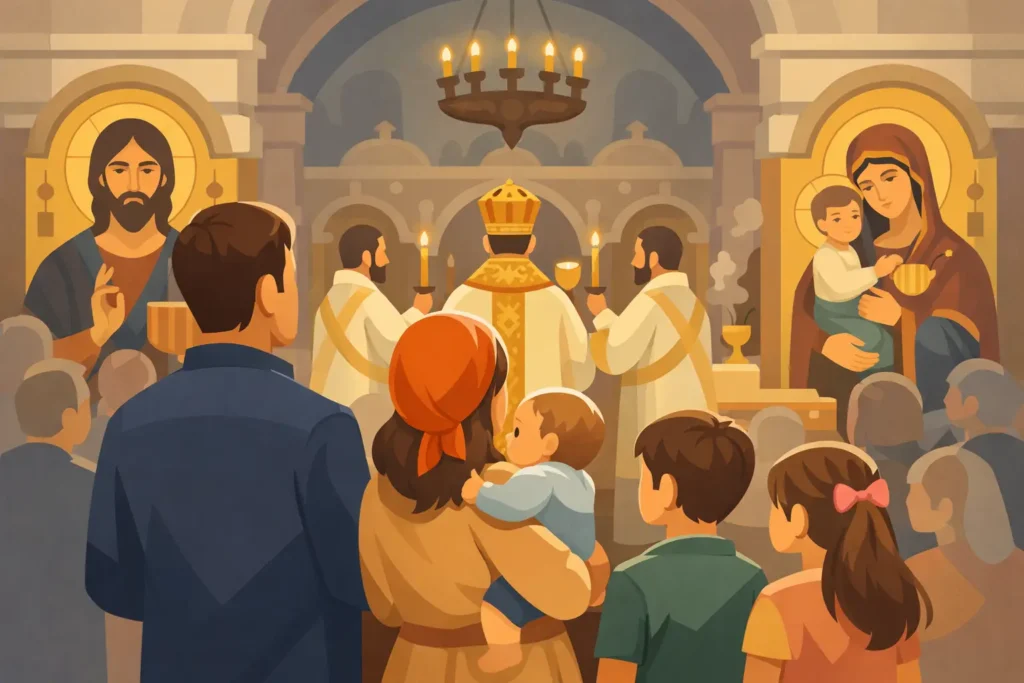
Orthodox worship engages the whole person. You will see icons, candles, vestments, bows, the sign of the cross, and frequent references to the Holy Trinity, the Mother of God, the saints, and the departed. You will hear psalms, petitions, hymns, and repeated prayers for peace, mercy, and salvation. This can feel unfamiliar to evangelical Protestants, and even to Roman Catholics, because the Liturgy assumes a sacramental and historic Christian worldview from beginning to end.
It also helps to know what not to expect. The sermon is important, but it is not the center of the service. The music is prayer, not performance. The clergy lead, but they do not improvise the worship according to mood. The people participate not by being entertained, but by praying.
The Main Movement of the Liturgy
The Divine Liturgy has a clear shape. Once you begin to recognize that shape, the service becomes easier to follow.
The opening petitions and hymns
The service begins by blessing the Kingdom of the Father and of the Son and of the Holy Spirit. That opening is decisive. Orthodox worship begins not with our feelings, but with God’s reign. The deacon or priest then leads petitions for peace, for the Church, for the world, and for the needs of the faithful.
This tells you something essential about Orthodox prayer. We do not come to church to think private thoughts in a room full of strangers. We come as the Body of Christ, praying together for all and for everything.
The Little Entrance and the Scriptures
There is a procession with the Gospel book, often called the Little Entrance, followed by hymns including the Trisagion: “Holy God, Holy Mighty, Holy Immortal, have mercy on us.” Then come the appointed Scripture readings, usually an Epistle and a Gospel.
This part of the service is sometimes called the Liturgy of the Word. The Church hears God’s revelation before approaching the Holy Mysteries. The sermon, when given, belongs here. A faithful sermon should clarify the text, call the hearers to repentance, and strengthen them for Christian life. It is not a motivational talk.
The Great Entrance and the offering
Later comes another procession, the Great Entrance, in which the bread and wine are solemnly brought forward. The Church now turns toward the Eucharistic offering. The prayers intensify. The Cherubic Hymn calls the faithful to lay aside earthly cares, not because earthly life is unimportant, but because worship requires attention, repentance, and spiritual sobriety.
For many first-time visitors, this is one of the most striking parts of the service. It expresses something the modern world rarely teaches: there are moments when reverence must overcome distraction.
The Creed, Anaphora, and consecration
Before the Eucharistic prayer, the people confess the Nicene Creed. This is not filler. Orthodox worship is doctrinal worship. Right praise and right belief belong together.
Then the priest offers the Anaphora, the great prayer of thanksgiving. He recounts God’s saving work, recalls Christ’s command at the Mystical Supper, and invokes the Holy Spirit upon the gifts and upon the people. Bread and wine are set apart as the Body and Blood of Christ. The Church does not reduce this mystery to bare symbolism, nor does she pretend to explain it away by clever theories. She receives it with faith.
Holy Communion
After the Lord’s Prayer and further prayers of preparation, the faithful Orthodox who have properly prepared receive Holy Communion. This point requires clarity. In Orthodoxy, Communion is not generally open to all visitors, because it expresses full unity in faith, sacramental life, and ecclesial communion. To some, that may sound severe. In truth, it is honest.
The Church does not use the Eucharist as a gesture of vague friendliness. She guards it as holy. Visitors who are not receiving should not feel singled out. Instead, they should recognize that Orthodoxy takes Communion with utmost seriousness.
What You Should Do During the Liturgy
Stand when you are able. Watch the people. Follow along as best you can. If others make the sign of the cross, you may simply observe until you understand when and why it is done. If there is a service book available, use it lightly. Do not bury your face in the page so completely that you miss the prayers unfolding around you.
It is also wise to resist the urge to decode everything immediately. Some parts of the Liturgy become clearer only through repeated attendance. Orthodoxy is learned by study, but also by faithful participation. The service forms you over time.
As for practical concerns, arrive a little early if possible. Wear modest clothing. Keep your phone put away. If you have children, bring them. Orthodox parishes expect children in worship. They may wiggle, whisper, and need gentle correction. That is part of parish life, not a disruption of it.
What the Divine Liturgy Means
A true guide to Orthodox Divine Liturgy must go beyond sequence and explain meaning. The Liturgy is not a religious pageant. It is the Church’s ascent into the worship of God, her offering of thanksgiving, and her participation in the life of Christ.
This means the Liturgy is formative. Week by week, it teaches humility, repentance, attention, gratitude, and obedience. It places the believer inside the language of the Psalms, the confession of the Creed, and the sacramental life of the Church. It resists the individualism that dominates modern religion.
It also exposes us. If worship feels slow, the problem may not be the service. It may be our impatience. If reverence feels foreign, the problem may not be the Church. It may be how deeply we have been shaped by distraction. The Divine Liturgy is merciful, but it is not designed around our restlessness.
When the Liturgy Feels Unfamiliar
For some, the first few visits are marked by awe. For others, they are marked by confusion. Both responses are normal. The question is whether you will keep coming.
Familiarity does not cheapen the Liturgy. Done rightly, it deepens it. Over time, the repeated prayers cease to feel repetitive in the shallow sense and begin to feel stable, like a rule of prayer that carries you when your emotions do not. That stability is one reason many inquirers and families, including those in Surprise, Peoria, Glendale, and Buckeye, seek out serious Orthodox parish life in the first place.
If you are exploring Orthodoxy, do not judge the Divine Liturgy by a single visit. Attend regularly. Ask questions afterward. Learn from the clergy. Read, study, and pray. The Church does not rush people into understanding, but she does call them to seriousness.
Welcome with reverence, watch with patience, and return with expectation. The Divine Liturgy is not something you master quickly. It is something you enter, and by God’s mercy, something that begins to remake you.