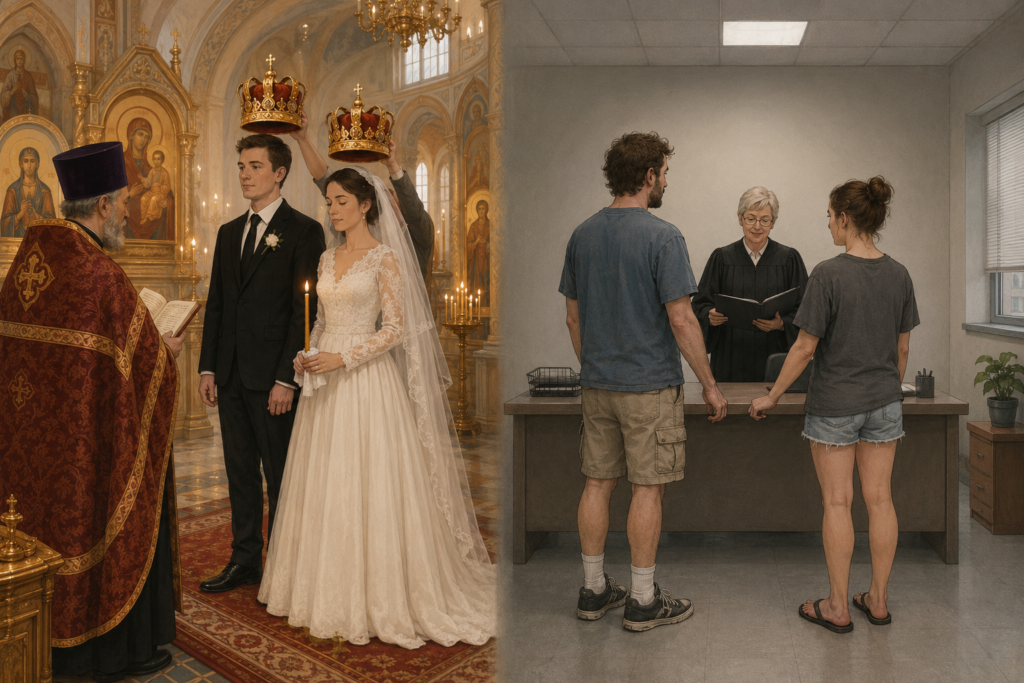
A marriage license can establish a household before the State. The crowning of a man and woman in the Orthodox Church establishes something far greater: a shared vocation of salvation. That is the decisive difference in Orthodox marriage versus civil marriage. Both involve public promises and real responsibilities, but they do not mean the same thing, and Christians should not treat the Church’s sacrament as a religious decoration added to an otherwise complete arrangement.
What Civil Marriage Does – and Does Not Do
Civil marriage creates a legal bond. It gives a couple recognized standing before the government and provides a framework for matters such as property, taxes, inheritance, medical decisions, parental rights, and the orderly dissolution of legal obligations if a marriage collapses. These are not trivial concerns. Christians should honor lawful public commitments, care for one another responsibly, and avoid arrangements that leave a spouse or children unprotected.
A civil wedding may also contain sincere vows, family joy, and a serious intention to remain faithful. The Orthodox Church does not mock those goods. Faithfulness, sacrifice, and the desire for a stable home are good wherever they appear.
But the State does not bless a union as a mystery of Christ and His Church. It cannot give the grace of the sacrament, form a couple through prayer and fasting, or call husband and wife into the ascetic labor of becoming holy together. Civil marriage addresses a couple’s legal status. It does not by itself make their union an Orthodox Christian marriage.
What Happens in an Orthodox Marriage
In the Orthodox wedding service, the Church does not simply witness two people making a private contract. The Church receives them, prays over them, crowns them, and asks God to unite them in peace, faithfulness, and love. The crowns speak of joy, royal dignity, and martyrdom. Marriage is joyful, but it is not easy. Husband and wife learn to lay down self-will, forgive repeatedly, bear one another’s burdens, and put Christ at the center of ordinary life.
The marriage rite reveals that this union is never merely about personal fulfillment. A husband and wife become one flesh, yet neither loses his or her personhood. Their home becomes a small church, ordered toward prayer, hospitality, chastity, generosity, the raising of children in the faith, and service to others.
The Church also understands marriage as an icon of Christ’s faithful love for His Bride, the Church. That is why Orthodox marriage cannot be reduced to compatibility, chemistry, a beautiful venue, or even deeply felt affection. Those things matter, but they cannot carry the weight of a lifelong covenant by themselves. The sacrament calls a couple to receive and live a love stronger than changing feelings.
Orthodox Marriage Versus Civil Marriage in Daily Life
The contrast becomes clearest after the wedding day. Civil marriage asks whether a couple has met the requirements of the law. Orthodox marriage asks how husband and wife will be saved together.
That question changes the shape of daily life. An Orthodox couple does not wait for a crisis to turn toward God. They learn to pray at home, attend the Divine Liturgy, confess their sins, keep the fasts as they are able, give alms, and seek counsel before resentment becomes a habit. They do not use spiritual practices to perform perfection. They use them because marriage exposes the passions with unusual force, and no one defeats pride, anger, lust, or selfishness by willpower alone.
This does not mean that Orthodox married life is emotionally cold or relentlessly severe. On the contrary, sacramental life gives tenderness a deeper foundation. A couple can enjoy friendship, laughter, intimacy, shared work, and family celebrations without demanding that the other spouse become a source of ultimate meaning. Only Christ can bear that burden.
Civil law can require a divorce decree when a marriage legally ends. The Church must also address the spiritual wound. Orthodox teaching holds marriage to be lifelong, and divorce is a tragedy, not an easy exit or a routine life transition. Yet the Church ministers to those whose marriages have broken through sin, abandonment, violence, betrayal, or other grave circumstances. Civil dissolution and ecclesiastical judgment are related, but they are not identical. A person seeking a future Church marriage needs pastoral guidance, not assumptions based on civil paperwork alone.
Why Preparation Must Be More Than Planning a Ceremony
Many couples spend months choosing flowers, music, clothing, and a reception. Those decisions can serve a joyful celebration, but they cannot prepare a couple for the first serious conflict, a miscarriage, financial strain, infertility, illness, or the exhausting years of raising children. Marriage preparation must reach the soul.
For an Orthodox understanding of marriage, clergy will ordinarily help a couple address their faith, baptismal status, freedom to marry, prior marriages, relationship to the parish, and readiness to live as Orthodox Christians. Civil requirements must also be handled correctly. In Arizona, couples should speak with their parish and the appropriate county office early enough to understand licensing, documentation, and timing. Do not leave either the legal process or the Church’s preparation until the final weeks.
More importantly, begin practicing the life you are asking God to bless. Attend services together. Read the wedding service before the wedding day. Learn the Church’s teaching on chastity, repentance, and the purpose of family life. Make confession a real part of preparation. If a couple is already living together or sexually active, the answer is not despair or concealment. It is honest repentance and a concrete conversation with the priest about how to move forward faithfully.
When One or Both People Are Not Orthodox
This is where many couples discover that an Orthodox wedding is not interchangeable with a civil ceremony. The Church has clear boundaries because sacraments confess a shared faith. A marriage between an Orthodox Christian and a non-Christian cannot be crowned in the Orthodox Church. In some circumstances, the Church may permit a marriage between an Orthodox Christian and a baptized Christian from another Trinitarian confession, but this is handled pastorally and under the Church’s canonical discipline. It should never be presumed or negotiated as though the sacrament were a vendor service.
If you are engaged and exploring Orthodoxy, begin the conversation early. Do not pressure a fiancé or fiancée into a hurried conversion merely to satisfy a wedding requirement. The Church seeks sincere faith, not paperwork. At the same time, do not postpone serious questions about worship, children, moral life, and spiritual authority until after the honeymoon. What seems avoidable during engagement often becomes painful after vows are made.
For couples in Surprise, Peoria, Glendale, Buckeye, Sun City, and the surrounding west Phoenix communities, All Saints of North America Orthodox Church welcomes an early, honest conversation about the path toward an Orthodox marriage. Good pastoral preparation does not make marriage less romantic. It makes its promises more truthful.
A wedding lasts an afternoon. Marriage asks for every ordinary day that follows. Seek the blessing of the Church not as an accessory to a celebration, but as the beginning of a life in which husband and wife learn, day by day, to belong more fully to Christ.