When a loved one dies, memorial arrangements arrive quickly while the heart is still stunned. An Orthodox memorial in Glendale, Arizona is not chiefly a ceremony for remembering a life well lived. It is the Church’s prayer for a departed person who stands before the merciful judgment of Christ. In grief, that distinction gives a family something firmer than sentiment: the prayers of the Church, the hope of the Resurrection, and the presence of people who will not ask them to carry sorrow alone.
Orthodox Christians do remember the departed with love. We speak their names, give thanks for the good they gave, and care for those left behind. Yet the center of a memorial service is prayer: “Memory eternal.” It is a plea that God receive His servant or handmaid into the light of His Kingdom and grant rest where there is no pain, sorrow, or sighing, but life everlasting.
What an Orthodox Memorial Service Is
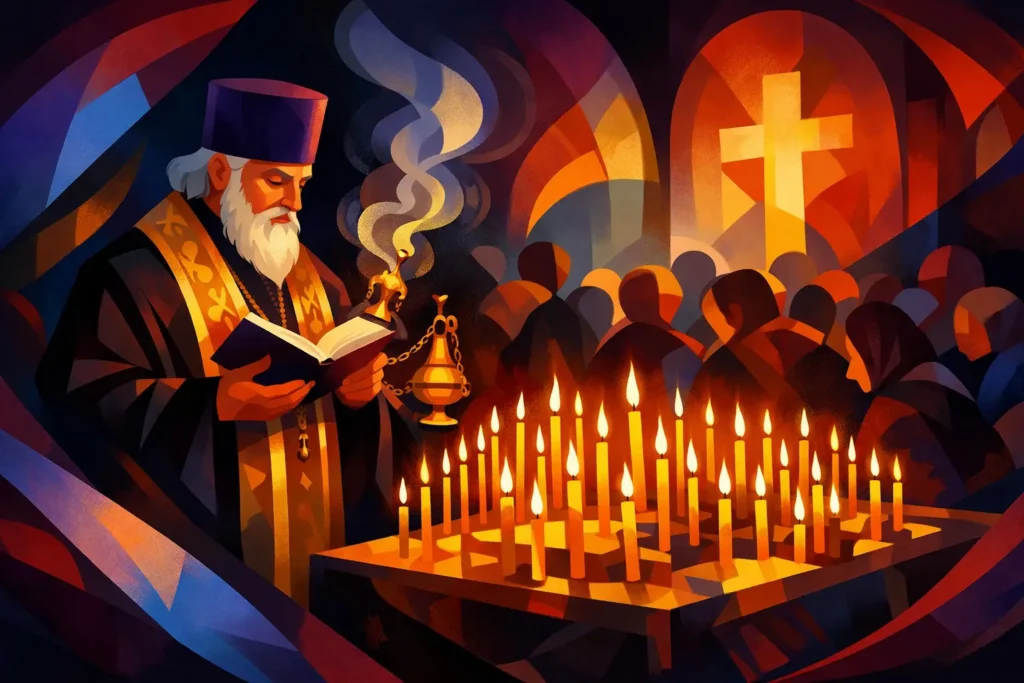
An Orthodox memorial service is commonly called a Panikhida, or memorial service. It is a service of intercession for the departed, marked by psalms, hymns, Scripture, incense, and prayers for forgiveness and eternal rest. A shorter prayer service, often called the Trisagion, may be served at the funeral home, graveside, or in another fitting setting.
These services proclaim a truth that changes how Christians grieve: death is real, terrible, and an enemy. Christ has also trampled down death by His death. Therefore, Orthodox mourning is neither denial nor despair. We weep because we love. We pray because Christ is risen and because His mercy is deeper than our own understanding.
A memorial service differs from a eulogy-centered gathering. Personal remembrances may have a place at a meal or family gathering, especially when they help others give thanks and comfort one another. During the Church’s service, however, the focus remains on God, on the departed, and on the resurrection promised to those who die in Christ.
Planning an Orthodox Memorial in Glendale, Arizona
The first call should be to the parish priest. Do this before setting a date with a funeral home whenever possible. The priest can guide the family through what is appropriate, where the service may be held, and how it fits with the parish calendar. Not every day permits the same service, and a priest’s direction prevents a grieving family from having to sort through liturgical questions on its own.
Bring the departed person’s full Christian name, the date of death, and any immediate plans for burial or a funeral. If the person was Orthodox, let the priest know the parish they attended and whether they received the sacraments. If the departed was not Orthodox, speak plainly and early. The Church has a specific order for her own faithful, and the priest must discern what prayers may be offered publicly. That is not a cold refusal of compassion. It is the Church taking prayer, truth, and pastoral care seriously.
Families in Glendale and the wider west Phoenix area often face practical pressures: relatives traveling from out of state, work schedules, cemetery arrangements, and the intense heat of much of the year. Those matters are real. Still, do not let logistics eclipse the spiritual work before you. Ask the parish what can be arranged, then choose a plan that gives the family room to pray rather than merely rush from one obligation to the next.
All Saints of North America Orthodox Church serves families throughout the west side of the Phoenix metro area and can help inquirers and Orthodox Christians understand the Church’s pattern of prayer for the departed. A priest can explain what is customary, what is required, and what may vary according to the circumstances.
The funeral, burial, and memorials that follow
The funeral is normally served soon after death, followed by burial. Orthodox Christianity treats the body with reverence because it was created by God, sanctified in baptism, and destined for resurrection. For that reason, burial is the Church’s normal and expected practice. If cremation is being considered or has already taken place, contact a priest before making further plans. These circumstances require careful pastoral guidance, not assumptions or arguments at a painful moment.
Memorial prayers do not end at the funeral. Orthodox families commonly request prayers on the third, ninth, and fortieth days after death, then at the one-year anniversary and subsequent anniversaries. The exact observance may vary with the parish calendar and family circumstances, but the fortieth day is especially significant in Orthodox practice. It is a fitting time to gather again, offer prayers, and remember that Christian love continues in intercession.
The Church also sets aside particular Saturdays during the year for commemorating the departed. These are not substitutes for a personal memorial, but they teach a vital truth: the departed belong to the whole Church. We do not pray for them as isolated individuals trying to hold on to the past. We pray as members of Christ’s Body.
Koliva and the Meaning of the Memorial Table
A family may prepare koliva, boiled wheat sweetened and often decorated with a cross, for a memorial service. Wheat recalls Christ’s own words: unless a grain of wheat falls into the earth and dies, it remains alone; but if it dies, it bears much fruit. The grain points toward burial, resurrection, and the life that God brings forth from what appears to be lost.
Koliva is a meaningful Orthodox custom, not a test a grieving family must pass. If the family cannot prepare it, ask the parish what is customary or whether help is available. In some communities, a simple offering of bread or another appropriate food may be arranged. The purpose is not display. It is prayer joined to an act of remembrance and charity.
A photograph, flowers, or a small memorial table may be appropriate depending on the parish setting. Keep the center clear: the cross, the candlelight, the incense, and the prayers of the Church tell the story that matters most. A memorial should not become a performance of personality or a contest over who can create the most elaborate tribute.
How Family and Friends Can Participate
Those attending an Orthodox memorial do not need to know every response. Stand reverently, follow the service book or the congregation where possible, and join in the repeated prayer, “Memory eternal.” Non-Orthodox relatives are welcome to be present and to pray with respect. They should not feel pressured to imitate Orthodox actions they do not understand, such as making the sign of the cross or venerating an icon.
If children attend, prepare them with honest, simple words. Tell them that someone we love has died, that we are sad, and that we are coming to church to pray because Jesus Christ defeated death. Children should not be shielded from every sign of grief. They need to see that Christians can mourn openly without being abandoned to hopelessness.
After the service, a meal shared with family and friends can be a real work of mercy. Keep it simple enough that the bereaved are cared for rather than made responsible for hosting. Bring food, help with transportation, sit quietly with someone who is hurting, and continue to remember the departed by name in your own prayers. Grief does not keep office hours, and neither should Christian love.
Prayer After the Day of the Service
A memorial is not the final task to complete after a death. It begins a life of remembrance. Add the departed person’s name to your daily prayers. Request commemoration at the Divine Liturgy when appropriate. Give alms or perform acts of mercy in their memory, not as a bargain with God, but as an offering of love to the One who is merciful.
For those who are new to Orthodoxy, these practices can feel unfamiliar. Modern culture often urges people to “move on” quickly or to replace grief with vague assurances. The Church offers something more demanding and more hopeful: remain faithful, pray without pretending, and entrust the departed to Christ.
When the days after a death feel scattered and unreal, begin with one faithful act. Call the parish. Give the Christian name of the person you love. Ask for prayer. The Church will answer not with empty optimism, but with the unshakable confession that Christ is risen, and that every name offered to Him is held in His mercy.