A first encounter with Orthodox iconography can feel unfamiliar. The icons do not aim at photographic realism, the perspective seems to work differently, and the gold background refuses to behave like ordinary scenery. This Orthodox iconography beginner guide begins with the central truth: Icons are not religious decoration. It is a holy image that calls us to prayer, confession of Christ, and communion with the saints.
The Church does not ask you to become an art historian before you can pray before an icon. She does ask you to approach holy things with reverence. Begin there. Let the icon slow you down, turn your attention toward the Lord, and teach you that Christianity is not an idea about salvation but participation in the life of the incarnate God.
Why Orthodox Christians Use Icons
Orthodox Christians honor icons because Jesus Christ truly became man. The eternal Son of God took visible flesh from the Virgin Mary. He could be seen, touched, heard, and depicted. To reject every sacred image as inherently forbidden would fail to reckon with the Incarnation itself.
An icon therefore proclaims something precise: God has entered His creation without ceasing to be God. Christ is not a distant spiritual concept. He is the Lord who took a human face, suffered, died, rose bodily from the dead, and ascended in that same glorified humanity.
Icons of the Mother of God and the saints make a related confession. The grace of God truly transforms human persons. The saints are not dead heroes kept alive by our memories. They are alive in Christ, and the Church asks for their prayers as she asks faithful Christians on earth to pray for one another.
This is why Orthodox Christians venerate icons but worship God alone. Worship belongs to the Holy Trinity. Veneration is honor offered to the person depicted. When a Christian kisses an icon of Christ, he does not kiss wood and pigment as though matter were a god. He offers love and reverence to Christ Himself. When he venerates an icon of a saint, he honors the grace of God revealed in that saint’s life.
How to Read an Orthodox Iconography Beginner Guide
Icons have a visual grammar. You do not need to memorize every feature at once, but learning a few principles will help you see what the Church is saying.
First, look for the name. Orthodox icons normally identify the person or event shown. Christ is commonly marked with the Greek letters IC XC, an abbreviation for Jesus Christ. In His halo are the letters O Omega N, meaning “He Who Is,” a confession of His divine identity. An icon of the Theotokos, the Virgin Mary, often bears the letters MP THY, meaning Mother of God.
Second, notice that the icon is theological rather than naturalistic. Saints may have enlarged eyes because they behold God. Their ears may be visible because they have heard His word. Their mouths are often small because holiness is not noisy self-assertion. These are not arbitrary artistic quirks. They teach us how a person looks when his life is turned toward the Kingdom.
Third, do not expect every icon to show a moment exactly as a camera would. An icon may present several moments of a biblical event in one image, or place holy persons together in a way that expresses spiritual truth. Its perspective can seem to open outward toward the person praying. The icon does not merely invite you to observe a distant scene. It places you before the reality it proclaims.
Color also serves meaning, though the details can vary by tradition. Gold often signifies divine glory and the uncreated light of God. Blue may suggest heaven or mystery. Red can speak of life, sacrifice, royalty, or divine love. It is wise to learn these meanings gradually rather than treating icons as a code to crack. Prayer comes before analysis.
Begin With Christ
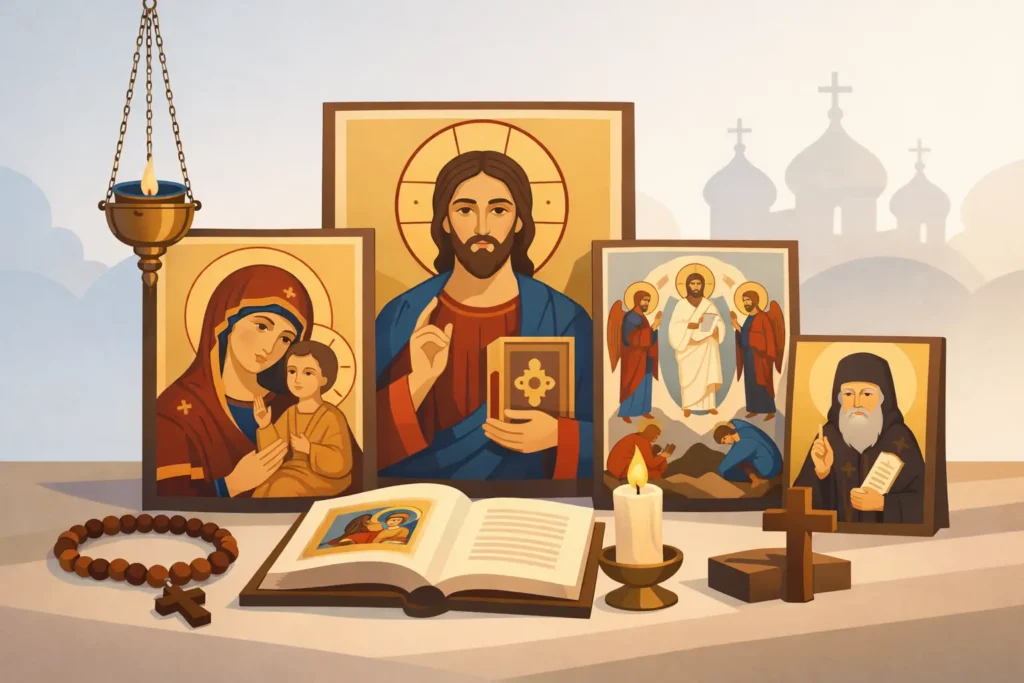
If you are building familiarity with icons, begin with an icon of Christ, especially Christ Pantocrator, meaning Ruler of All. In many such icons, Christ blesses with His right hand and holds the Gospel in His left. Look at His face. Stand quietly. Make the sign of the cross and pray simply: “Lord Jesus Christ, have mercy on me.”
This is a better beginning than collecting many icons quickly. One well-chosen icon of Christ, prayed before faithfully, can become part of a stable rule of prayer. The aim is not to create a visually impressive room. The aim is to learn repentance, attention, and love for God.
A Simple Home Icon Corner
Orthodox homes traditionally set aside a prayer corner, often on an eastern wall when practical. East is a meaningful direction because Christians await the coming of Christ, the Light from the East. But do not become anxious if your apartment, home layout, or family circumstances make that difficult. A clean, quiet, dignified place is more important than architectural perfection.
Start with an icon of Christ and an icon of the Theotokos. Add a cross. If you have room, a small lamp or candle can serve as a reminder that Christ is the Light of the world. Keep fire safety in mind, especially around children, pets, curtains, and crowded shelves. A battery-operated lamp is not the same thing as an oil lamp, but it may be the prudent choice in some homes.
You may later add icons of your patron saint, your family’s patron saints, or feast-day icons. Let your prayer life guide the growth of the corner. Avoid treating it as a display shelf for objects gathered without prayerful purpose. A modest corner used every day is far better than an elaborate arrangement left untouched.
How to Pray Before an Icon
You do not need special emotional experiences to pray well before an icon. Stand if you are able. Make the sign of the cross. Light a candle or lamp if appropriate. Offer thanksgiving, confess your sins, ask mercy, and pray for the living and departed.
You might begin with the Trisagion prayers if you know them, read a Psalm, or pray the Jesus Prayer slowly: “Lord Jesus Christ, Son of God, have mercy on me, a sinner.” If you are new to Orthodox prayer, keep the rule small and consistent. Five attentive minutes each morning and evening is more fruitful than an ambitious routine abandoned after three days.
Bowing or kissing an icon can be a fitting expression of reverence, but it should never become theatrical or mechanical. If physical limitations prevent bowing, God is not measuring your mobility. Bring Him an honest heart. The body matters in Orthodox prayer, yet the body is not a performance.
What Not to Do
Do not treat an icon as a lucky object, a tool for getting your preferred outcome, or a substitute for repentance. An icon does not control God. It brings you face to face with the One to whom you must answer.
Do not use icons casually as props, novelty décor, or social-media accessories. A holy image deserves a clean and respectful place. This does not require fearfulness. Iconography requires love.
Also, do not assume every image marketed as an “Orthodox icon” is a suitable image for prayer. Some are sentimental religious artwork; others borrow Orthodox features without expressing Orthodox faith. A parish priest can help you choose sound icons, especially when you are unsure about a particular image or saint.
Learning Without Turning Icons Into a Hobby
The beauty of iconography can awaken real interest in Church history, Scripture, saints, and theology. That is good. Yet the goal is not simply to become knowledgeable about styles, schools, pigments, or eras. The icon calls for a response: faith in Christ and a life shaped by His commandments.
If you want to learn the craft of icon writing, receive patient instruction. Traditional iconography involves more than artistic skill. It is a disciplined ecclesial practice, connected to prayer, fasting, theological understanding, and obedience to the Church. Some people can begin with drawing and study; others may be called to leave the craft to trained iconographers while learning to pray before their work. Both paths can be faithful.
For those exploring Orthodox iconography in the west Phoenix area, All Saints of North America Orthodox Church can help place icons within the larger life of the Church: worship, catechism, confession, the sacraments, and daily repentance. Iconography is never meant to stand alone. It belongs to the worshiping community that confesses the same Christ it reveals.
Choose one icon of Christ. Put it in a place of honor. Stand before it tomorrow morning, cross yourself, and offer one truthful prayer. The holy icon/image will not ask you to invent a new spirituality. It will quietly direct you to the living Lord.