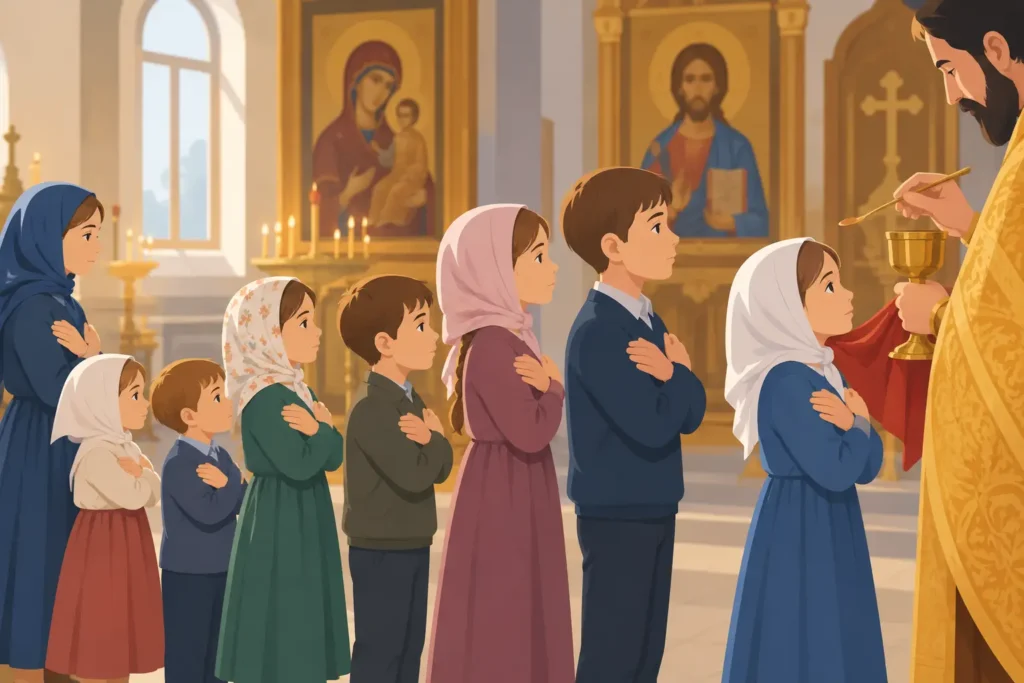
A baby is baptized, receives Holy Chrismation, and then is brought forward to receive the Body and Blood of Christ. For many visitors, this moment raises an immediate question: when do Orthodox children receive communion? The answer is simple, though its meaning is profound: Orthodox children commune from the time they are baptized and chrismated into the Church.
This is not a sentimental custom or a shortcut around serious faith. It expresses what the Church believes about salvation, baptism, the Eucharist, and the place of children in the household of God. Children do not stand outside the life of grace until they can explain it. They are received into Christ’s Church and nourished at His Table.
When Do Orthodox Children Receive Communion?
In the Orthodox Church, an infant or child receives Holy Communion immediately after baptism and chrismation. From that day forward, the child may commune at the Divine Liturgy as often as the family and priest determine is appropriate.
Orthodoxy does not have a later “first Communion” ceremony in which a baptized child reaches a certain age before first approaching the Chalice. The child’s first Communion normally follows baptism itself. This reflects the unity of the mysteries of initiation: baptism joins a person to Christ’s death and resurrection; chrismation seals the gift of the Holy Spirit; and the Eucharist feeds the newly received member of Christ’s Body.
A child who was baptized Orthodox as an infant, therefore, does not need to wait until age seven, eight, or twelve. He or she is already a full member of the Church, though still growing in understanding, self-control, and personal faith.
Why Orthodox Infants Receive the Eucharist
Christ’s words are not reserved for adults who can give a detailed theological account of them. He said, “Let the little children come to Me.” The Church takes those words seriously in her worship, not only in her sentiment.
The Eucharist is the true Body and Blood of Christ, given for the life of the world. It is not merely a public statement that someone has reached a certain intellectual milestone. No Christian, regardless of age, earns Communion through knowledge or moral achievement. This is also the ancient western Christian tradition! We receive because Christ gives Himself to His baptized people, calling each of us to receive with faith, repentance, and reverence.
This does not make preparation unimportant. It puts preparation in its proper place. An infant receives through the faith of the Church and through the faithful care of parents and godparents. As the child matures, he gradually learns to prepare personally: to pray, to fast according to his strength, to confess sins, to forgive others, and to approach the Chalice with attention rather than casualness.
The Church does not treat children as spiritually irrelevant until adulthood. Nor does she pretend that a child possesses adult judgment. She receives children fully while forming them patiently.
What Communion Looks Like for Young Children
At the Divine Liturgy, Orthodox Christians receive the consecrated Gifts from a common communion spoon. Infants and young children are given a small portion with great care. Parents commonly hold an infant securely or bring a young child forward in their arms.
As children become mobile and verbal, parents should begin teaching simple, practical reverence. A child can learn to stand quietly in line, keep his hands down, tilt his head back slightly, receive from the spoon without grabbing it, and take the communion cloth gently if it is offered. These small habits matter because they train the body as well as the mind to recognize that the Chalice is holy.
Parents should also tell the priest or deacon if a child is ill, has food restrictions, or may have difficulty receiving safely. Pastoral care is not an interruption of reverence. It is reverence expressed through wise attention.
How Children Prepare for Communion as They Grow
There is no single age at which every Orthodox child begins adult forms of communion preparation. A wise priest considers the child’s age, health, maturity, family circumstances, and the established practice of the parish. Parents should not turn fasting or confession into a burden that makes a child fear the Church. They also should not teach that Communion is ordinary, automatic, or disconnected from repentance.
For a very young child, preparation may be as simple as attending Liturgy, hearing prayers at home, being brought to the Chalice calmly, and learning that this is the gift of Jesus Christ. Parents carry much of the responsibility at this stage. Their own prayer, confession, fasting, and faithful attendance shape the child’s understanding long before he can articulate it.
As children grow, parents can add practices gradually. Before Communion, a child might help say a short prayer, ask forgiveness from family members, refrain from snacks for a modest period if health permits, and listen closely during the prayers before the Chalice. Older children should begin regular confession when their priest judges that they can recognize and confess sins meaningfully.
The goal is not to create religious anxiety or make a child perform spirituality for adults. The goal is a truthful Christian life. A child should learn both that Christ welcomes him and that Christ calls him to repentance, obedience, courage, and love.
Do Orthodox Children Have to Fast Before Communion?
Fasting practices for children require pastoral judgment. Infants do not fast from nursing or necessary food before Communion. Young children, children with medical needs, and children taking medication should never be subjected to a rule that harms their health or creates needless distress.
Many families introduce a small fast as children become able to understand it. That may mean no food or drink after waking before a morning Liturgy, or a more limited practice agreed upon with the priest. What matters is that parents do not invent a rigid household standard and then mistake it for the universal law of the Church.
Fasting is not a price paid for the Eucharist. It is an ascetical preparation that teaches desire, self-restraint, and hunger for God. For children, it must be taught with wisdom and warmth. A child who is hungry and frightened has not learned the meaning of fasting.
What About Children Who Are Not Orthodox?
Only baptized and chrismated Orthodox Christians receive Holy Communion in an Orthodox parish. This includes Orthodox children. Children from Roman Catholic, Protestant, evangelical, Mormon, Muslim, or non-Christian families are welcome to attend, pray, observe, and be received with kindness, but they do not commune until they have entered the Orthodox Church through the appropriate pastoral process.
This boundary is not a judgment upon a child or a family. Communion visibly expresses full unity in the faith, sacramental life, and pastoral care of the Orthodox Church. To invite someone to receive before that unity exists would say with an action what has not yet become true in the person’s ecclesial life.
If your family is exploring Orthodoxy, do not feel embarrassed by this. Bring your questions to the clergy. A serious parish will help you understand what your children are seeing, how to participate respectfully in services, and how a family enters the Church together.
A Word to Orthodox Parents
The strongest preparation for a child’s Communion is not a flawless Sunday routine. It is a home where Christ is named, forgiveness is practiced, prayers are said, and parents themselves take the sacramental life seriously. Children notice whether Communion is treated as the center of life or as one more item on a crowded schedule.
At All Saints of North America Orthodox Church, families who are new to Orthodox practice should feel free to ask for clear guidance. Questions about a child’s baptism, confession, fasting, behavior in church, or readiness for greater responsibility deserve patient and direct pastoral answers.
Bring your children to Christ. Teach them, correct them, and be patient with them. At the Chalice, they meet not an abstract idea, but the Lord who receives them and calls the whole family deeper into His life.