A newborn cannot explain the Creed, choose a patron saint, or profess faith with mature words. Yet an infant can truly receive the mercy of God. In Orthodox infant baptism, the Church does not wait for a child to become spiritually independent before welcoming him or her into Christ. She receives the child as a person made in God’s image, in need of healing, grace, and a life rooted in the Church. Parents need to know what to expect!
For parents, this is not a sentimental family ceremony or a religious milestone arranged for photographs. Baptism is the beginning of a child’s sacramental life in Christ. It calls parents, godparents, and the whole parish to a serious and joyful task: helping this newly illumined child grow into the faith he or she has received.
Why the Orthodox Church Baptizes Infants
The Orthodox Church baptizes infants because baptism is first God’s gift before it is our response. Through baptism, a person is united to Christ’s death and Resurrection, cleansed from sin, born again by water and the Holy Spirit, and received into the one Body of Christ.
Every human being enters a fallen world marked by death, corruption, and estrangement from God. Orthodoxy does not teach that a baby bears personal guilt for Adam’s sin. An infant has committed no personal sins. But infants, like all of us, are born into a mortal and broken condition. They need the same Savior, the same healing, and the same victory over death that every adult needs.
Christ Himself welcomed children. He did not treat them as future members of His Kingdom only after they reached an age of decision. He said, “Let the little children come to Me.” The Church takes those words seriously. She brings children to Christ not merely for a blessing, but for incorporation into His life.
Some Christians object that baptism should follow a conscious confession of faith. Orthodox Christians agree that faith matters profoundly. But Scripture and the Church’s earliest practice also show that faith is never a private possession. Families came into the Church together. Households, children with their parents, were baptized. The faith of the Church surrounded and carried those who could not yet speak for themselves, just as friends carried the paralytic to Jesus when he could not walk there alone.
What Happens in Orthodox Infant Baptism
An Orthodox baptism is not simply a symbolic washing. It is a sacrament, an act of Christ in His Church. The prayers and actions of the service proclaim what God is doing for the child.
The service begins with prayers of exorcism and renunciation of Satan. This can surprise those expecting a quiet, abbreviated ceremony. Yet it speaks with honesty about the world into which a child is born. Christ does not merely improve a child’s life. He delivers us from the dominion of darkness and brings us into His Kingdom.
Because an infant cannot make these renunciations and confessions personally, the sponsor speaks on the child’s behalf. The godparent renounces Satan, turns toward Christ, recites the Creed, and promises to help raise the child in the Orthodox faith. This is not empty formality. It is a public promise made before God.
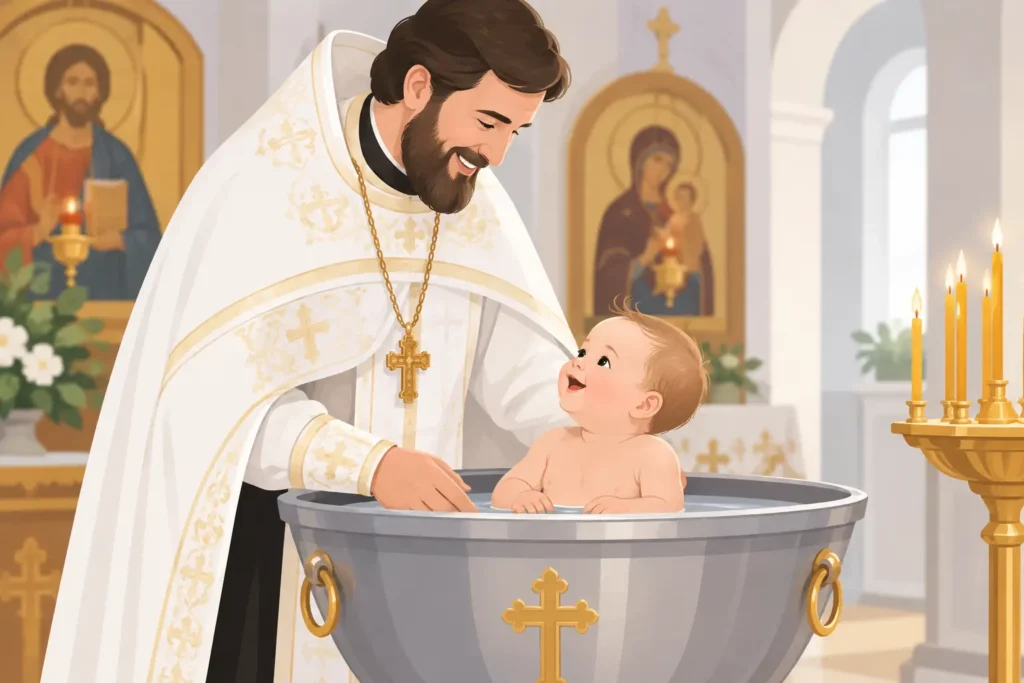
The priest blesses the water, anoints the child with oil, and immerses the child three times in the name of the Father, the Son, and the Holy Spirit. Immersion expresses burial and Resurrection with Christ. In settings where immersion is genuinely impossible, the Church may use another pastoral provision, but the normal Orthodox practice remains threefold immersion.
Immediately after baptism, the child receives Chrismation. The priest anoints the child with holy chrism, saying, “The seal of the gift of the Holy Spirit.” Baptism and Chrismation belong together: the child is born into Christ and sealed with the Holy Spirit.
Then comes a point many visitors find striking: the newly baptized infant receives Holy Communion. Orthodoxy does not separate a child from the Eucharistic life of the Church until the child can produce adult reasoning. If the child has been joined to Christ, he or she belongs at Christ’s Table with his or her parents. As the child grows, parents teach reverence, fasting as appropriate to age and pastoral guidance, confession, prayer, and a mature participation in the mysteries already given.
Parents Are Preparing for More Than a Service
Parents sometimes begin with practical questions: What should the baby wear? Who can be a godparent? How do we schedule the date? Those questions matter, but preparation must go further. A baptismal day without a baptismal life becomes a contradiction.
At least one parent should be prepared to raise the child actively in the Orthodox Church. That means regular participation in the Divine Liturgy, prayer in the home, instruction in the faith, and a family pattern shaped by repentance and forgiveness. No parent performs this perfectly. The point is not to present a flawless household. The point is to offer the child a real Christian home, where Christ is not mentioned only at major life events.
Parents should also speak candidly with the priest about their own spiritual situation. If the family is new to Orthodoxy, coming from another Christian tradition, or still learning the Church’s life, that is not a reason to hide. It is a reason to begin a deliberate path of formation. The Church receives people patiently, but she does not reduce baptism to a social custom.
Choosing a Godparent
A godparent is not an honorary parent or relative, a party host, or simply the person most likely to buy memorable gifts. A sponsor stands as a spiritual parent. He or she should be an Orthodox Christian in good standing, living the faith seriously enough to make the baptismal promises honestly.
The godparent’s role continues after the service. A faithful sponsor prays for the child, remembers the child’s name day and baptismal anniversary, encourages church life, and offers a steady Orthodox witness. Distance does not make this impossible, but it does require intention. A godparent who has no relationship with the Church cannot give what he or she does not possess.
Common Questions Families Ask
Does baptism guarantee a child will remain faithful?
Baptism is not magic, and it does not remove human freedom. A baptized child must still grow, struggle, repent, and learn to love God. The grace given in baptism is real, but it must be lived. This is why the Church calls parents and godparents to ongoing faithfulness rather than treating the sacrament as a completed obligation.
Should we wait until our child is older?
Families may delay for serious pastoral reasons, especially if they are still entering the Church or need instruction. But delaying solely so a child can make an independent decision later misunderstands the nature of baptism. Parents make weighty decisions for children every day: medical care, education, safety, and family life. Bringing a child to Christ is not less meaningful because the child receives it before fully understanding it. Understanding grows within the grace already received.
What if relatives do not understand infant baptism?
Speak with patience and clarity. Explain that Orthodox Christians baptize infants because salvation is God’s gift and because the Church has done so from her earliest centuries. Avoid turning a family gathering into a theological contest. At the same time, do not apologize for the Church’s faith. A child’s baptism is a joyful confession that Christ has conquered death and that this child belongs to Him.
The Work Begins After the White Garment
The white baptismal garment and candle are beautiful signs, but the most demanding part begins after everyone goes home. A child learns the faith by hearing prayers repeated, seeing parents ask forgiveness, standing near the icons, receiving blessings, keeping feast days, and knowing that Sunday worship is not optional entertainment but the center of Christian life.
Bring children to the services, even when they are restless. Teach them short prayers before expecting long attention. Read Scripture and lives of the saints in forms they can understand. Let them see that fasting, giving, confession, and forgiveness are not punishments imposed by the Church, but the medicine of life in Christ.
For families in the west Phoenix area who are preparing for baptism or seeking a serious Orthodox home, All Saints of North America Orthodox Church offers a deliberate path of pastoral preparation and continuing formation. The goal is not simply to arrange a date, but to help families enter a life that can sustain them for decades.
A baptized child needs more than a certificate and a memory. He or she needs a praying home, faithful adults, and a parish family that keeps pointing toward Christ. That holy work begins at the font, and by God’s mercy, it can shape an entire life.