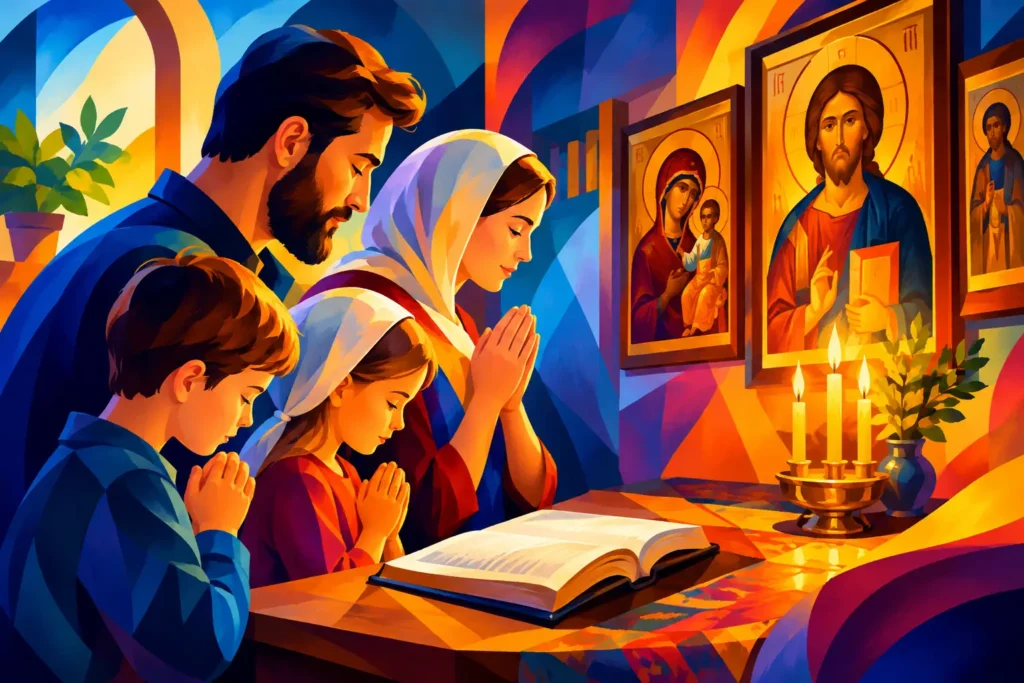
A child will learn what Christianity is long before he can explain the Nicene Creed. He learns it by watching his parents prepare for the Divine Liturgy, make the sign of the cross when bad news arrives, ask forgiveness after harsh words, and return to prayer when they have grown distracted. Orthodox family discipleship is not a religious add-on for exceptionally organized households. It is the patient work of becoming a Christian household under the life of the Church.
This work matters because children are being discipled already. Screens, peers, advertising, schools, fears, and ambitions all make claims on their imagination. The question is not whether a family has a formation plan. The question is whether that formation is intentional, truthful, and ordered toward communion with Christ.
Orthodox Family Discipleship Is Church Life at Home
The Orthodox home has often been called a little church. This does not mean the family replaces the parish, the priest, the sacraments, or the Divine Liturgy. It means that the grace received in the Church must be lived, guarded, and practiced around the family table, in the car, at bedtime, and when conflict exposes the heart.
A home becomes Christian not because every wall holds an icon or because every meal includes a long discussion of theology. Icons, prayer books, fasting foods, and holy water can serve a real purpose, but they are not magic decorations. The center is a family learning to repent, forgive, worship, and obey Christ together.
Parents should therefore resist two opposite errors. One error treats faith as a private preference, important perhaps, but easily displaced by sports, work, travel, or fatigue. The other turns the home into a pressure chamber where every failure becomes a spiritual crisis. Orthodox formation is serious, but it is not frantic. It joins clear expectations with patience, because children need both a firm path and the assurance that they are loved when they stumble.
Put the Divine Liturgy at the Center
The strongest practical decision a family can make is to protect Sunday worship. Children need to know that the Divine Liturgy is not one option among many weekend activities. It is the gathering of the Church before God. It is where they learn the rhythm of reverence, Scripture, beauty, repentance, thanksgiving, and communion.
This will require choices. A family may need to decline an early game, leave a Saturday event sooner, prepare clothes and meals the night before, or accept that young children will sometimes be noisy and restless. Do not let imperfect behavior convince you that bringing children is pointless. They are learning how to stand before God by standing with the faithful, even before they understand every word.
At the same time, parents should not expect small children to carry an adult level of attention. Bring them into the service with calm direction. Teach a short response, point out an icon, whisper a simple explanation, and correct them without public drama. As they grow, invite deeper participation: following readings, singing familiar hymns, helping prepare for confession, and learning why the feasts shape the year.
The parish is not a childcare provider while adults worship. It is the family’s spiritual home. Children need relationships with faithful adults beyond their parents, and parents need the support, correction, and encouragement of the wider Church.
Build a Rule of Prayer You Can Keep
A prayer rule for a family must be real enough to survive an ordinary Tuesday. If the household attempts an elaborate rule that collapses within a week, discouragement quickly takes over. Begin modestly and keep it faithfully.
Morning prayer may be as simple as gathering before the family leaves the house, making the sign of the cross, and praying the Trisagion prayers or a brief prayer for protection and mercy. At night, parents can lead thanksgiving, ask forgiveness, remember the departed, and pray for those who are suffering. A child who hears his parents pray for a difficult neighbor or a sick relative learns that prayer is not a performance. It is the Church’s living response to the world.
Use an icon corner if your home permits it. Keep it simple, visible, and cared for. Light a lamp or candle when appropriate and safe. Read a few verses from the Gospels. Mark feast days with a special meal, a hymn, or a story from the saint being commemorated. Small practices, repeated over years, become spiritual memory.
Consistency matters more than length. There are seasons when infants wake repeatedly, a parent works shifts, illness visits the home, or a teenager’s schedule creates real strain. In those times, do not abandon prayer because the ideal is impossible. Pray what you can, then return to a fuller rule when circumstances permit.
Let Parents Repent in Front of Their Children
No technique teaches the Gospel more clearly than a parent who asks forgiveness. When a father speaks cruelly, when a mother reacts in anger, when parents mishandle a conflict, their children see something decisive in what happens next. Excuses teach self-protection. Repentance teaches Christian freedom.
A plain sentence can change the atmosphere of a home: “I was wrong to speak that way. Please forgive me.” This does not weaken parental authority. It gives authority its proper shape. Parents are not pretending to be sinless rulers. They are leading their children toward Christ as people who themselves need mercy.
Children should also be taught to ask forgiveness without being shamed. Do not demand theatrical apologies. Help them name what happened, make amends where possible, and receive forgiveness. The goal is not behavior management alone. The goal is a heart that recognizes sin and turns back toward God.
Teach the Faith Through Ordinary Conversation
Formal instruction has an essential place. Children should learn the Scriptures, the Creed, the sacraments, the saints, the feasts, and the moral teaching of the Church. But family discipleship cannot be limited to a lesson once a week. The faith must become the language by which the family understands ordinary life.
When someone dies, speak truthfully about death, judgment, resurrection, and prayer for the departed. When a child sees injustice, talk about the image of God in every person. When anxiety rises, do not offer shallow reassurance. Teach them to bring fear to Christ. When entertainment presents a distorted vision of love, sexuality, courage, or success, name the distortion with moral clarity and without panic.
This requires parents to keep learning. A child’s question may expose an area where a parent is uncertain. There is no shame in saying, “I do not know, but we will find out.” What matters is that the question is not dismissed. Orthodox parents are called to hand on what they have received, and that requires a life of continued catechesis, Scripture, prayer, and attention to the Church’s teaching.
Practice Fasting and Feasting as a Family
The fasting calendar teaches that appetite is not our master. The feasts teach that creation is good, joy is holy, and salvation has entered history. Both belong in the home.
Families should keep the fasts according to the blessing and guidance appropriate to their circumstances. Young children, pregnant or nursing mothers, people with medical needs, and those new to Orthodox practice may not keep the same rule. Fasting should never become a contest of spiritual toughness or a source of fear around food. Yet parents should not use children’s preferences as a reason to teach nothing at all. Even a small adjustment in meals, a simpler dessert, or an act of generosity can help a child understand that the Church has a rhythm.
Feasts deserve attention too. Make Pascha feel different from an ordinary Sunday. Tell the stories of Nativity and Theophany. Learn the troparia. Welcome friends, share food, give thanks, and let joy be unmistakable. Children need to see that Orthodox Christianity is not a grim refusal of pleasure. It is the transformation of life into thanksgiving.
Do Not Outsource What Belongs to Parents
A parish class, youth gathering, camp, or online lesson can bless a child greatly. None of these can replace the spiritual witness of parents. If children hear about Christ at church but never see prayer, forgiveness, generosity, and reverence at home, they will recognize the contradiction.
This does not mean parents must become lecturers or recreate a seminary curriculum at the kitchen table. It means they must take responsibility for the spiritual atmosphere they create. The home should be a place where truth can be spoken, where sin is neither celebrated nor hidden, where questions are welcomed, and where no one must earn love by appearing spiritually impressive.
For families in the west Phoenix area, a serious parish life provides needed strength for this task. At All Saints of North America Orthodox Church, parents and children can receive the same deep formation through worship, catechesis, confession, and a community ordered around Christ rather than convenience.
The household will not become holy through one perfect routine. It becomes holy through thousands of small returns: returning to the Liturgy, returning to prayer, returning to forgiveness, returning to the truth when the world offers a cheaper story. Start with the next faithful thing your family can do, and do it together before God.