Many Christians who are Protestants first encounter Orthodox Christians, and Orthodoxy, with a mixture of recognition and alarm. The prayers sound ancient, the worship is visibly reverent, and the Church speaks with a confidence that can feel unfamiliar after years of competing interpretations. Orthodox answers for Protestants begin by taking those questions seriously. They do not ask anyone to abandon Scripture or faith in Jesus Christ. They ask whether the faith received from the apostles is larger, more concrete, and more unified than many of us have been taught to expect.
The Orthodox Church does not present herself as a new option in the Christian marketplace. She confesses that she is the one, holy, catholic, and apostolic Church proclaimed in the Creed: the Church that received the Gospel, preserved it, worshiped Christ, baptized believers, and handed down the faith through the centuries.
Orthodox Answers for Protestants Begin With the Church
A common Protestant question is simple: “Where is this in the Bible?” It is a good question, provided we also ask another: “Who gave us the Bible, and how has the Church understood it?”
Orthodoxy reveres Holy Scripture as the inspired word of God. The Gospel is read aloud in the Divine Liturgy. The Psalms saturate the Church’s prayers. The Old Testament is not treated as a collection of discarded religious documents, but as the preparation for Christ. Orthodox Christians are not asked to choose between the Bible and the Church.
Rather, Scripture belongs within Holy Tradition. Tradition does not mean human customs added alongside God’s word. It is the living transmission of the apostolic faith: the preaching of the apostles, the worship of the Church, the decisions of the councils, the witness of the saints, and the right reading of Scripture within the communion that received it.
The New Testament itself points to this reality. Christians are told to hold fast to what was delivered to them both by word and by letter. Before there was a completed New Testament canon, the Church was already preaching, baptizing, celebrating the Eucharist, and guarding the faith against error. The Bible is not less authoritative because it is read in the Church. It is protected from becoming a book that says whatever each reader needs it to say.
Salvation Is More Than a Legal Declaration
Many evangelicals have been taught to frame salvation mainly in terms of guilt and acquittal: humanity has broken God’s law, Christ bears the penalty, and believers are declared righteous by faith. Orthodoxy certainly confesses that Christ died for our sins, that forgiveness is real, and that no one can save himself by moral effort.
But the Orthodox Church speaks of salvation with the fuller language of Scripture. Christ came not only to cancel a debt but to destroy death, heal human nature, defeat the devil, forgive sins, and unite mankind to God. Salvation is communion with the living God. It is forgiveness, but it is also transformation.
This is why Orthodox Christians speak of repentance as a lifelong turning of the heart, prayer as communion rather than mere duty, and the sacraments as God’s appointed means of grace. We are saved by grace. We respond in faith. That faith must become living, obedient, and fruitful, because a faith that never changes the life is not the faith described by the apostles.
This is not a denial of assurance in Christ. Our confidence rests in His mercy, His resurrection, and His faithfulness. Yet Orthodox Christians resist reducing salvation to a past decision detached from the ongoing work of repentance. We do not merely receive a new status. In Christ, we are being made new.
Why Orthodox Christians Baptize Infants
For many Protestants, infant baptism is among the first serious objections. If faith is personal, why baptize a child who cannot yet make a confession?
The Church baptizes infants because baptism is first God’s gift before it is our testimony. In baptism we are united to Christ’s death and resurrection, receive forgiveness, enter the covenant people of God, and are clothed with Christ. The child is not excluded from God’s mercy because he cannot yet explain it.
This is consistent with the biblical pattern of household faith and with the Old Covenant, where children were received into the covenant community. Of course, a baptized child must later grow into a conscious and faithful life in Christ. Parents and godparents bear a serious responsibility. Baptism is not magic, nor is it a social ceremony. It is the beginning of a life that must be nourished through worship, prayer, confession, fasting, and participation in the Eucharist.
Mary and the Saints Do Not Compete With Christ
Questions about Mary, icons, and the saints often arise from a proper desire to protect the unique glory of Jesus Christ. Orthodox Christians share that desire without reservation. Jesus Christ alone is the incarnate Son of God, the Savior of the world, and the one Mediator who reconciles God and man.
The Church honors the Virgin Mary because of who her Son is. Calling her Theotokos, or God-bearer, does not make Mary divine. It protects the truth that the One born of her is truly God in the flesh. To honor the mother of the Lord is to confess rightly the identity of the Lord.
Likewise, asking the saints to pray is not worshiping them or treating them as replacements for Christ. Christians ask one another for prayer because Christ has made His people one body. Death does not remove the faithful from Christ’s body. The saints are alive in Him, and the Church honors them as witnesses to His grace.
The same distinction matters for icons. An icon is not a god and is not a magical object. It is a Christian confession that the invisible God truly became visible in Jesus Christ. Because the Word took flesh, Christians may depict Christ according to His humanity. Honor offered before an icon passes to the person represented, not to wood and paint.
The Eucharist Is the Center of Christian Worship
Protestant visitors often notice that Orthodox worship does not feel like a sermon-centered service with music added around it. The Divine Liturgy is the worshiping Church gathered around the risen Christ, hearing His word and receiving His Body and Blood.
Orthodoxy takes Christ’s words at the Last Supper seriously: “This is My Body” and “This is My Blood.” The Eucharist is not merely a mental reminder. It is a true participation in Christ, given for the life of the world. The Church does not try to explain this mystery with philosophical precision beyond what has been handed down. She receives it with fear of God, faith, and love.
The sermon matters. Biblical teaching matters. Clear preaching against sin and for holy living matters. But Christian worship cannot be reduced to instruction. The Church gathers to offer thanksgiving, confess the faith, intercede for the world, and commune with the Lord who is present among His people.
A Careful Path for the Protestant Inquirer
No one should become Orthodox merely because ancient worship feels compelling or because modern Protestantism feels unstable. Conversion requires truthfulness, patience, and a willingness to be taught. Some questions take time. Some Protestant assumptions must be examined carefully. Some people need to heal from real wounds inflicted by churches or religious leaders.
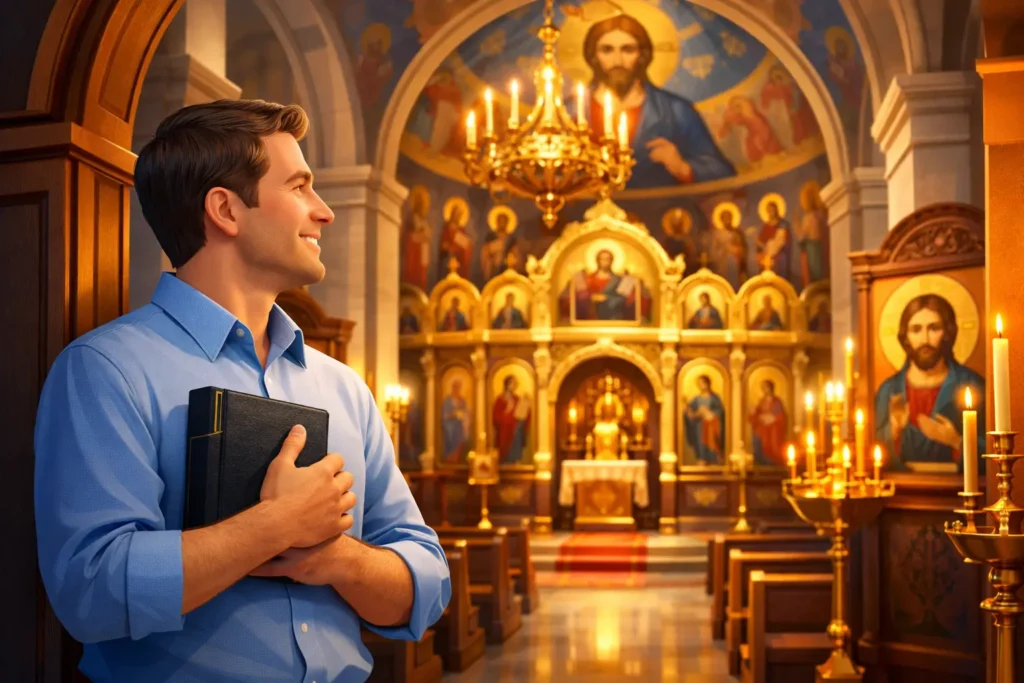
Begin by attending the Divine Liturgy regularly. Listen before attempting to judge every phrase. Read the Gospels and Acts with the question of the Church in mind. Learn the Creed. Speak openly with a priest about your background, convictions, marriage, baptism, and concerns. Do not pretend agreement where you have not yet reached it, but do not assume that a first objection is a final answer.
For those in the west valley of Phoenix, All Saints of North America Orthodox Church offers a serious place to ask these questions, receive instruction, and encounter the Church’s worshiping life. The path into Orthodoxy is not rushed. It is a return to Christ in the communion of His Church.
Come with your Bible open, your questions honestly stated, and your heart prepared to follow the truth wherever Christ leads. The Church does not offer a private spiritual preference. She offers the life of repentance, worship, and communion that the Lord has entrusted to His people.