A great many people begin asking about Orthodoxy after they have already grown tired of religious novelty. They are not looking for a spiritual product. They want the truth, the worship of God, and a Church that knows what she teaches. If that is where you are, an Orthodox catechism for beginners is not a sales pitch or a quick class. It is the Church’s patient way of forming a person to believe, pray, repent, and live as an Orthodox Christian.
Some people come from evangelical churches and feel exhausted by doctrinal instability. Others come from Roman Catholic backgrounds with sincere questions about authority, tradition, and the shape of the ancient Church. Others have no church background at all, but they can see that modern life has not made the soul whole. In each case, catechism begins in the same place – with the call to turn toward Christ and enter the life of His Church.
What an Orthodox catechism for beginners really is
Catechism is not merely information transfer. It includes teaching, but it is more than a course of study. In the Orthodox Church, catechism is formation. A beginner learns the faith with the mind, but also with the body, the heart, and the habits of daily life.
That matters because Orthodoxy does not separate doctrine from worship. What the Church teaches is what she prays. What she prays is what she lives. A person preparing for baptism or chrismation is not simply memorizing correct answers. He is learning how to stand in prayer, how to repent, how to hear Scripture within the Church, and how to submit his life to Christ.
This is why a serious catechism usually takes time. A rushed process may satisfy curiosity, but it does not always build stability. Some people are ready to move more quickly because they already have strong Christian formation and have spent time studying the Church. Others need to proceed more slowly, especially if they are untangling years of confusion, church hurt, or moral compromise. Both situations require pastoral discernment.
What beginners usually learn first
An Orthodox catechism for beginners typically starts with the most basic realities of the faith. Who is God? Who is Jesus Christ? What is the Holy Trinity? What is the Church? Why do sin, death, and salvation mean something different in Orthodoxy than they are often described in modern Western Christianity?
From there, instruction usually expands into the shape of Orthodox life. A beginner learns why the Church venerates the saints, why icons matter, why the sacraments are not optional symbols, and why liturgical worship stands at the center of Christian existence. He learns that the Bible is honored as the word of God within the living tradition of the Church, not treated as a private text for self-directed interpretation.
This can feel both clarifying and demanding. Clarifying, because Orthodoxy presents a coherent faith rather than a shifting collection of personal opinions. Demanding, because the Church speaks with authority. She does not ask each person to invent his own Christianity.
Orthodox catechism for beginners and the life of worship
One common mistake is to think catechism happens only in a classroom. In truth, the temple teaches. The services teach. The fasts teach. The prayers teach. A person can read many books and still misunderstand Orthodoxy if he never begins to attend the services faithfully.
This is why beginners are usually encouraged to worship regularly while they are learning. Vespers, Matins, and the Divine Liturgy are not background atmosphere for an educational program. They are part of the education itself. In the services, a newcomer starts to hear the language of repentance, holiness, mercy, judgment, resurrection, and the kingdom of God in the Church’s own voice.
There is a trade-off here that honest pastors should acknowledge. At first, Orthodox worship can feel unfamiliar, even overwhelming. The services are full of Scripture, symbolism, and reverence that modern Americans are not used to. Yet that very strangeness is often part of the healing. It reminds the seeker that he is not entering a consumer environment built around his preferences. He is entering the worship of the living God.
What catechism asks of you
Beginners sometimes ask what they need to do before formally becoming Orthodox. The answer depends in part on their background, but several commitments are nearly always present.
First, there must be regular consistent attendance. A person cannot be formed by the life of the Church while remaining distant from it. Second, there must be teachability. Catechism only bears fruit where there is humility. Third, there must be moral seriousness. Orthodoxy is merciful toward sinners, but it is not casual about sin.
This means practical change. A catechumen should begin developing a prayer rule under guidance, reading Scripture seriously, and learning the discipline of confession and repentance. If a person is living in open contradiction to Christian teaching, that must be addressed honestly. The point is not to create an impossible standard before someone is received into the Church. The point is that conversion is real. Christ receives us as we are, but He does not leave us as we are.
Questions beginners often carry
Many inquirers want to know whether they must agree with everything immediately. Usually, the better way to put it is this: are you willing to be taught by the Church? Complete understanding often comes gradually. Stubborn resistance is different from sincere struggle.
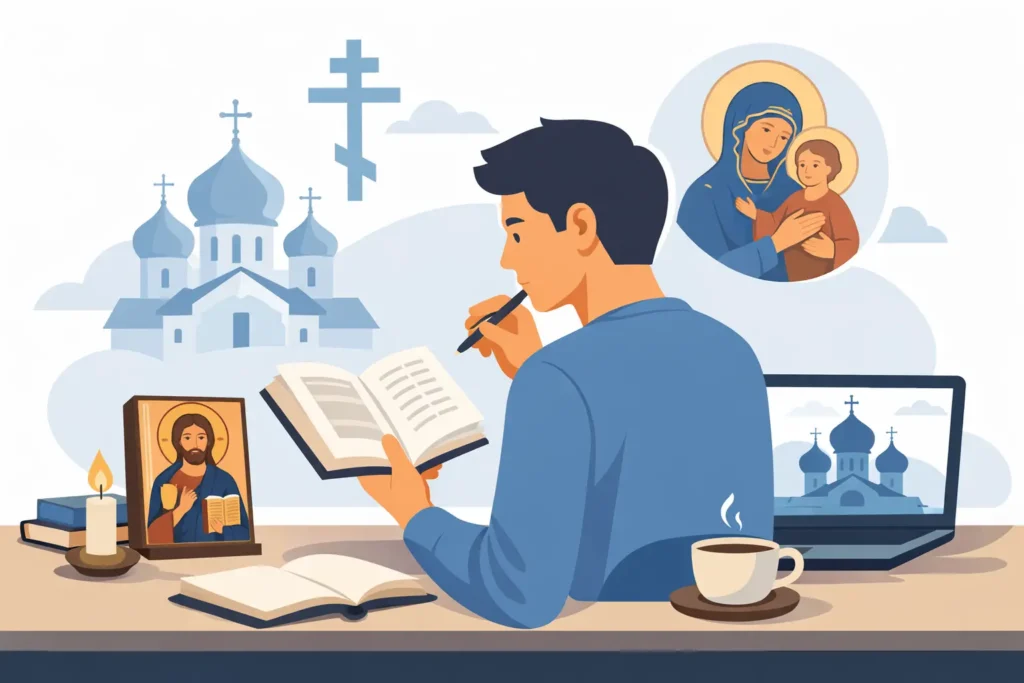
Others ask whether they should keep reading on their own. Certainly, but reading should support catechism, not replace it. Books are useful. Audio lectures can help. Online lessons can clarify major themes. But Orthodoxy is learned best under pastoral care, in a real parish, among real people, with real accountability.
Another common concern is family life. What if one spouse is ready and the other is hesitant? What if children are involved? Here again, there is no single formula. The Church does not treat souls like identical cases. Patience may be needed. So may courage. A priest’s guidance is indispensable when family questions become complicated.
How to know if a parish takes catechism seriously
Not every church environment treats formation with the same depth. A serious Orthodox parish will not pressure people emotionally, nor will it reduce conversion to a casual handshake and a reading list. It will provide real teaching, clear expectations, and access to clergy who can answer questions with doctrinal confidence.
That structure matters. A beginner needs more than warm feelings. He needs a place where the faith is taught fully, where worship is offered reverently, and where the path from inquiry to catechumen to Orthodox Christian is actually defined. For many families in the western Phoenix area, especially in places like Surprise, Peoria, Glendale, Buckeye, Litchfield Park, and Waddell, that kind of steady guidance is not a luxury. It is often the difference between drifting and finally putting down spiritual roots.
If you are searching for that path, All Saints of North America Orthodox Church exists to offer it with seriousness and hospitality. Welcome Home.
A realistic beginning
If you are new, do not wait until every question is solved before taking your first step. Come to the services. Listen carefully. Speak with the priest. Begin learning in the place where the faith is actually lived. Orthodoxy makes sense from the inside out.
You should also expect catechism to expose things in you that need healing. That is not failure. That is part of conversion. Some beginners discover intellectual pride. Others discover fear, instability, or a long habit of treating religion as self-expression. The Church addresses all of this, not by flattering the ego, but by bringing the person into communion with Christ.
A true catechism is gentle, but it is not soft. It is patient, but it is not vague. It is welcoming, but it is ordered toward baptism, chrismation, confession, communion, and a life of enduring faithfulness. If you are ready for more than religious sampling, then begin where the Church begins – with prayer, worship, repentance, and the humility to be taught.