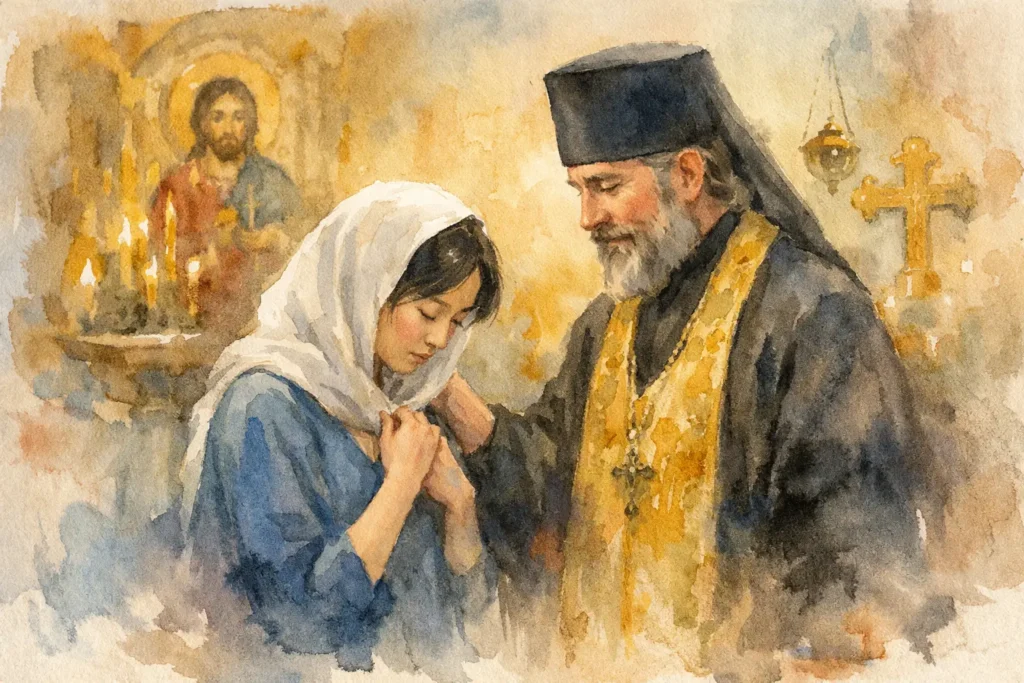
A great many Christians ask, often with real sincerity, why do Orthodox confess to priests if God already knows every sin and hears every prayer. That question is not a small one. It touches repentance, authority, healing, and what the Church believes she is.
Orthodox Christians do not confess to a priest because God is hard to reach. We confess to a priest because Christ established a visible Church, gave real pastoral authority to His apostles, and made repentance something spoken, concrete, and accountable. In Orthodoxy, confession is not a private coping exercise. It is a return to communion with God in the life of His Church.
Why do Orthodox confess to priests in the first place?
The short answer is that confession is both biblical and ecclesial. After His resurrection, Christ breathed on His apostles and gave them authority concerning the forgiveness and retention of sins. The Church has never treated those words as symbolic only. She has understood them as part of Christ’s gift of pastoral ministry.
That does not mean the priest replaces God. He does not. The priest is a witness, a pastor, and a steward of what belongs to Christ. Orthodox prayers before confession say this plainly. The penitent stands before the Lord, confessing to God, while the priest listens, counsels, and pronounces the Church’s prayer of absolution.
This matters because sin is never merely private. Even the hidden sin of one person wounds the soul, damages relationships, and distorts life in the Body of Christ. If sin has a church dimension, repentance does too. Confession is therefore not only about inner relief. It is about restoration.
Confession is not a legal loophole
Many modern people assume confession must be either unnecessary or mechanical. Either you speak directly to God, or you tell your faults to a clergyman to get them erased. Orthodoxy rejects both ideas.
Confession is not a loophole that lets someone sin all week and reset his conscience on demand. It is also not a courtroom transaction where the priest acts like a religious notary. It is medicine for a wounded soul. The Orthodox Church often speaks of sin less as a broken rule in the abstract and more as a sickness that needs healing. That is why serious repentance includes honesty, sorrow, a desire to change, and the willingness to accept spiritual guidance.
This medical image helps many inquirers. A person can admit to being sick in general terms, but real healing usually begins when the illness is named plainly. Confession works in that way. What is hidden tends to grow stronger. What is brought into the light can begin to be healed.
The biblical foundation for confessing to a priest
When people ask why do Orthodox confess to priests, they are often really asking whether Scripture supports the practice. Orthodox Christians answer yes.
Christ gave authority to His apostles regarding sins. The New Testament also speaks of confessing sins and of the ministry of reconciliation entrusted to the Church. The apostolic ministry was not an invisible idea. It took shape in real shepherds who taught, corrected, bound, and loosed.
From the earliest life of the Church, repentance was not treated as a purely individual affair detached from pastoral oversight. The bishop and presbyters had responsibility for guarding the flock and helping restore the fallen. Over time, the form became more regular and more private, but the basic conviction remained the same. Christ works through His ministers in the Church He founded.
That continuity matters in Orthodoxy. The question is not simply, “Can I tell God I am sorry by myself?” Of course one should repent in private prayer every day. The deeper question is whether Christ gave His Church any concrete role in reconciling sinners. Orthodoxy says He did.
What the priest is actually doing
One reason some hesitate is that they misunderstand the priest’s role. He is not a spiritual substitute for Christ. He is not receiving worship. He is not acting as though forgiveness originates in his personality or private power.
He stands as the Church’s ordained pastor. He hears the confession that is made before God. He helps the penitent speak truth without excuse or vagueness. He may ask careful questions, not from curiosity, but from pastoral concern. He may offer counsel, assign prayers or disciplines, or urge someone toward a change that has been avoided for too long.
In this sense, confession is personal in the best way. Most of us are experts at self-justification. We rename pride as principle, lust as weakness, anger as stress, and neglect as busyness. A wise confessor helps strip away those disguises. That is often uncomfortable, but it is merciful.
This is also why Orthodox Christians normally confess to their own priest or spiritual father when possible. Confession is not random religious disclosure. It is part of an ongoing pastoral relationship.
Why private confession to God is not enough by itself
Orthodoxy absolutely teaches private repentance. Every Christian should confess sins to God in daily prayer. We ask mercy constantly. We examine ourselves. We repent with tears when God grants them.
But private confession alone has limits. Left to ourselves, we tend to hide from the very sins that most need healing. We minimize them, reinterpret them, or postpone dealing with them. Spoken confession before a priest forces a kind of honesty that private thought often avoids.
It also gives something many people do not realize they need – assurance. A burdened conscience does not always quiet down just because a person prayed alone. In confession, the penitent hears the Church’s prayer of forgiveness and is restored openly, though privately, within the life of the Body. That is not psychology replacing grace. It is grace working through an embodied, sacramental life.
There are also cases where a person needs direction, not just relief. Some sins are entangled with habits, wounds, family patterns, addictions, or long-term confusion. The priest does not function as a therapist, though pastoral counsel can be deeply healing. He helps the Christian repent concretely and remain within the path of salvation.
Why do Orthodox confess to priests instead of to God alone?
Because Orthodoxy does not separate Christ from His Church. To say “I only need Jesus, not the ministry He established” sounds spiritual to modern ears, but it is not the mind of the ancient Church.
God certainly hears the cry of any repentant sinner. No Orthodox priest would deny that. Yet the same Lord who hears private prayer also established shepherds for His flock. He gave sacraments, not just ideas. He gave a Church, not just isolated spiritual experiences.
This is one place where modern individualism collides with historic Christianity. Many people want forgiveness without submission, healing without exposure, and spiritual comfort without accountability. Confession refuses that pattern. It teaches humility. It requires truthfulness. It restores us not only inwardly, but ecclesially.
For converts and inquirers, this can be one of the hardest practices to accept. It can also become one of the most freeing. The humility that first feels painful often becomes the doorway to peace.
What confession looks like in Orthodox life
In healthy Orthodox parish life, confession is regular, serious, and pastoral. It is not meant to produce scrupulosity, nor is it meant to be neglected for months or years. Frequency can vary depending on a person’s spiritual condition, season of life, and the guidance of his priest.
Some need frequent confession because they are battling long-standing passions or are early in learning repentance. Others may confess less often, but still steadily, with sobriety and preparation. There is no virtue in treating confession casually, and there is no virtue in turning it into panic-driven self-analysis either. The right path is honest repentance under guidance.
Those preparing to become Orthodox often find that confession helps them understand the Church’s vision of salvation. Salvation is not merely being declared safe while remaining inwardly unchanged. It is a life of repentance, communion, and transformation in Christ.
For those seeking a serious Orthodox parish home in the west valley, including communities such as Surprise, Peoria, and Glendale, this is one of the reasons clear pastoral guidance matters. People do not simply need religious content. They need real shepherding.
Confession can feel difficult at first. That is normal. Shame resists exposure. Pride resists correction. Fear resists surrender. Yet Christ meets people precisely there. He does not humiliate the repentant. He heals them.
If you are asking this question because you are exploring Orthodoxy, do not treat confession as an odd custom from another era. See it for what it is – one of the Church’s great mercies. God does not leave us alone with our sin, our evasions, or our wounded conscience. He calls us into the light, and in that light, there is peace.