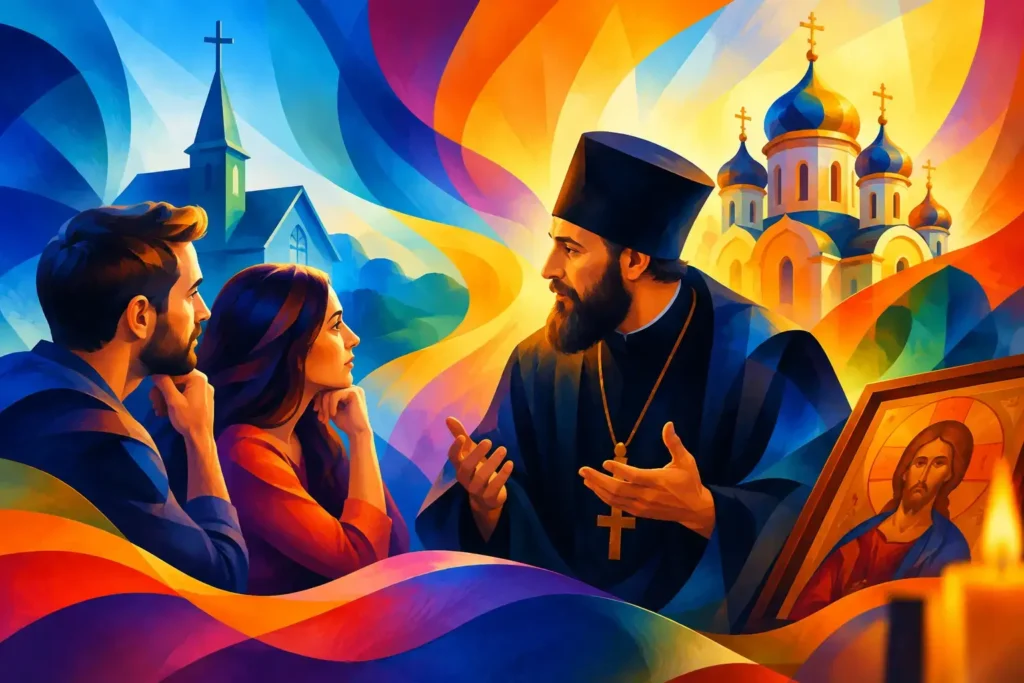
A family’s first Liturgy often reveals what a conversion story cannot fit into a testimony. A child grows tired before the homily. A parent does not know when to stand. Someone wonders whether the icons are being understood correctly. Yet beneath the unfamiliarity, many families recognize something they have been seeking for years: worship that does not depend on their preferences, doctrine that does not change with the moment, and a life in Christ large enough to form a household.
Orthodox family conversion stories are not merely accounts of leaving one religious setting for another. At their best, they tell of people submitting their lives to the Church Christ established, receiving the apostolic faith, and learning that salvation is not a private project. A family may enter the Church together, but each person must still learn repentance, prayer, patience, and faithfulness.
Why Families Start Looking for Orthodoxy
Many parents begin with a concern they cannot dismiss. They want to give their children more than a set of values, a weekly lesson, or a religious identity built around personal preference. They want their children to know the living God, to recognize sin for what it is, and to belong to a people whose faith did not begin with the latest religious trend.
Others arrive after years of doctrinal instability. They have watched churches divide over basic Christian moral teaching, reduce worship to performance, or treat the Bible as raw material for competing private interpretations. Some come from evangelical backgrounds marked by sincere love for Scripture but little agreement about who has authority to interpret it. Roman Catholics may seek a fuller encounter with the Orthodox understanding of conciliarity, sacramental life, and the undivided Church. People from no Christian background often find that Orthodoxy answers a hunger they did not yet have words to name.
The initial reasons differ, but the deeper question is often the same: where can our family be formed in the fullness of the Christian faith?
The Story Is Usually Slower Than It Sounds
Conversion stories can make a long journey sound sudden. Someone says, “We found Orthodoxy and knew we were home.” That recognition may be real, but it is not the whole story. A household still needs time to test its assumptions, ask difficult questions, learn the rhythm of the Church year, and discern whether it is willing to receive rather than revise the faith.
This is why serious catechism matters. The Orthodox Church does not ask people to make an emotional decision after one beautiful service. She calls them to learn what she teaches about the Holy Trinity, Christ, the Scriptures, the saints, the sacraments, salvation, marriage, confession, fasting, and the life to come. Clarity is a form of mercy. It keeps people from mistaking aesthetic attraction for conversion.
For families, the pace may need special care. Parents should not use their children as proof that they have found the right church, nor should they demand instant enthusiasm from them. Children often need time to understand why worship is longer, why the calendar matters, and why the family’s habits are changing. Their questions deserve honest answers, not pressure.
A shared decision does not erase individual journeys
In some households, one spouse reaches conviction first. In others, teenagers are eager while parents are cautious. Occasionally, a family comes to church together while one member remains unconvinced. These situations require patience and truthfulness.
No one should be manipulated into conversion to preserve appearances. The Church calls for a free and faithful response to Christ. At the same time, the person who is ready should not hide his conviction simply because the rest of the family needs more time. A wise priest can help a household move without coercion, resentment, or secrecy.
What Changes After Baptism or Chrismation
The beginning of sacramental life is not the finish line of a family conversion story. Baptism and chrismation unite a person to Christ and His Church. They also begin the lifelong work of living what has been received.
This is where many moving testimonies become ordinary, demanding, and beautiful. A family learns to make room for prayer even when mornings are rushed. They learn that fasting requires planning, especially with children and work schedules. They begin to measure Sunday not as one more activity but as the Lord’s Day, ordered around the Divine Liturgy. They discover that confession is not a punishment for failures but a medicine for the soul.
None of this means a newly Orthodox family becomes instantly peaceful or spiritually impressive. They may argue on the way to church. They may struggle to establish a prayer rule. They may find that their old habits of individualism follow them into parish life. The cure is not pretending. It is returning again and again to repentance, worship, counsel, and the sacraments.
Children learn Orthodoxy by inhabiting it
Parents understandably want to teach the faith well. Catechism at home, Scripture reading, saint stories, and age-appropriate instruction all have their place. But children also learn through what they see repeated with love.
They learn when they see their parents ask forgiveness. They learn when a feast day changes the texture of the home, when an icon corner is used rather than displayed, and when the family comes to Liturgy even when it would be easier to stay in bed. They learn that fasting is not a grim diet and that feasting is not mindless indulgence. They learn that the Church is not an optional supplement to family life. It is the family’s true home.
This does not require parents to create a flawless miniature monastery. It requires consistency, humility, and a willingness to begin again. A short daily prayer said faithfully can form children more deeply than an ambitious rule abandoned after two weeks.
The Trade-Offs Are Real
Orthodoxy asks something of a family. It gives no permission to construct a custom-made Christianity around convenience, political identity, or personal taste. The calendar will interrupt familiar routines. Moral teaching may place a family at odds with surrounding culture. Fasting, confession, and regular worship will expose the difference between admiring the faith and living it.
There can also be relational costs. Relatives may misunderstand the use of icons, prayers to the saints, or the veneration shown to the Mother of God. Friends from a former church may interpret a family’s decision as rejection. Children may feel different from their peers. These burdens should not be minimized.
Yet a family need not answer every objection with an argument. Over time, a steady life of Christian love speaks clearly. The goal is not to win a debate with grandparents or former pastors. The goal is to remain faithful without contempt, to explain the faith with confidence, and to honor others without surrendering the truth.
Orthodox Family Conversion Stories Need a Parish
A family cannot carry the weight of conversion alone. The Church is not a set of online lessons, however valuable those lessons may be. It is a Eucharistic people gathered around Christ, with bishops, priests, godparents, fellow strugglers, and the communion of saints.
A healthy parish gives newcomers room to learn without leaving them anonymous. It offers serious instruction before reception into the Church and continued formation afterward. This post-baptism formation, often called mystagogy, matters because the mysteries of the faith open more deeply as they are lived. New Orthodox Christians need help learning how to confess, fast, pray, serve, endure temptation, and grow in discernment.
For families on the west side of Phoenix, All Saints of North America Orthodox Church seeks to offer that kind of rooted parish life: reverent worship, clear catechesis, pastoral guidance, and a real path from inquiry to mature participation in the Church.
A Better Question Than “Is Orthodoxy Right for Us?”
The first question is not whether Orthodoxy fits neatly into a family’s present life. The better question is whether this is the Church of Christ, faithful to the apostolic faith once delivered to the saints. If it is, then the task is not to make Orthodoxy conform to us. The task is to ask Christ to conform us to Him.
That question deserves time, study, prayer, and pastoral conversation. Visit the services. Listen carefully. Ask the questions you have been carrying. Do not rush toward a dramatic story, and do not fear a slow beginning. The Lord often builds a Christian home through small acts of faithfulness: showing up, learning to pray, asking forgiveness, and returning to the chalice with gratitude.