At your first visit to an Orthodox church, the question of how to enter church can feel larger than finding the right door. You may wonder when to arrive, whether you should light a candle, what everyone is doing with their hands, or whether you belong if you are not Orthodox. Take heart: you are welcome to come, pray, watch, and learn. No one expects a first-time visitor to know every custom.
Orthodox worship is not designed as a performance for an audience. It is the worship of the Church before the living God. That can feel unfamiliar, especially if you come from an evangelical, Roman Catholic, Mormon, Muslim, or nonreligious background. Yet the first step is wonderfully simple: enter quietly, stand with reverence, and allow the service to teach you.
How to Enter Church for Your First Visit to an Orthodox Church
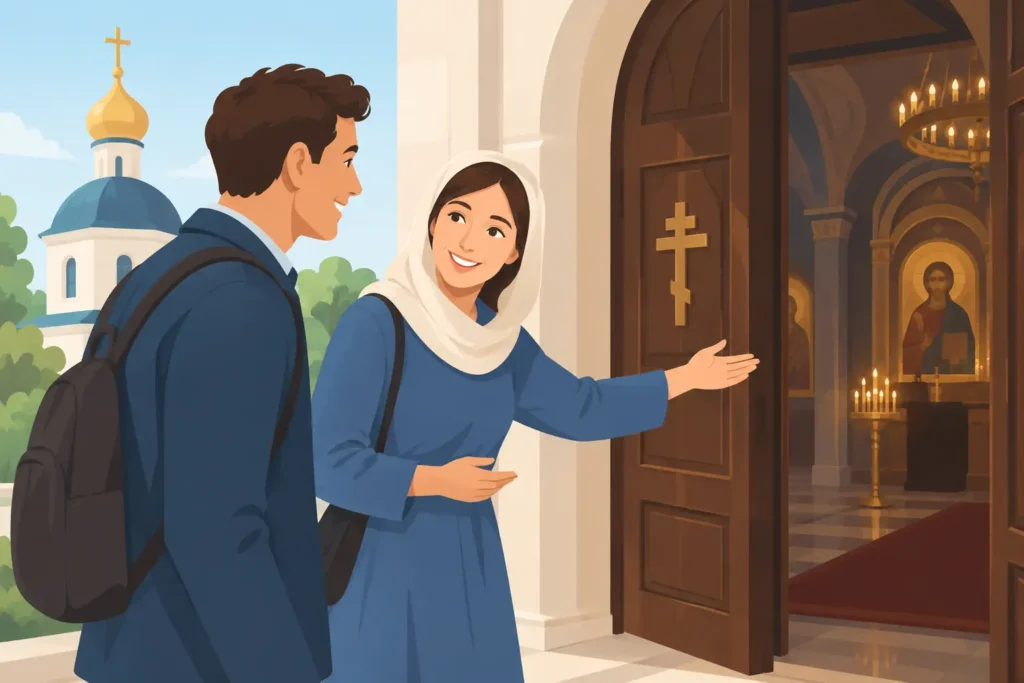
Arrive ten to fifteen minutes before the service if you can. This gives you time to park, find the entrance, settle your family, and enter without the pressure of rushing. At many Orthodox parishes, the main doors lead into a vestibule or narthex before the nave, the main worship space. Greeters or parishioners may welcome you, but do not worry if the building is already quiet and people are praying.
Dress modestly and respectfully. You do not need to purchase special clothing or imitate everyone around you. Clean, modest everyday clothes are appropriate. Some women choose to cover their heads, while others do not. Some men wear jackets; others do not. A visitor is not judged by whether he or she knows every local custom. Come prepared to meet God, not to pass a social test.
When you enter the worship space, take a moment to be still. Orthodox Christians often make the sign of the cross, bow, or venerate icons. These actions express faith in Christ and belong to the Church’s life of prayer. You are welcome to observe them without copying them. If you wish to make the sign of the cross, Orthodox Christians generally touch forehead, chest, right shoulder, then left shoulder. But it is better to stand attentively than to imitate gestures you do not yet understand.
Many churches have a candle stand near the entrance. Lighting a candle is a quiet offering of prayer, often for the living or departed. It is not required. You may light one if you wish, but you may also simply enter, find a place to stand or sit, and pray: “Lord Jesus Christ, have mercy on me.”
What to Do During the Service on your first visit
Orthodox services involve standing, singing, Scripture, incense, processions, and periods of silence. You will hear prayers addressed to the Father, through the Son, in the Holy Spirit. You will see icons, not as decorations, but as witnesses to the reality that Christ became man, sanctified human nature, and joined His people into one heavenly and earthly worship.
Do not be anxious about keeping up. Service books, screens, or handouts may be available, but you do not need to follow every word on your first visit. Listen for the repeated prayers. Let the Psalms, hymns, and Gospel readings work on you. Orthodox worship asks for attention, but it does not demand instant expertise.
Standing is customary because the Church worships the risen Christ. Still, sit when needed. Parents may need to step out with a child. Those with injuries, illness, or limited mobility should sit without embarrassment. Reverence does not mean pretending to be stronger than you are.
During the Divine Liturgy, visitors who are not Orthodox should not receive Holy Communion. This is not a rejection of guests. Holy Communion is the sacramental expression of full unity in the Orthodox faith and life, after preparation, confession, and the blessing of a priest. To receive it before that unity exists would say something with the body that has not yet become true in faith.
If bread is offered after the service, often called blessed bread or antidoron, visitors may usually receive it. Practices can vary, so simply ask someone nearby if you are unsure. The same principle applies throughout your visit: a humble question is always better than quiet anxiety.
Do You Need to Know the Rules Before You Come?
No. You do not need to complete catechism, have your life in perfect order, or settle every theological question before walking through the doors. Christ calls sinners, seekers, the wounded, and the doubtful. The Church does not lower the truth to make it easier to enter, but she receives people patiently so they may be healed by that truth.
There are, however, a few practices worth honoring. Keep conversation low inside the worship space. Silence your phone. Avoid walking around unnecessarily during Gospel readings, sermons, processions, or the Eucharistic prayers. If you arrive late, enter discreetly and follow the lead of those around you. If a priest is available afterward, introduce yourself and tell him plainly that you are visiting.
Children are welcome in Orthodox worship. They may be noisy, restless, or tired. That is part of parish life, not an interruption to it. Parents should guide their children with love and patience, but no family should believe they must wait for perfectly behaved children before coming to church.
Entering the Orthodox Church Is More Than Attending
A first visit is an honest beginning, but entering the Church in the fullest sense means receiving the Orthodox faith and being joined to the Body of Christ. This is not a consumer choice or a quick change of religious labels. It is a conversion of mind, heart, habits, and loyalties.
For someone already baptized outside Orthodoxy, the path may involve a period of inquiry and catechism, followed by reception into the Church in the manner the bishop and priest determine. For someone not baptized, the ordinary path is catechumenate, baptism, chrismation, and first Communion. The process takes time because the Church is not merely adding names to a list. She is forming disciples who can confess the apostolic faith, pray, repent, and live faithfully within a parish.
This patient process can be difficult for people accustomed to immediate decisions. Yet it is a mercy. Serious questions deserve serious answers. If you are leaving behind a Protestant, Roman Catholic, Mormon, Muslim, or secular worldview, you need room to understand what Orthodoxy teaches about God, salvation, the Scriptures, the saints, the sacraments, marriage, repentance, and the moral life.
At All Saints of North America Orthodox Church, inquirers can begin this process through worship, conversation with clergy, and structured catechetical instruction. Whether you live in Surprise, Peoria, Glendale, Sun City, Buckeye, or a surrounding west-valley community, you do not need to discern these questions alone.
What to Do After Your First Visit
Stay for fellowship if the parish gathers after the service. Coffee hour is not a sales pitch. It is simply an opportunity to meet ordinary Orthodox Christians, ask practical questions, and see whether a parish is becoming a place where you can be known. Introduce yourself to the priest when possible, especially if you are considering returning.
Then return. One visit can be meaningful, but Orthodox worship becomes clearer through repetition. The prayers that first seem foreign on your first visit begin to become familiar. The rhythm of fasting and feasting, confession and forgiveness, Scripture and sacrament gradually forms a Christian life that is deeper than an emotional moment.
As you continue, ask direct questions. What does the Church teach? Why are icons honored? Why is Communion reserved for Orthodox Christians? What does repentance look like in daily life? A healthy parish will not shame you for asking. It will also not pretend that every answer is simple or that discipleship costs nothing.
The door of the church is open, but Christ calls us beyond the threshold. Come honestly. Stand prayerfully. Listen carefully. If you find that the ancient faith is true, do not remain forever at the doorway. Let the Church lead you, step by faithful step, into the life of Christ.