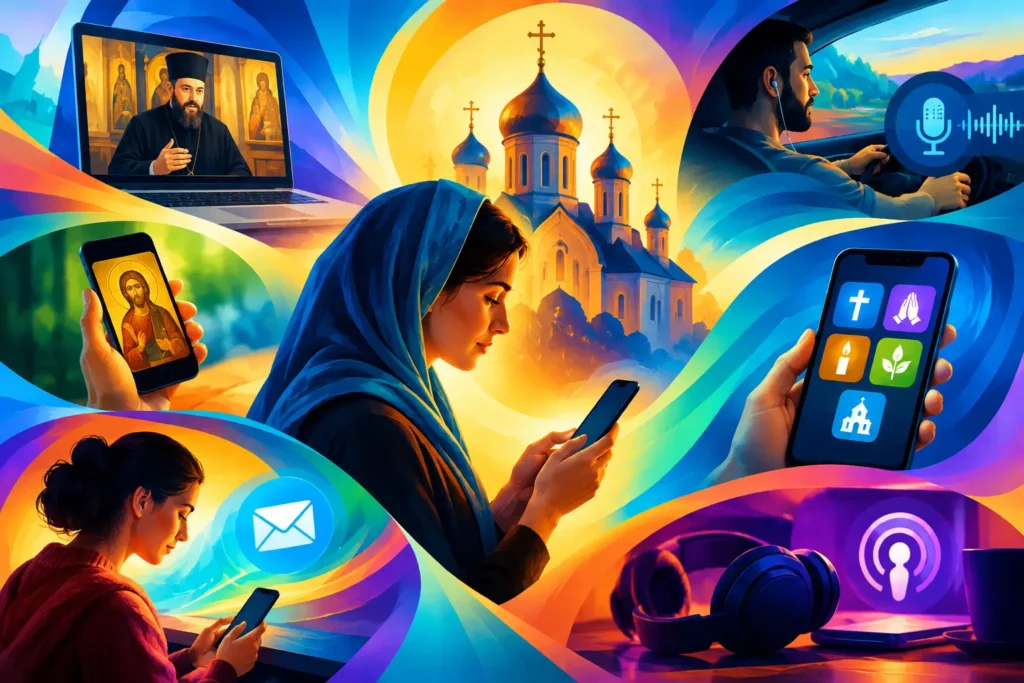
A family watches the Divine Liturgy from a hospital room. A shift worker listens to a Bible lesson before dawn. An inquirer in Surprise has questions about baptism but does not yet know whom to ask. These are real occasions for digital parish ministry trends to serve the Church. But the purpose of digital ministry is never to make parish life virtual. It is to help real people take the next faithful step toward Christ, His sacraments, His people, and a life of repentance.
The Church has always taught through available means: preaching, letters, icons, hymnography, councils, and careful catechesis. Digital tools do not change the Faith once delivered to the saints. They do, however, change how readily a parish can place sound teaching, clear invitations, and practical guidance before those who need them.
Digital Parish Ministry Trends That Serve Real Formation
The healthiest trend is not more content for its own sake. It is a clearer path from initial curiosity to active participation in the life of the Church. For an Orthodox parish, that path must remain personal, sacramental, and accountable. A video may answer a question. It cannot hear a confession. A live-stream may sustain someone who is home-bound. It cannot replace standing with the faithful, receiving pastoral care, and learning to pray within a worshiping community.
Digital ministry succeeds when it refuses to pretend otherwise. It welcomes the seeker at the doorway while pointing beyond the doorway.
Live-streaming as a bridge, not a destination
Live-streamed services have become a normal expectation for many families, travelers, and inquirers. Used rightly, they offer a reverent first encounter with Orthodox worship and maintain a connection for parishioners who are sick, caring for an infant, deployed, or temporarily away.
Yet a parish should speak plainly about its limits. Watching the Liturgy is not the same as gathering for the Liturgy. The camera can show the holy place, but it cannot make a living room into the parish temple or provide the communion of the faithful. This distinction is not harsh. It is an invitation: come and see, then come and belong.
A thoughtful live-stream also respects the holiness of worship. It does not turn the service into a performance or place every private pastoral moment on display. Good audio, a stable image, and modest camera placement help people pray without making the technology the center of attention.
Catechesis that gives seekers a real next step
Many people encounter Orthodoxy online long before they enter a parish. They may arrive carrying sincere questions, painful church experiences, or assumptions formed by Protestant, Roman Catholic, Mormon, Muslim, or secular backgrounds. A short explanation of an icon or a feast day can help, but it rarely answers the deeper question: How do I become Orthodox, and what will that ask of me?
This is where organized digital catechesis matters. Rather than offering disconnected religious clips, a parish can provide a coherent progression through Scripture, the Creed, the Holy Trinity, the Church, the sacraments, prayer, fasting, repentance, and Christian moral life. The material should be substantial enough to form the mind, yet clear enough that a newcomer can begin without embarrassment.
The best digital instruction also makes its pastoral boundaries clear. Online lessons prepare a person for conversation with clergy; they do not eliminate the need for it. Catechumens need more than information. They need prayer, examination of life, patient correction, participation in worship, and a community that knows them by name.
The Return of Patient, Long-Form Teaching
One of the more hopeful digital parish ministry trends is the renewed appetite for serious teaching. Many adults are weary of shallow religious messaging and endless arguments on social media. They want to know what Christians have believed, why the Church prays as she does, and how the Gospel addresses suffering, sexuality, marriage, work, death, and the struggle against sin.
This does not mean every parish resource must become an academic lecture. It means teaching should have enough depth to bear the weight of a real human life. Audio lectures, Bible survey lessons, parish classes, and carefully written articles can give people something better than instant religious opinion: a stable framework for learning the Orthodox Faith.
Long-form teaching is especially helpful after baptism or chrismation. The early enthusiasm of entering the Church is a gift, but the Christian life is not sustained by enthusiasm alone. Mystagogy, the continuing formation of those received into the Church, helps new Orthodox Christians understand what they have received and how to live it. Digital resources can reinforce that work during the week, while the parish provides the face-to-face guidance no recording can offer.
Short content still has a place
Brief videos and posts can serve a useful purpose when they direct people toward something deeper. A short reflection on the Sunday Gospel, a reminder about a feast, or a practical answer to a visitor’s question may be exactly what someone needs that day.
The trade-off is clarity. Short-form content easily rewards controversy, oversimplification, and a personality-driven approach to the Faith. A parish should not shape its teaching around whatever receives the fastest reaction. It should communicate truthfully, reverently, and with enough context that people are not left with slogans in place of doctrine.
Digital Hospitality Must Be Concrete
A parish website and online presence often function as a person’s first visit. If the service times are unclear, the location is difficult to find, or a newcomer cannot tell what to expect, the digital welcome has failed before the person reaches the door.
Practical information is pastoral information. Visitors need to know when services begin, whether children are welcome, how to dress without anxiety, where to park, and how to speak with a priest or parish representative. Inquirers need a plain explanation of the path toward Orthodoxy. Families need to see that the parish takes the formation of children seriously. Those preparing for baptism, marriage, or confession need clear guidance about preparation.
For the west side of the Phoenix metro area, this clarity can make a particular difference. Someone in Sun City, Peoria, Glendale, Buckeye, or Surprise may be willing to travel for a serious Orthodox parish home, but only if they can quickly understand where they are going and what faithful participation looks like. Digital access removes unnecessary confusion. It should never remove the necessary commitment of showing up.
Community Requires Careful Boundaries
Parish groups, email updates, class recordings, and online conversations can strengthen contact between services. They can also create noise, misunderstandings, and the illusion that public commentary is the same as spiritual counsel.
A healthy parish sets a tone of sobriety. Sensitive matters belong with clergy, not in comment threads. Confession is never conducted through casual messaging. Families should not feel pressured to share private struggles publicly in order to prove they belong. The digital space should support prayer, learning, and practical coordination, while the deeper work of pastoral care remains personal and appropriately guarded.
This is especially important for a parish that welcomes people from complex religious backgrounds. Converts often need patience as they unlearn old habits and discover the demanding beauty of Orthodox life. Public debate may expose a question, but it rarely heals a wound. Wise ministry knows the difference.
Measure Faithfulness, Not Attention
A parish can count video views, email opens, and social-media responses. Those figures may help leaders see what reaches people. They cannot measure repentance, prayer, reconciliation, or growth in holiness.
The better questions are more searching. Are inquirers finding a clear way to speak with clergy? Are catechumens receiving careful formation? Are those who are sick or isolated being remembered? Are parishioners coming more faithfully to worship, learning the Faith more deeply, and serving one another more readily? Is digital communication making the parish more accessible without making it less human?
At All Saints of North America Orthodox Church, digital teaching and live-streamed worship can be a genuine mercy for those who are beginning their search or need continued instruction. But every faithful resource should say, in one form or another: Welcome home. Come pray. Come learn. Come enter the life of the Church.
The screen can open a door. The Church asks us, by God’s grace, to walk through it.