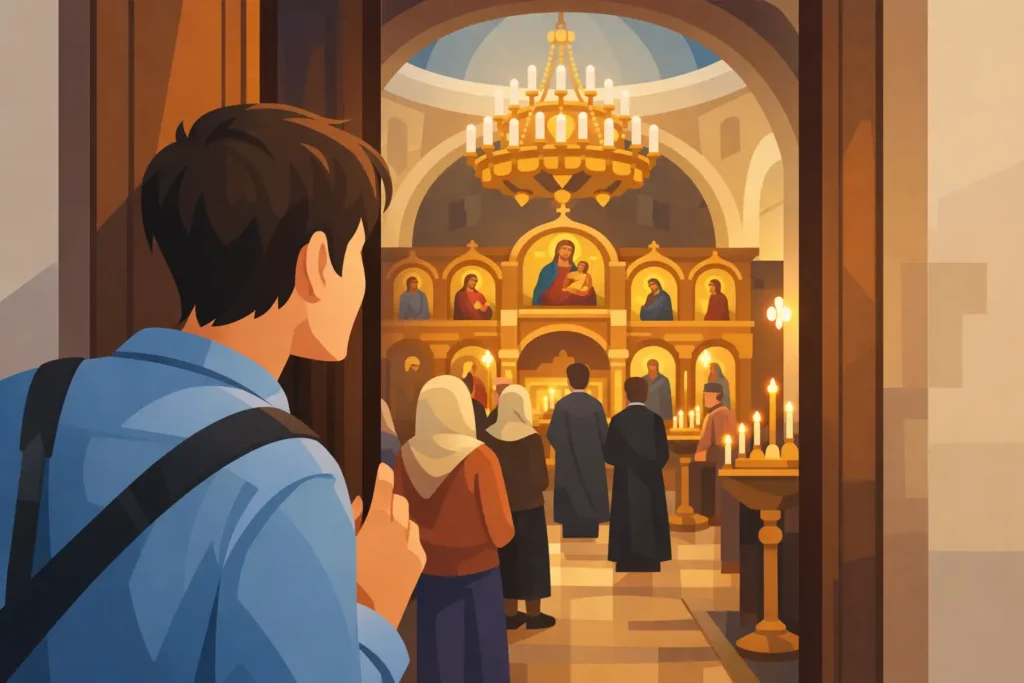
The first time you enter an Orthodox church, you may notice that almost everything asks you to slow down. The icons, candles, chanting, incense, and moments of silence are not religious decoration. They proclaim that worship is an encounter with the living God. This church visitor guide will help you arrive prepared, participate with peace, and recognize what you are seeing without pretending to know more than you do.
You do not need to be Orthodox to visit. You do not need to have every question settled. Come honestly, come reverently, and give yourself permission to observe. The Church receives seekers as persons, not as projects.
Before You Arrive
Check the service time carefully and plan to arrive 10 or 15 minutes early. Orthodox worship does not operate like a concert or a lecture that begins only when the main speaker appears. The prayers before the Divine Liturgy, the preparation of the clergy, and the gathering of the faithful all belong to the Church’s life of prayer.
If you arrive late, do not be embarrassed. Enter quietly, find a place near the back, and wait for a natural moment to settle in. The service may already be underway, but you have not missed the opportunity to pray.
Dress modestly and respectfully. There is no need for expensive or formal clothing, but worship deserves more than the casual habits of errands or recreation. Men commonly wear slacks and a collared shirt. Women often wear dresses, skirts, or modest pants. Some women cover their heads, while others do not. Visitors are not expected to imitate every local custom before they understand it.
Bring your children. Children belong in the Church, and they learn worship by being present in it. A restless child is not a scandal. Parents should guide their children with patience, step out when genuinely necessary, and return without apology. A parish that has no room for children has forgotten that Christ said, “Let the little children come to Me.”
What You Will See in Orthodox Worship
An Orthodox church is arranged to teach the faith. At the front stands the iconostasis, a wall or screen of icons with doors leading into the altar. It does not hide God from the people. Rather, it reveals that heaven and earth meet in worship, and that Christ reigns with His Mother, the saints, and the angels.
You will see people light candles, make the sign of the cross, bow, kiss icons, and move about during parts of the service. Do not feel pressured to do any of these things. You may simply stand quietly and watch. Reverence cannot be borrowed through imitation. It grows through faith, understanding, and a life of repentance.
Most parishes stand for much of the Divine Liturgy because standing is an ancient posture of prayer and resurrection. If you need to sit, sit. Age, health, pregnancy, injury, and physical limitation all matter. The goal is not to prove endurance. The goal is to offer yourself to God with attention.
The service will include Scripture readings, litanies, hymns, a sermon, and the celebration of the Eucharist. You may hear the people respond repeatedly with words such as “Lord, have mercy” and “Amen.” These are not empty repetitions. They are the Church praying together, again and again, because human need remains real and God’s mercy remains inexhaustible.
You may not understand every word on a first visit. That is normal. Orthodox worship carries the depth of Scripture, the teaching of the early Church, and centuries of prayer. Let the service work on you before you demand that it perform for you. Listen for the name of Jesus Christ. Listen for the repeated language of mercy, peace, forgiveness, resurrection, and the Kingdom of God.
Church Visitor Guide: How to Participate
Participation begins with attention. Put your phone away, silence notifications, and resist the urge to narrate the service internally. If a printed service book is available, use it, but do not worry about keeping your place perfectly. Follow the congregation when you can. When uncertain, remain still and observe.
You are welcome to join the spoken responses that you recognize, especially the Lord’s Prayer and the Creed if you can say them in good conscience. You may sing along when the music becomes familiar. Orthodox chanting is meant for the gathered Church, not for a stage audience. Still, a visitor should never feel forced to sing loudly or perform participation.
When the congregation approaches the chalice for Holy Communion, remain in your place unless you are an Orthodox Christian who has prepared and received the blessing to commune. The Eucharist is not a private expression of sincerity or a general symbol of welcome. It is the sacrament of full unity in the Orthodox faith and life.
This boundary may feel unfamiliar, particularly to Christians from traditions with open communion. Yet it is not a rejection of visitors. It tells the truth about what Communion is: the shared life of those who confess one faith, receive pastoral care, and prepare through repentance. You are welcome at the service, welcome in conversation, and welcome to begin the path toward that unity.
At some parishes, blessed bread may be offered after Communion or at the end of the service. This is not the Eucharist and may be received by visitors unless the priest gives different instruction. If you are unsure, simply ask.
Questions You Do Not Need to Hide
Many visitors arrive carrying serious questions. Perhaps you were raised evangelical and wonder why Orthodox Christians honor saints and venerate icons. Perhaps you are Roman Catholic and want to understand the Orthodox confession of the Church. Perhaps you have no Christian background and need someone to explain the Gospel before the details of liturgy can make sense.
Ask your questions. Do not settle for vague answers or sentimental assurances. Orthodoxy makes real claims about Jesus Christ, the Holy Trinity, Scripture, salvation, the sacraments, and the moral life. Those claims deserve careful study.
At the same time, do not judge the whole faith by one awkward conversation, one unfamiliar custom, or the fact that a service felt difficult on your first Sunday. A historic Church will not always be immediately familiar to people formed by modern religious habits. Give yourself time. Return more than once. Read, pray, listen, and speak with clergy who can help you distinguish essential doctrine from local practice.
After the Service
Stay for fellowship if it is offered. Coffee hour is not an interruption to church. It is one way the parish learns to bear one another’s burdens and receive strangers as neighbors. Introduce yourself simply. Say that you are visiting and share as much or as little of your story as you wish.
If you are exploring Orthodoxy seriously, ask about an inquirer class or catechism. Do not rush into baptism or chrismation because the beauty of worship moved you deeply. Beauty can awaken the heart, but conversion requires a changed life. The Church calls people to learn the faith, establish a rule of prayer, confront sin, receive pastoral guidance, and enter a real community.
All Saints of North America Orthodox Church serves those seeking that kind of rooted life across the west side of the Phoenix area. Whether you come from Surprise, Peoria, Glendale, Buckeye, Sun City, or a nearby community, you do not need to navigate the first steps alone.
Your first visit may leave you peaceful, unsettled, curious, or all three. That is not a problem to solve before you leave the parking lot. Carry the experience into the week. Pray simply: “Lord Jesus Christ, lead me into Your truth.” Then return with an open heart, a serious mind, and the courage to let Christ call you deeper.