A parish is not a place one samples once a week for inspiration. It is a people gathered around Christ, His altar, His sacraments, and the apostolic faith He entrusted to the Church. An Orthodox parish exists to form whole human beings: men, women, and children who learn to repent, pray, love, endure, and live in communion with God.
That may sound demanding because it is. The Christian life cannot be reduced to agreeing with ideas about Jesus, attending a religious event, or collecting spiritual content. Christ calls His people into a life of worship and obedience. The parish is where that life becomes concrete: where names are known, sins are confessed, children are baptized, the departed are prayed for, and the Gospel is received not as a private preference but as the truth that remakes us.
Remember, 99% of the work the Church accomplishes is done in the parish!
An Orthodox Parish Is a Eucharistic Family
The center of parish life is the Divine Liturgy. Orthodox Christians do not gather chiefly to hear a speaker or to consume music that matches their tastes. We gather to offer worship to the Holy Trinity and to receive the Body and Blood of Christ with fear of God, faith, and love.
This is why a parish cannot be understood merely as a building, a ministry calendar, or a Sunday crowd. It is a Eucharistic family. Its members stand before God together, bearing one another’s burdens and learning to say, with one voice, “Amen.” The prayers are ancient because the faith is ancient. They teach us to put God before ourselves, to remember the saints, to intercede for the world, and to see all of life in the light of Christ’s death and resurrection.
For someone used to church as a weekly program, this can require patience. The services are not designed for hurried consumption. They ask us to listen, stand, sing, bow, fast, and pray. Yet over time, this rhythm gives shape to the soul. What first feels unfamiliar often becomes a spiritual home.
The Parish Forms Us Through a Rule of Life
A faithful parish does not leave people alone between Sundays. It teaches them how to carry the Church’s prayer into ordinary life: into work, marriage, parenting, suffering, financial decisions, conflict, and rest.
That formation includes regular worship, a prayer rule at home, fasting according to one’s strength and blessing, reading Scripture, acts of mercy, confession, and spiritual counsel. None of these practices earns salvation. They train the heart to receive God’s grace rather than resist it. A person who never prays except during a crisis will struggle to recognize the quiet work of God. A person who never examines his conscience will find repentance abstract. A person who never learns self-denial will mistake every desire for a need.
The parish gives these practices their proper context. Fasting is not a diet plan. Confession is not emotional unloading. Bible study is not an argument exercise. Each belongs to a life of repentance and communion in Christ.
This is also why clergy matter. Orthodox Christianity is not self-directed spirituality. A priest does not replace Christ or control a person’s conscience. He serves as a spiritual father, teacher, and shepherd who helps people apply the faith truthfully to the circumstances of their lives. Wise pastoral guidance protects us from both despair and self-deception.
Why Teaching Must Be Clear
Many seekers arrive at Orthodoxy after years of doctrinal uncertainty. They have heard competing accounts of salvation, Scripture, the Church, baptism, Mary, the saints, and the Eucharist. Some have been told that history does not matter. Others have been given a faith of slogans, vague encouragement, or personal interpretation.
An Orthodox parish should not answer confusion with more vagueness. It should teach clearly, patiently, and from the fullness of the Church’s life. The Orthodox faith is not a collection of isolated teachings. It is a coherent confession of the God who creates, saves, sanctifies, and will judge the world.
For this reason, serious catechism is an act of pastoral care. Inquirers deserve more than a quick overview before being told to blend in. They need time to ask difficult questions, learn the services, understand the Creed, read the Scriptures in the Church, and confront the changes that Christian discipleship requires.
A mature process also continues after baptism or chrismation. The ancient Church called this mystagogy: ongoing instruction into the mysteries newly received. Baptism is a beginning, not a graduation ceremony. New Orthodox Christians need help learning how to pray, fast, confess, serve, raise children, and remain faithful when early enthusiasm gives way to the ordinary labor of growth.
Belonging Is More Than Attendance
People often say they are looking for community. Usually they mean something real: a place where they will not remain anonymous, where their children will be known, and where joy and grief can be shared. A parish should offer this, but Christian belonging is deeper than social compatibility.
You may not naturally share the same age, profession, politics, or personality as everyone in the parish. You may find that some relationships grow slowly. That is not a failure. The Church gathers people whom the world would often keep apart and teaches them to become one body in Christ.
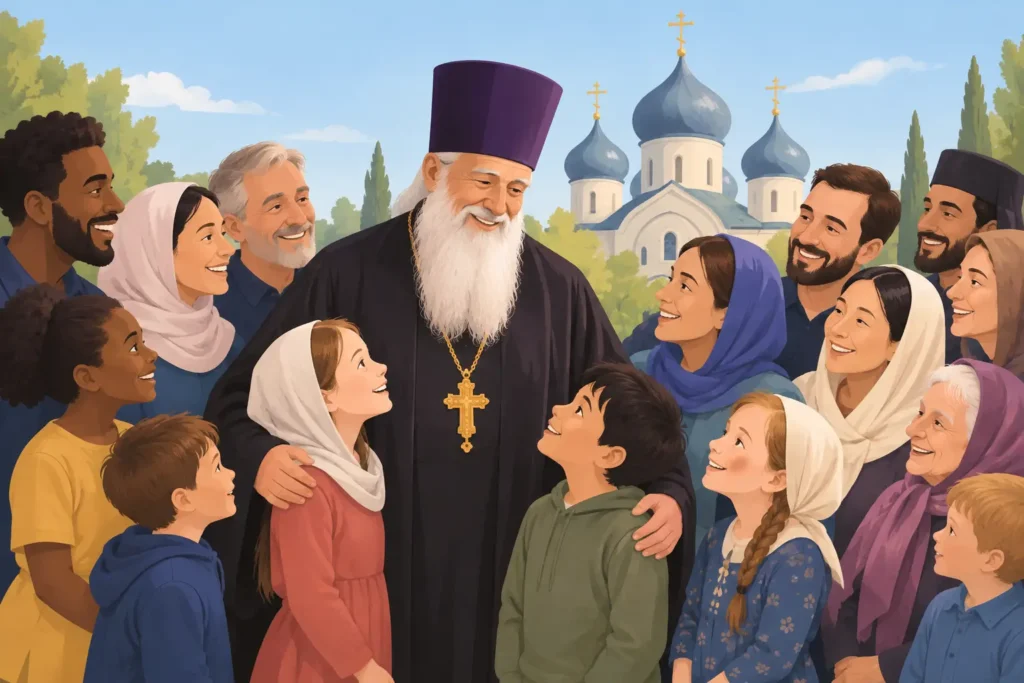
Parish life becomes visible in very practical ways. Families bring meals to the sick. People pray for a member facing surgery or grief. Children learn that church is not entertainment reserved for adults but their own spiritual family. Older believers offer wisdom and stability. Those who have received mercy learn to extend it.
This kind of community requires commitment. It is difficult to be known if one comes only occasionally and leaves immediately after services. It is hard to serve if church remains one more consumer choice among many. A parish grows stronger when its people show up, pray for one another, give generously, forgive quickly, and take responsibility for the life they share.
What Newcomers Should Expect at an Orthodox Parish
If you are visiting for the first time, you do not need to pretend that you understand everything. Come, observe, pray as you are able, and allow the service to speak. You will see icons, hear chanting, smell incense, and encounter many gestures that may be new. These are not decorations around the faith. They express the Orthodox conviction that the whole person, body and soul, worships God.
You should also expect a distinction between attending and receiving Holy Communion. Visitors are welcome to pray with the congregation, but Holy Communion is received by Orthodox Christians who have prepared through the Church’s sacramental life. This is not an attempt to exclude anyone. It is an honest confession that Communion is the visible seal of a unity in faith and life that takes time to enter.
If you are considering becoming Orthodox, do not rush because a service moved you deeply, and do not withdraw because the path asks something of you. Speak with the clergy. Enter catechism. Bring your questions. Let the faith test and heal the assumptions you carry. Conversion is not the adoption of an aesthetic or the rejection of one’s past. It is a turning of the whole person toward Christ and His Church.
For families across the west side of the Phoenix metro area, from Surprise and Sun City to Peoria, Glendale, Buckeye, and the surrounding communities, a serious parish home can end the exhausting search for a church that is both ancient and alive. All Saints of North America Orthodox Church seeks to offer that home through reverent worship, clear teaching, pastoral care, and a deliberate path for those entering the Orthodox faith.
The Parish Is a School of Repentance and Joy
No parish is perfect because no parish is made up of perfected people. There will be misunderstandings, weaknesses, growing pains, and moments when love costs more than we expected. Do not confuse those realities with the absence of grace. Christ did not establish His Church as an escape from difficult people. He established it as the place where difficult people, beginning with us, are healed.
The measure of parish life is not whether every preference is met. It is whether the people are being drawn into deeper worship, clearer faith, sincere repentance, and active love. A healthy parish tells the truth about sin without crushing the sinner. It holds fast to the faith without treating newcomers as outsiders. It calls people to holiness while trusting that God alone gives growth.
If you are weary of spiritual rootlessness, do not settle for a faith that asks little and forms little. Come and see what it means to live within the Church’s prayer. Stay long enough to be known. Learn patiently. Bring your family, your questions, your wounds, and your willingness to repent. Christ still gathers His people into one body, and He still makes a home for those who come to Him.