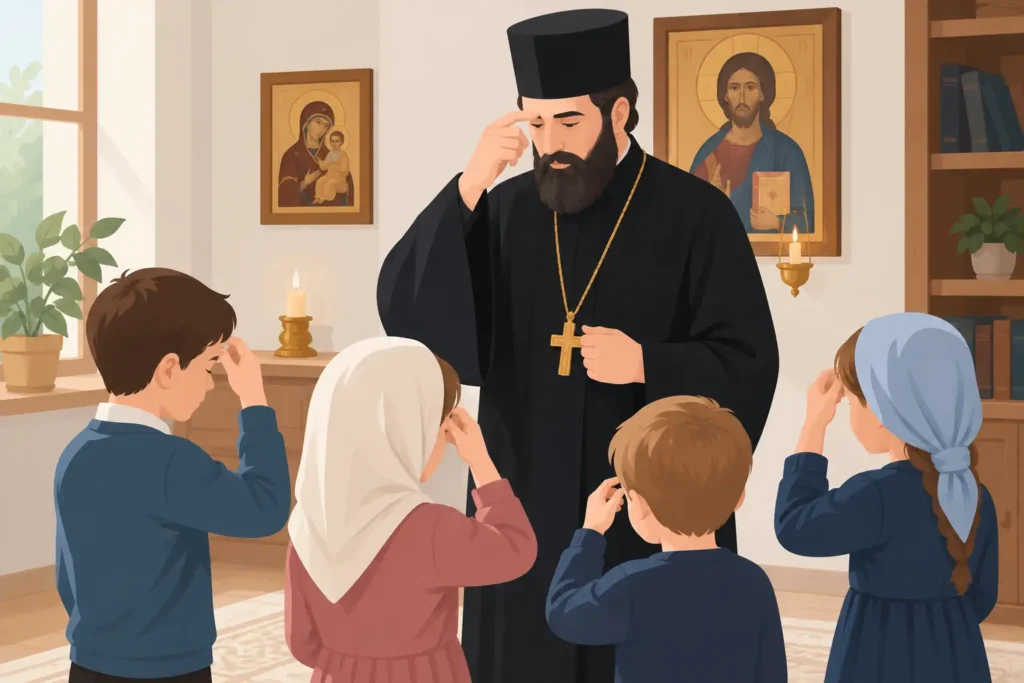
A child slides into the pew, whispers during the Gospel, reaches for a snack, or asks loudly when Communion will be over. Parents can feel every nearby glance. Yet teaching Orthodox children reverence is not accomplished by producing perfectly quiet children on demand. It is the patient work of teaching them that they stand before the living God – a work that begins at home, matures in the Divine Liturgy, and requires both warmth and firm guidance.
Reverence is not fearfulness, stiffness, or a performance for other parishioners. It is a truthful response to holiness. A reverent child learns, slowly and concretely, that the church building is set apart, that icons are not decorations, that the Holy Gifts are not ordinary food, and that prayer is speech directed to God. Children need this formation because they are full members of the Church, not spectators waiting for adulthood to begin.
What Reverence Actually Teaches
The goal is not merely external order. A child can stand still while his mind wanders, and another may struggle physically while genuinely trying to pray. Parents and pastors should not confuse a child’s age-appropriate limitations with defiance. At the same time, we should not surrender the expectation that children can grow.
Reverence teaches children to receive a world that does not revolve around their immediate wishes. This is a mercy. The modern child is constantly told to express, consume, choose, and move on. The Church teaches another way: be still, give thanks, ask forgiveness, wait, listen, bow, and receive. These practices form humility not as self-hatred, but as freedom from the tyranny of the self.
Children also learn reverence by watching adults. If parents rush into church distracted, speak casually through services, leave whenever they are bored, or treat the chalice and the priest as ordinary religious accessories, children will absorb that lesson. If parents cross themselves with attention, venerate icons with love, sing what they can, and repent when they fail, children see that worship is real.
Teaching Orthodox Children Reverence Before Sunday
Sunday morning reveals habits formed during the week. A family that never prays together at home cannot reasonably expect children to understand why the Divine Liturgy calls for attention. Home prayer need not be long to be serious. A brief morning or evening rule, faithfully kept, gives children a pattern: gather, stand before the icons, make the sign of the cross, listen, and offer their own petitions.
Begin with what the household can sustain. For a young family, this may be the Trisagion prayers, a short Psalm, the Lord’s Prayer, and prayers for relatives or someone who is suffering. Older children can take turns reading, leading responses, or remembering names for prayer. The point is not to create an impressive domestic service. The point is to make prayer normal.
Teach physical acts with their meaning. Show a child how to make the sign of the cross carefully, then explain that we confess the Holy Trinity and Christ’s coming down for our salvation. Teach bows and prostrations according to the season and the guidance of the parish. Explain why we kiss an icon: not because wood and paint are magic, but because honor passes to the person depicted, and because Christ truly took flesh.
Simple preparation the night before also matters. Lay out church clothes, prepare what is needed for the morning, and speak calmly about the service. Tell young children one thing to listen for: the Gospel reading, the Cherubic Hymn, the words “Holy Things are for the holy,” or the dismissal. Give them a place in the service rather than only telling them what not to do.
In Church, Give Clear and Loving Boundaries
Children need explicit expectations. Before entering, speak quietly and plainly: “We are entering God’s house. We will walk, use soft voices, stay with our family, and pray as we are able.” A long lecture in the parking lot usually fails. One or two consistent sentences, repeated every week, are more effective.
For toddlers, reverence will look different than it does for a twelve-year-old. Very young children may need to be carried out, fed, or comforted. This is not a failure. Parents should return when possible rather than allowing the narthex or hallway to become the preferred destination. A child who learns that disruption always earns playtime outside will naturally repeat it.
For school-age children, gradual participation is appropriate. Encourage them to stand for the Gospel, join the processions when directed, sing familiar responses, and help care for younger siblings after they have learned to pray themselves. Do not hand a child a screen simply to buy silence. There may be unusual circumstances, but routine digital distraction teaches that worship must compete with entertainment.
When correction is necessary, keep it calm and immediate. A quiet hand on the shoulder, a whispered reminder, or a brief trip outside may be enough. Public shaming rarely produces reverence; it more often produces resentment or embarrassment. Afterward, reconnect. Say what went wrong, name what should happen next time, and assure the child that he belongs in church. Firmness and tenderness are not enemies.
Let Children See That Adults Repent
Parents sometimes think they must project complete spiritual competence. Children know better. They see impatience in the car, hurried prayers, and distracted worship. The better witness is honest repentance.
When you speak harshly before Liturgy, ask your child’s forgiveness. When you lose attention during prayers, say so without drama and return to prayer. When your family misses a service through carelessness rather than necessity, acknowledge it. This teaches a crucial distinction: reverence is not pretending that we are holy. It is returning to the Holy One who heals us.
Confession belongs in this formation as well. Children should not experience confession as a threat deployed by anxious parents. It is a sacrament of reconciliation and healing. As they become ready, help them understand that they speak truth before Christ, receive counsel, and begin again. A family culture of repentance makes reverence living and personal.
Explain the Liturgy in Small Portions
Children cannot treasure what remains completely unintelligible. They do not need a graduate-level explanation of every rubric, but they do need real teaching. Choose one moment of the Liturgy each week and explain it over a meal or during the drive home.
You might explain why the priest censes the people, why we face east, why the deacon calls us to pray, or why we fast before receiving Holy Communion. Use clear language and do not reduce the mysteries to mere symbols. The bread and wine truly become the Body and Blood of Christ. The Gospel is Christ speaking to His people. The saints are alive in Him and pray with us. Children can receive these truths with more seriousness than adults often expect.
It also helps to connect feast days with the home. Set out an icon, read a brief account from the Scriptures or the life of the saint, sing a hymn, and mark the day with a meal or act of mercy. Reverence grows when the Church calendar shapes family memory.
Avoid Two Opposite Mistakes
One mistake is harsh control. Some parents demand adult stillness from very young children, correct every small movement, and communicate that church is mainly a place where they are likely to fail. This may produce temporary compliance, but it can make worship feel cold and unsafe.
The opposite mistake is permissiveness. If children are allowed to run, play, talk freely, and treat the temple as a social hall, they are being deprived of the very gift their parents want them to have. Love does not remove every boundary. Love introduces a child to reality and helps him bear its demands.
The wise path depends on the child’s age, temperament, developmental needs, and the family’s circumstances. A child with sensory or medical challenges may need particular accommodations and patient pastoral care. Yet every child can be invited into prayer, given a next step, and treated as capable of growth in Christ.
A Parish Is a School of Reverence
Parents do not carry this burden alone. The parish gives children a larger pattern of faithful life. They see elderly Christians standing through prayer, altar servers serving carefully, chanters offering the hymns, and families from different backgrounds gathered around one chalice. This is why regular attendance matters. Reverence is caught as well as taught.
At All Saints of North America Orthodox Church, families can also seek guidance from clergy when a particular struggle persists. Good pastoral counsel does not offer a one-size-fits-all formula. It helps parents form a realistic rule, remain united in their approach, and keep the child’s salvation rather than public appearance at the center.
The next time your child fidgets, complains, or tests a boundary, do not despair. Bring him back gently. Make the sign of the cross with him. Whisper, “We are before God.” Then stand with him, week after week, until those words become not a demand from a parent, but a glad recognition of home.