A glass of water can be ordinary, necessary, and easily overlooked. Yet at Holy Baptism, water becomes the appointed means by which Christ grants new birth. Bread and wine remain bread and wine, yet in the Eucharist they become the true Body and Blood of the Lord. This is not religious imagination added to an otherwise secular world. An Orthodox sacramental worldview begins with the conviction that God made the material world good, entered it in the Incarnation, and uses it to bring His people into communion with Him.
For many modern people, reality is divided in two: spiritual matters belong to private belief, while ordinary life belongs to work, politics, technology, consumption, and personal preference. Orthodoxy refuses that split. The faith does not treat creation as disposable scenery or the body as a prison for the soul. God made the world, called it good, and took flesh from the Virgin Mary. In Jesus Christ, matter itself has become the place of our salvation.
The Orthodox Sacramental Worldview Begins with Christ
The heart of this worldview is not an interest in rituals, symbols, or religious atmosphere. It is the Incarnation. The eternal Son of God truly became man without ceasing to be God. He had a human body, ate food, touched the sick, shed blood, died, rose bodily from the grave, and ascended in the flesh. Christianity is therefore not an escape from the material world. It is the redemption and transfiguration of human life within it.
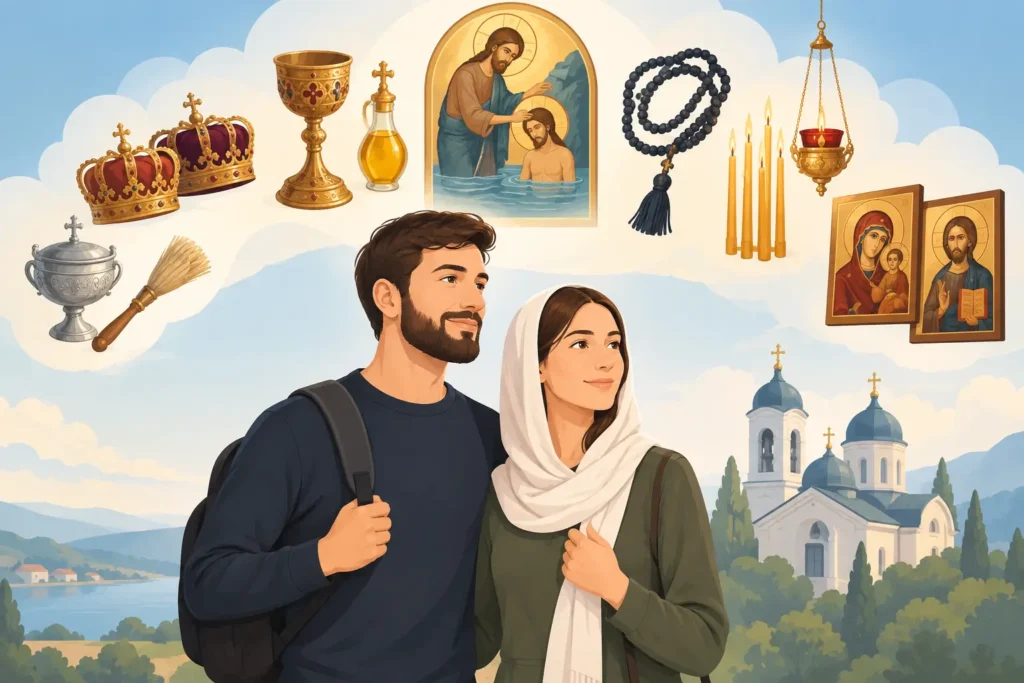
Because Christ has united humanity to God in His own Person, physical things can become bearers of divine grace. Water, oil, bread, wine, the laying on of hands, spoken words, a blessing, and even the bodies of the saints all matter. None of these things has power apart from God. They are not charms. Their power comes from the Holy Spirit, who acts in the Church and gives what Christ has promised.
This also explains why Orthodox Christians venerate icons. An icon is not a replacement for God, nor is it a decorative religious object. It proclaims that the invisible God has made Himself known in the visible flesh of Jesus Christ. When Christians honor an icon of Christ, His Mother, or a saint, they honor the person depicted, not wood and paint as though these were gods. The honor passes to the prototype.
The Holy Mysteries Are Not Mere Symbols
Orthodox Christians often speak of the sacraments as the holy mysteries. The word “mystery” does not mean something irrational or vague. It means a divine reality that exceeds our ability to control or fully explain. God truly acts, but He is never reduced to a technique.
In Baptism, a person dies and rises with Christ. In Chrismation, the newly baptized receives the gift of the Holy Spirit. In the Eucharist, the Church receives the Body and Blood of Christ for the remission of sins and life everlasting. In Confession, Christ forgives and heals through the ministry of His priest. Marriage, ordination, and holy unction also reveal and communicate God’s grace in concrete human circumstances.
The Church does not call these mysteries empty reminders. At the same time, Orthodox Christians do not imagine that simply receiving a sacrament mechanically saves a person who refuses repentance. Grace is not magic. A man may stand in water at Baptism, receive Communion, or hear absolution in Confession, yet still resist the life God gives. The mysteries require faith, repentance, and a life of obedience. They are God’s gifts, not religious achievements.
This is one reason serious preparation matters. Baptism preparation is not paperwork before a ceremony. Catechism is not an academic hurdle before membership. A person entering the Church is learning to receive a new way of life: prayer, fasting, worship, confession, mercy, chastity, stewardship, and love for the brethren. The Church calls this continuing formation mystagogy – learning to live from the mysteries after one has entered them.
Creation Is Good, but It Is Not God
A sacramental vision does not collapse into sentimentality about nature or a vague spirituality that finds God equally in everything. Creation reveals God because it is His creation. It is not divine by nature. The sun, a mountain, a child, and a meal are gifts that point beyond themselves to the Giver.
That distinction matters. Pantheism says that God and the world are essentially one. Materialism says that the world is only matter in motion. Orthodoxy confesses something better: the world is created, contingent, and good; God is uncreated, wholly beyond creation, and yet truly present to it by His energies and grace.
Sin has wounded both the human heart and our use of the world. We turn good things into idols. Food becomes gluttony, sexuality becomes self-rule, work becomes pride, money becomes mastery, and even religion can become performance. The answer is not contempt for creation. It is asceticism: learning, by grace, to receive every good gift with thanksgiving and self-control.
Fasting is a clear example. Orthodox Christians do not fast because food is dirty. We fast because appetite must not rule us. By voluntarily limiting good things for a season, we learn freedom, make room for prayer, and remember those who lack daily bread. Feasting after fasting also becomes clearer: food is received with joy, gratitude, and fellowship rather than entitlement.
Worship Reorders Ordinary Life
The Divine Liturgy is the center of Orthodox life because there the Church offers thanksgiving to God and receives Christ Himself. But the Liturgy is not a weekly religious break from real life. It teaches us what real life is for.
We bring bread and wine, the fruit of the earth and human labor. God returns them to us as the Eucharistic gift of His Son. Then we are sent into the world to carry that Eucharistic pattern into our homes, workplaces, and neighborhoods: receiving with gratitude, offering with thanksgiving, and giving ourselves in love.
This does not mean every decision has an easy religious answer. A sacramental worldview will not tell a parent exactly which school to choose, an employee exactly which job to accept, or a family exactly where to live. It does, however, ask better questions. Does this choice help us pray? Does it form gratitude or feed vanity? Does it strengthen faithfulness, hospitality, courage, and mercy? Will it make faithful participation in the Church more difficult or more possible?
For families in the western Phoenix area, this can be especially practical. A parish cannot be one more activity added to an already crowded schedule. It must become a spiritual home: the place where children learn reverence, adults learn repentance, and households are anchored in the worship of God. The rhythms of Sunday Liturgy, feast days, fasting seasons, family prayer, confession, and acts of mercy slowly reshape a life that the surrounding culture constantly fragments.
A Sacramental Life Requires Repentance
It is possible to admire Orthodox beauty while avoiding Orthodox conversion. Incense, chant, icons, and ancient prayers can stir the heart, but they are not the destination. The destination of the Orthodox sacramental world view is union with God, which always includes repentance.
Repentance is not self-hatred. It is the truthful turning of the whole person toward Christ. In Confession, we stop defending the passions that enslave us. We name our sins, receive Christ’s mercy, and take up the work of change. In Communion, we do not receive a religious token for personal encouragement. We receive the Lord who calls us to become one Body in Him.
This is demanding, and it should be. The Gospel does not flatter our self-sufficiency. Yet it does not leave us alone with our weakness. Christ gives His Church, her prayers, her saints, her pastors, and her mysteries so that sinners may become holy.
If you are beginning to ask whether Christianity is more than a set of ideas or a private inspiration, begin simply. Come and pray. Stand attentively at the Divine Liturgy. Ask questions with honesty. Learn the faith patiently, and do not rush past repentance. The living God still meets His people through the humble things He has blessed.