Orthodox parish education begins with a different question: not merely, “What facts should someone know?” but, “How is this person being drawn into the life of Christ?” The answer includes doctrine, certainly, but it also includes worship, repentance, fasting, the Scriptures, the saints, sacramental life, and a real community that learns to pray together. A parish can offer excellent information and still fail to form disciples.
For those who have known Christianity chiefly as private belief, an occasional sermon, or a collection of online opinions, this can feel wonderfully demanding. The Orthodox Church does not separate theology from life. We learn the faith so that we may confess it, live it, and be changed by it.
Orthodox Parish Education Is More Than a Class
A class matters. Clear catechism protects people from confusion and gives words to convictions they may already sense. Yet instruction detached from the Church’s worship can become one more subject to master. Orthodox parish education places teaching within the rhythm of the parish because the faith is not an idea constructed in isolation. It is the apostolic life received, guarded, prayed, and handed on.
At Vespers, Matins, and the Divine Liturgy, the Church teaches with Scripture, hymns, feast days, psalms, icons, and repeated prayers. A person may first hear the doctrine of the Incarnation in a lesson, then sing it at a feast, see it before him in an icon, and bring it into his prayer rule at home. Over time, what was once unfamiliar becomes the Church’s language on his own lips.
This is why Orthodox parish education should never be treated as a side program for the especially interested. Every faithful Orthodox Christian is called to grow in understanding. The parent teaching children, the recent convert, the lifelong Orthodox believer, and the man returning after years away all need patient, serious formation.
The Path Begins With Honest Questions
Many inquirers arrive with urgent questions. Why are there icons? What does the Church mean by salvation? Why confess sins to a priest? Why do Orthodox Christians fast? Are we saved by faith, works, or grace? These questions deserve direct answers, not vague reassurance.
A sound catechetical process gives people time to ask, listen, read, pray, and observe. It does not pressure someone into a decision before he understands what he is entering. At the same time, it does not pretend that the Orthodox faith can be reduced to personal preference. Christ established one Church, and entering her life requires trust, repentance, and a willingness to be taught.
For a Protestant or evangelical, the adjustment may involve seeing the Church not as a voluntary association but as the Body of Christ across time. For a Roman Catholic, it may involve careful attention to the claims of the Orthodox Church and the history of the first millennium. For someone with little Christian background, the first task may be learning the biblical story itself. The pace and emphasis can differ, but no one is served by skipping foundations. Orthodox parish education fills in the gaps.
Catechism Builds a Coherent Christian Mind
Orthodox Catechism should teach the whole shape of the faith: the Holy Trinity, the Person of Jesus Christ, creation and the fall, the sacraments, the communion of saints, the Scriptures, the moral life, the Church’s worship, and the hope of resurrection. These are not disconnected topics. Each one clarifies the others. This is the essence of Orthodox parish education.
When people lack this coherence, they often borrow beliefs from whatever source is loudest: popular preachers, social media arguments, political tribes, or self-help spirituality. Orthodox parish education and teaching offers something firmer. It teaches believers to recognize error, not because they have memorized every controversy, but because they have come to know the sound of the Church’s confession.
Clear teaching also serves humility. A catechumen is not asked to invent a private theology. He receives a faith that was believed before him and will remain after him. That is not an intellectual cage. It is freedom from the exhausting demand to make oneself the final authority.
Worship Teaches What Words Alone Cannot
Orthodox parish education begins with worship. The Divine Liturgy is not an illustration added after the lesson. It is the Church at prayer before the living God. There, doctrine becomes praise. We do not simply define the Trinity; we bless the Father, Son, and Holy Spirit. We do not merely discuss the Resurrection; we proclaim Christ’s victory over death. We do not speak abstractly about communion; we prepare to receive the holy Gifts with fear of God, faith, and love.
This is also why regular attendance matters. One visit can reveal beauty, but a stable life in the Church is learned through repetition. The services form memory. The fasting seasons teach self-denial. The feast days order time around Christ rather than around consumption, sports schedules, or the endless news cycle.
There are practical limits, especially for families balancing work, children, illness, and long drives across the west side of the Phoenix metro area. No one should confuse frantic activity with faithfulness. But a parish should help people move from occasional attendance toward a real liturgical rule of life, one that is serious enough to form them and realistic enough to endure.
Orthodox Parish Education Continues After Baptism
Baptism or chrismation is not graduation. It is birth into the Church. New Orthodox Christians often discover that their deepest questions arise after they have entered the faith. How do I establish a prayer rule? How do I prepare for confession? How should our family keep the fast? What do I do when relatives do not understand my conversion? How do I read the Fathers without turning every passage into a debate?
This period of post-baptismal formation, often called mystagogy, deserves careful attention. The newly illumined need more than congratulations. They need ongoing instruction, pastoral care, and relationships with faithful people who can show what a persevering Orthodox life looks like over years.
At All Saints of North America Orthodox Church, this means treating formation as a deliberate path rather than a brief orientation. Classes, Bible survey lessons, articles, audio teaching, and clergy-led guidance can serve those at different stages. Digital resources are especially helpful when work, distance, or family responsibilities prevent someone from attending every opportunity in person. They support parish life, however; they do not replace standing in prayer with the Church.
Parents Are Not Spectators in Their Children’s Formation
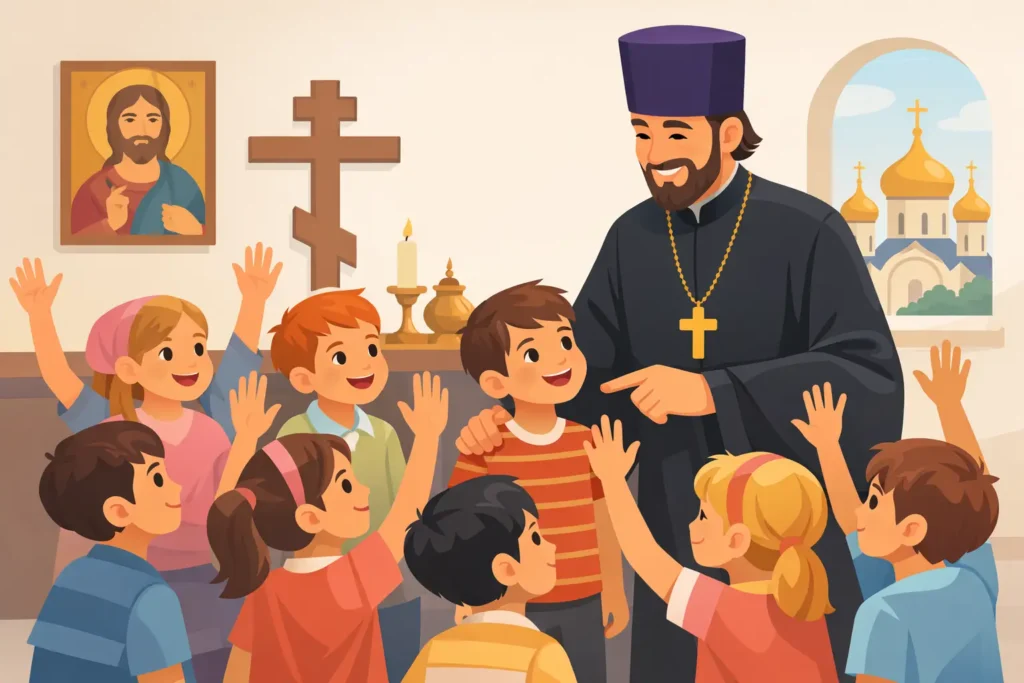
Children need age-appropriate teaching, but Orthodox parish education cannot be outsourced to a classroom. A child learns the faith most deeply by seeing adults pray, forgive, fast with joy, attend services, speak reverently of the saints, and repent after failure.
This does not require parents to become experts overnight. It requires honesty and steadiness. Read a small portion of Scripture together. Keep a family prayer corner. Bring children to the services as they are able. Explain what they see in simple language. Let them know that the Church is not an activity their family attends but the home in which they are being raised.
A parish strengthens this work by equipping parents rather than merely entertaining children. Good teaching gives families the confidence to answer basic questions and the humility to say, “Let us learn this together,” when they do not know.
Orthodox Parish Education Must Lead to Repentance
There is a danger in serious religious study: a person can learn to speak correctly while remaining uncorrected in heart. Orthodox education must therefore keep confession, prayer, and repentance close to every lesson. The goal is not to win arguments about Orthodoxy. The goal is to become faithful people who love God and neighbor.
This changes how we approach disagreement. The Church does not soften truth to avoid offense, yet Christians must not use truth as a weapon for pride. A well-formed believer can state what the Church teaches plainly, listen carefully to another person, and refuse the temptation to treat every conversation as a contest.
It also changes how we measure growth. More reading is good. Better questions are good. But growth appears in patience under pressure, greater honesty in confession, mercy toward difficult people, courage against sin, and a growing hunger for God.
Begin With Faithful Presence
If you are exploring Orthodoxy, begin by attending the services and allowing the Church’s prayer to address you. Bring your questions. Do not be embarrassed by what you do not yet understand. Serious inquiry is welcome, and it requires more than a quick comparison of beliefs.
If you are already Orthodox, ask where your formation has become passive. Return to the Scriptures. Attend an Orthodox parish education class. Speak with your priest. Make room for the services that have been pushed to the edges of life. The Church does not call us to collect religious knowledge, but to receive Christ with our whole heart, mind, body, and strength.
That work takes a lifetime, and it is one of the great mercies of parish life that we do not do it alone.