Orthodox funeral customs give the Church a faithful way to meet that hour: we pray beside the departed, honor the body, ask God for mercy, and confess without hesitation that Christ has trampled down death by death. When death enters a family, arrangements can feel urgent while grief makes clear thinking difficult.
The Orthodox funeral is not a celebration of death, nor is it simply a ceremony of remembrance. It is the Church’s prayer for a person who has fallen asleep in the Lord. Its hymns face the sorrow of separation honestly while directing our eyes to the resurrection of Christ and the promised resurrection of the dead.
What Orthodox Funeral Customs Proclaim
Orthodox Christians do not treat the body as a disposable shell. The human person is created as body and soul, and the body has been sanctified through baptism, anointed with holy chrism, and, for the faithful communicant, nourished by the Holy Mysteries. Even in death, the body is treated with reverence because it belongs to a person made in God’s image and because it awaits the general resurrection.
This is why the prayers of the funeral return again and again to Christ’s victory. The Church does not pretend that death is natural or harmless. Death is an enemy. Yet it is an enemy Christ has entered, defeated, and transformed through His Cross and Resurrection. At the graveside, this hope is proclaimed with particular force: the body is committed to the earth, but the final word belongs to the risen Lord.
The funeral also teaches the living. Standing before death strips away many false priorities. The prayers call us to repentance, mercy, sobriety, and a renewed life in Christ. A faithful funeral does not flatter the departed with vague claims about heaven. It entrusts him or her to the mercy of God and calls everyone present to prepare for eternity.
Before the Orthodox Funeral: The Church Begins to Pray
A family should contact the parish priest as soon as possible after a loved one dies or is nearing death. The priest can offer prayers at the bedside, hear confession when a person is able, bring Holy Communion, and guide the family through the decisions that follow. Do not wait until every detail with a funeral home is settled. The Church’s care begins immediately.
When possible, Orthodox Christians arrange for the body to be brought to the church before the funeral. A Trisagion prayer service may be served at the funeral home, at home, or in the church. The word Trisagion means “thrice-holy,” referring to the prayer, “Holy God, Holy Mighty, Holy Immortal, have mercy on us.” It is a brief but profound service of intercession for the departed.
In many parishes, family and friends keep a vigil near the body, reading Psalms or simply praying quietly. This is not a social reception. It is an act of love. The presence of the body helps us resist the modern temptation to hide death away. We stand with the one who has reposed, asking the Lord to grant rest where there is no pain, sorrow, or sighing.
Preparing the Body With Reverence
The body is ordinarily washed and dressed modestly, often in clothing that reflects the person’s Christian life. An Orthodox cross may be placed in the hands. The details can differ among Orthodox traditions and according to local circumstances, so families should follow the priest’s direction rather than trying to reproduce every custom found online.
The historic Orthodox practice is burial, not cremation. Burial expresses the Church’s reverence for the body and mirrors Christ’s own burial. Families should speak with their priest before making final arrangements, especially if cremation has already occurred or is being considered. There may be painful circumstances, financial pressures, or decisions made by someone else, but those circumstances should be met with pastoral care and truth, not embarrassment or silence.
The Orthodox Funeral Service
The funeral service is normally served in the church, with the body present. The open casket, where permitted and appropriate, is not intended to be distressing for its own sake. It allows the faithful to offer a final farewell and to pray in the presence of the departed person.
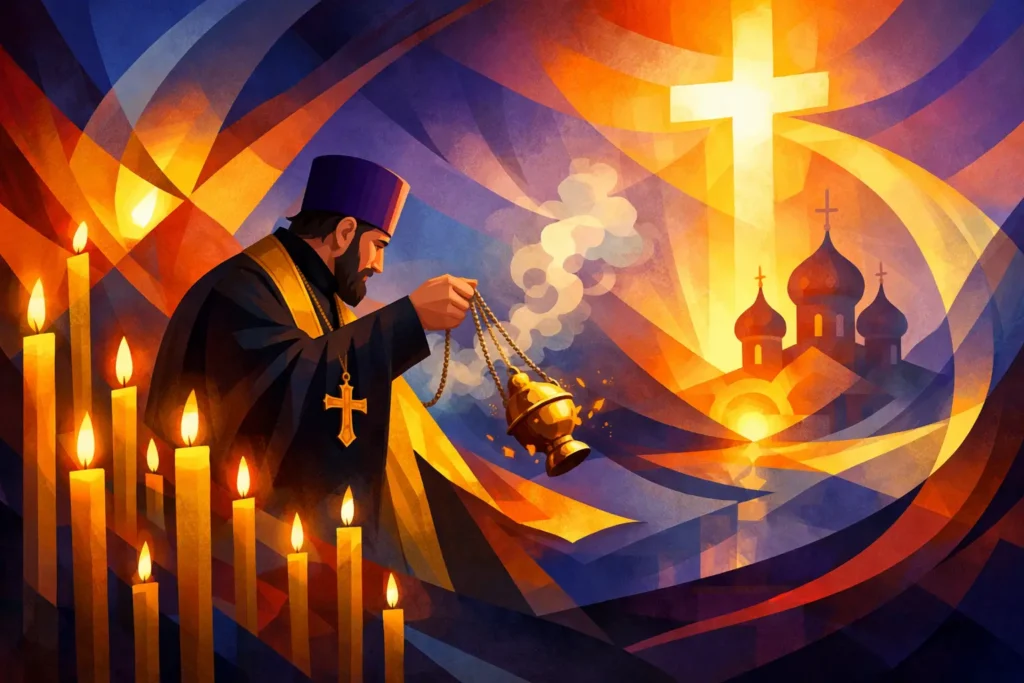
The service is filled with Scripture, psalms, hymns, incense, and petitions for mercy. Incense honors the body and signifies prayer rising before God. The priest prays that the Lord will forgive every sin, voluntary and involuntary, known and unknown. The congregation responds not as spectators but as the praying Church.
Near the end of the service, family and friends may come forward for the final kiss. They may kiss the cross or icon placed with the departed and offer a quiet farewell. This moment can be deeply emotional, but it is not theatrical. It is a last act of Christian love, carried out within the Church’s prayer.
Eulogies are handled differently from parish to parish. The Orthodox funeral itself already speaks with extraordinary depth about the meaning of a Christian life and death. A brief remembrance may sometimes be appropriate, especially at a meal after the burial, but it should not replace the service or turn worship into a program centered on personal accomplishment. The focus remains Christ, His mercy, and the resurrection.
At the Graveside
The burial follows the funeral whenever possible. At the grave, the priest serves another Trisagion and the body is committed to the earth. The words are stark and hopeful: “The earth is the Lord’s and the fullness thereof.” Soil may be cast upon the casket in the sign of the Cross, recalling God’s words that man is dust and to dust he shall return.
For many families, the graveside is the hardest moment. It is also a moment the Church refuses to leave empty. We do not abandon the departed to silence. We pray. We make the sign of the Cross. We sing. We entrust a beloved person to the God who knows every hidden sorrow and who will raise the dead on the last day.
Memorial Prayers After Orthodox Funeral and Burial
Orthodox care for the departed continues after the day of the funeral. Families commonly request memorial prayers on the third, ninth, and fortieth days after death, as well as on the anniversary of repose. These observances are not magic dates or a timetable for guessing at the condition of a soul. They are appointed occasions for the Church to remember the departed before God and for the family to remain rooted in prayer rather than grief alone.
A memorial service, often called a Panikhida or Parastas depending on local usage, asks God to grant rest to the departed. Families may prepare koliva, a dish of boiled wheat, as a traditional sign of resurrection. Just as a grain of wheat is sown in the earth and bears fruit, so Christians confess that those who die in Christ await resurrection.
Almsgiving and works of mercy in memory of the departed also have a fitting place in Orthodox life. A meal shared with family and friends after the funeral can become an act of hospitality rather than mere obligation. Grief does not end at forty days, of course. The Church gives us a pattern of prayer because sorrow often returns in waves, long after others have moved on.
Questions Families Often Face
Not every death follows the same pattern. A person may have died far from home, outside the Church, after a long estrangement from faith, or in circumstances marked by trauma. The priest will help the family discern what prayers may be offered and how the parish can care for them. This is especially important in cases of suicide, where surviving loved ones need compassion, prayer, and careful pastoral guidance rather than speculation or condemnation.
If the deceased was not Orthodox, the Church’s funeral service may not be used in the same way, but Orthodox family members should still speak with their priest. The Church does not ask us to stop loving or praying when a situation is complicated. It asks us to pray faithfully, humbly, and within the bounds of the faith we have received.
Children should usually be included in age-appropriate ways. They can attend part or all of a service, make the sign of the Cross, place a flower at the grave, and hear the Church’s language of resurrection. Shielding children from every sight and conversation about death can leave them alone with fears they cannot name. Honest, gentle participation can teach them that death is grievous, but Christ is near.
If you live in the west Phoenix area and are facing a death in the family, contact All Saints of North America Orthodox Church promptly. The first next step is not perfect planning. It is prayer with the Church. Let the words of the funeral carry you when your own words are few, and let Christ’s resurrection meet your grief with a hope strong enough to endure.