When Christians weigh liturgical worship versus contemporary services, they are often asking deeper questions: What is worship for? Who is the Church? How does a person actually grow in communion with God? These questions deserve more than a debate about hymn preferences, instruments, or clothing. A church service is never merely a matter of style.
Orthodox Christianity answers from the life of the Church received from the apostles. Worship is not a weekly religious event designed around personal taste. It is the gathered people of God entering, by grace, the worship of heaven. The Divine Liturgy forms us because it places Christ at the center and asks us to bring our whole selves before Him.
Liturgical Worship Versus Contemporary Services: The Central Difference
The most basic difference is not old music versus new music. It is whether worship is chiefly understood as something the congregation creates or something the Church receives and enters.
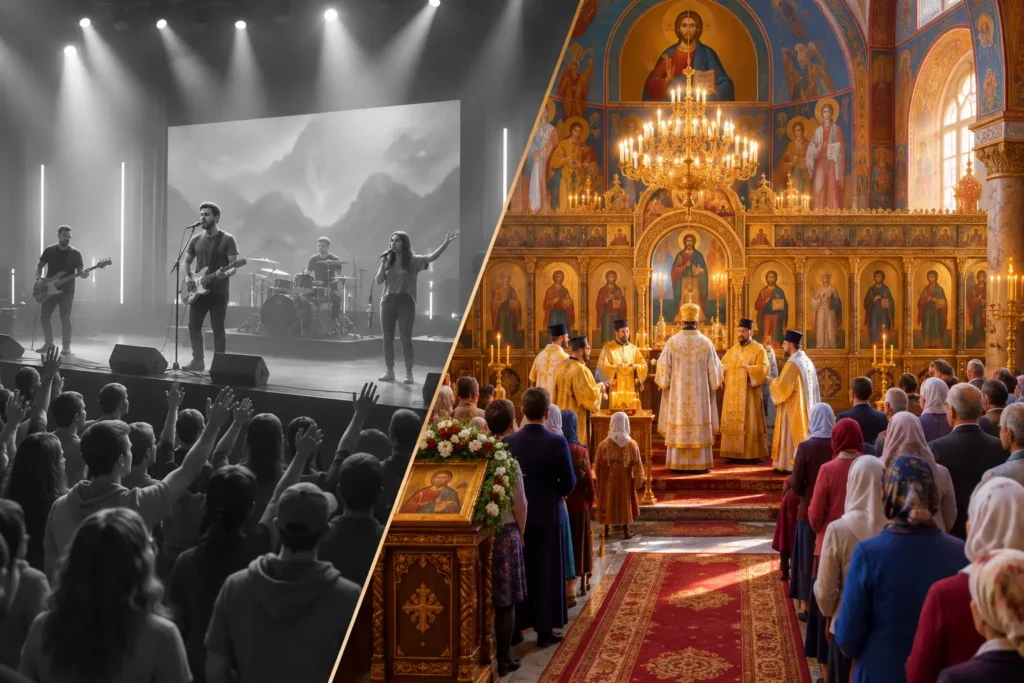
In a contemporary service, the order of worship may change often. Music, sermon themes, visual elements, and the emotional movement of the service are commonly arranged to connect with a particular audience. Many sincere Christians encounter real encouragement in such services. A faithful sermon may call people to repentance, and heartfelt singing may express genuine love for Christ.
But sincerity, by itself, cannot answer every question. Christians also need to ask whether the worship they offer is shaped by the faith once delivered to the saints. Is it teaching the whole Gospel? Is it preparing us for the sacraments? Does it join us to the Church across time and place, or does it mainly reflect the preferences of the present moment?
Liturgical worship begins with a different posture. The Church has received prayers, Scripture readings, hymns, gestures, feasts, fasts, and sacramental rites that carry the faith in a dense and living form. The congregation does not come to watch a religious presentation. The congregation comes to pray, sing, bow, confess, give thanks, hear the Word, and receive Christ.
The Divine Liturgy Is Not a Performance
Visitors sometimes enter an Orthodox liturgical service and wonder where the stage is. They may notice that the priest faces the altar at key moments, that the choir leads prayer rather than entertains, and that there are few pauses for explanation. This can feel unfamiliar, especially for someone formed by a service built around a band and a sermon.
Yet the apparent unfamiliarity points to something essential. In Orthodox liturgical worship, no one is the star. The priest serves as a steward of the mysteries of God. The choir gives voice to the prayers of the people. The faithful answer with “Amen,” make the sign of the cross, stand attentively, and offer themselves to God. Every part points beyond the people gathered in the room to the crucified and risen Lord.
This does not make Orthodox worship passive. It calls for a deeper kind of participation. Participation is not measured by how often someone is brought onto a platform or how strong an emotional response feels in a particular song. It is measured by attentive prayer, repentance, obedience, sacramental life, and the gradual transformation of the person.
The Liturgy asks more of us than an hour of inspiration. It trains us to say, again and again, “Let us commend ourselves and each other and all our life unto Christ our God.” That is not religious atmosphere. It is a way of life.
What Repetition Actually Does
A common objection to liturgical worship is that repeated prayers can become routine. That danger is real. Any Christian can say holy words with an inattentive heart. A familiar worship chorus can become empty, and so can the Lord’s Prayer, a Psalm, or the Creed when spoken without care.
The answer is not to discard repetition. Scripture itself gives Christians repeated words of prayer. The Psalms return to the same cries. The angels proclaim, “Holy, Holy, Holy.” Christ teaches His disciples a prayer meant to be prayed continually. Repetition can carry truth beneath the surface of our distracted minds and into the heart.
Consider what the Liturgy places before the faithful week after week: the Holy Trinity, the Incarnation, Christ’s saving death and Resurrection, the communion of saints, repentance, mercy, the Scriptures, and the coming kingdom. A child raised in the Church hears and sings the faith long before he can explain it in theological language. An adult convert slowly discovers that the words of the services are correcting assumptions, healing imagination, and giving shape to prayer.
We are formed by what we repeat. The question is whether what we repeat is true, beautiful, and capable of carrying us through suffering, temptation, joy, and death.
The Place of the Sermon and Scripture
Contemporary services often center their structure on the sermon. In some churches, this has produced serious Bible teaching and a welcome concern for practical discipleship. Orthodox Christians should not dismiss the need for clear preaching. The Church needs clergy who can proclaim the Gospel plainly, confront sin, answer questions, and feed the flock with sound doctrine.
At the same time, the sermon is not the summit of Orthodox liturgical worship. The Eucharist is. The Scriptures are read, sung, prayed, and preached because they lead the Church to Christ Himself. In the Divine Liturgy, the Word proclaimed and the Word made flesh belong together.
This protects the Church from making Christian worship dependent on the charisma of one speaker. A gifted preacher is a blessing. But the Church does not stand or fall on whether this week’s message was memorable. Christ remains present. The Church continues her prayer. The mysteries continue to nourish the faithful.
Why Beauty Matters Without Becoming Entertainment
Some people assume that icons, incense, chanting, vestments, candles, and processions are decorative additions. In Orthodox worship, they are not accessories designed to make a service feel ancient. They bear witness that the material world belongs to God and can be offered back to Him.
The Christian faith is not an escape from bodies, senses, and creation. The Son of God took flesh from the Virgin Mary. He was seen, touched, crucified, buried, and raised bodily from the dead. Because God entered the material world, Christians use material things reverently: water in baptism, bread and wine in the Eucharist, oil in anointing, icons in prayer, and the human voice in song.
Beauty can certainly be manipulated. Churches can spend heavily on appearances while neglecting repentance and mercy. Orthodox liturgcal worship rejects that false choice. Beauty should serve truth. It should make us less self-absorbed, not more impressed with ourselves. The beauty of the Liturgy directs the heart toward the glory of God and the holiness to which He calls us.
When Contemporary Worship Feels More Accessible
It would be simplistic to pretend that a contemporary service never feels easier for a newcomer. It often does. The language may be conversational, the music familiar, and the flow immediately recognizable. For a person nervous about entering a church, those things may lower the first barrier.
Orthodox worship makes a different claim: accessibility should not require reducing the faith to what is instantly familiar. Some realities take time to learn because they are larger than our habits. A newborn does not understand the life of a family on the first day at home. He grows into it. So too, a newcomer grows into the Church’s worship through patient attendance, instruction, and prayer.
No one should be embarrassed for not knowing what to do at first. Stand where you are comfortable. Listen closely. Follow the service book if one is available. Do not receive Holy Communion until you have been received into the Orthodox Church and prepared with the priest. Above all, return. The Liturgy becomes more intelligible as its prayers become familiar and as the life of the Church takes root.
Worship That Extends Beyond Sunday
The final test is not whether a service leaves us energized for an afternoon. It is whether it makes us into people who can forgive enemies, resist sin, care for the poor, raise children in the faith, endure hardship, confess honestly, and prepare for death with hope in Christ.
Orthodox worship is ordered toward this transformed life. The Liturgical worship is joined to fasting, confession, almsgiving, catechism, feasts, daily prayer, and life in a parish community. It gives Christians a stable center when emotions rise and fall, when culture shifts, and when personal circumstances become difficult.
For those in Surprise, Peoria, Glendale, Sun City, Buckeye, and the surrounding western Phoenix communities who are searching for historic Christianity, the right next step is not to settle the entire question from a distance. Come and pray. Bring your questions. Learn why the Church worships as she does. Then give the ancient prayers enough time to become more than unfamiliar words.
The door into the Orthodox faith is not a demand to pretend that everything makes sense immediately. It is an invitation to stand before God with humility and attention, and to let the worship of the Church teach your heart how to say, with the saints, “Glory to God for all things.”