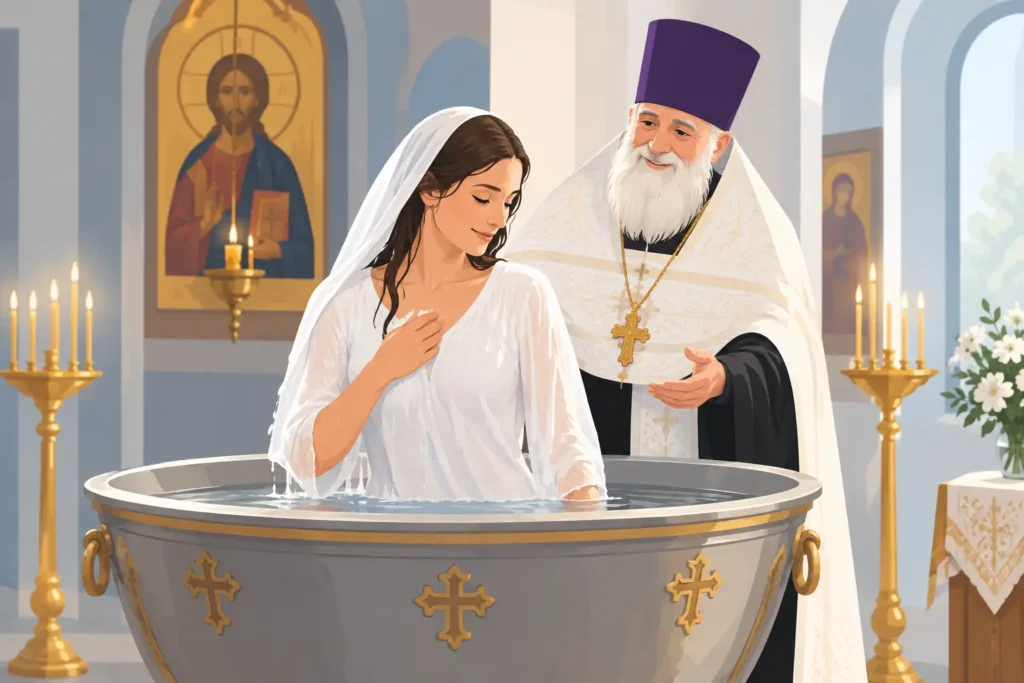
A person does not come up from the baptismal waters merely having made a meaningful religious statement. In Orthodox Christianity, baptism is a real participation in the death and resurrection of Jesus Christ. That is how Orthodox baptism changes life: the old life, ruled by sin and death, is put away, and a new life in Christ begins.
This is why the Church treats baptism with such joy and sobriety. It is not graduation from a class. It is not a public badge of private belief. It is the beginning of a new existence, received by grace and then lived through repentance, worship, prayer, confession, fasting, communion, and love of neighbor.
Baptism joins us to Christ Himself
St. Paul speaks plainly: those baptized into Christ Jesus are baptized into His death, so that they may walk in newness of life. The Orthodox Church receives these words as more than a metaphor. Christ truly acts in the sacrament. He cleanses, adopts, heals, and unites the baptized person to His own Body, the Church.
Before baptism, sin is not simply a collection of bad choices. It is a condition of alienation from God, a captivity from which people cannot rescue themselves. We may recognize our failures, seek self-improvement, or attempt to establish a better moral life. But the deepest need is not a revised personality. We need communion with God.
In baptism, Christ gives that communion. The baptized person is clothed in Christ and receives a new identity that no career, family history, political tribe, success, or failure can provide. This identity does not erase personality, memory, or legitimate human bonds. It puts them in their proper place. The central fact becomes this: you belong to Christ.
Forgiveness is the beginning, not the finish line
Baptism grants the forgiveness of sins. For an adult coming from a painful past, that truth can bring enormous relief. There is no sin too deep for the mercy of Christ when a person turns to Him in faith and repentance. The Church does not ask a seeker to pretend that the past was harmless. She proclaims that Christ is stronger than the past.
Yet baptism is not merely a spiritual reset button. The consequences of former sins may still need patient repair. A broken relationship may require an apology. An addiction may require treatment, accountability, and sustained spiritual struggle. Debts, legal obligations, and wounds do not evaporate because someone enters the water.
What changes is that none of these things has the final word. The baptized person faces them as one who has been received by God, not as one trying to earn a place before Him.
How Orthodox baptism changes life day by day
The dramatic moment at the font gives way to ordinary faithfulness. This is where many people need clear expectations. Baptism is decisive, but growth is gradual. A newly baptized Christian may still feel temptations, grief, anger, fear, or confusion. The presence of struggle does not mean baptism failed. It means the Christian life has begun in earnest.
The Church calls this life repentance. Repentance is not despairing self-accusation. It is the continual turning of the heart toward God. The baptized person learns to name sin honestly, reject excuses, ask forgiveness, and rise again through Christ’s mercy.
This is why the habits of parish life matter. Sunday worship is no longer optional religious encouragement when convenient. It is the gathering of Christ’s Body around the Lord’s table. Prayer at home becomes less about finding the right emotional state and more about standing before God faithfully. Fasting trains desire. Confession brings hidden sins into the light. Giving becomes an act of gratitude rather than an afterthought.
None of this is a payment for grace. It is the form grace takes in a human life. A person who has been planted in Christ is called to grow in Christ.
Baptism gives a person a people
Modern Americans are often told that faith is a private matter. Orthodox baptism says otherwise. No one baptizes himself. The Church receives the candidate, prays over him or her, anoints with holy oil, baptizes in the name of the Father, Son, and Holy Spirit, and welcomes the newly illumined into the Eucharistic community.
This matters especially for people who have lived with spiritual rootlessness. The Christian life cannot be sustained by podcasts, online arguments, private Bible reading, or occasional visits to a service. Such resources can help, but they cannot replace a parish family gathered in prayer.
To be baptized is to gain brothers and sisters who will sometimes encourage you, sometimes correct you, and sometimes simply stand beside you in sorrow. It also means accepting responsibilities. You are not a consumer of religious services. You become a member of a body, called to pray for others, serve where needed, forgive offenses, and remain present when community life becomes inconvenient.
For parents, baptism also changes the shape of family life. Children are not merely taught Christian values from a distance. They are raised in the worshiping life of the Church, learning reverence through repeated participation: making the sign of the cross, hearing Scripture, honoring feast days, asking forgiveness, and receiving the prayers of the community.
The gift of chrismation and the life of the Holy Spirit
In the Orthodox tradition, baptism is immediately followed by chrismation. The newly baptized person is anointed with holy chrism and receives the gift of the Holy Spirit. The Church does not treat this as a decorative addition to baptism. The Christian life cannot be lived by willpower alone. It requires the Spirit who gives life.
The Holy Spirit does not usually make a person instantly impressive. More often, He begins a quieter work: exposing pride, strengthening conscience, making prayer possible when it feels dry, deepening patience, and teaching the heart to desire what is good.
There can be seasons of great consolation after baptism, but there can also be seasons of temptation and spiritual dryness. Neither should be treated as the ultimate measure of faithfulness. The measure is whether we continue to turn toward Christ, receive the life of the Church, and obey what He has commanded.
A new life requires formation
The ancient Church did not send newly baptized Christians away with a certificate and a smile. It continued to teach them the mysteries they had received. This ongoing formation is often called mystagogy. It recognizes a simple truth: a person can enter the Church in a moment, but learning to live as an Orthodox Christian takes a lifetime.
For a convert, this may mean patiently unlearning assumptions about salvation, Scripture, authority, worship, and the Christian life. For someone baptized as an infant and returning later, it may mean receiving the faith as an adult for the first time. For every Christian, it means moving from information to transformation.
Serious catechism before baptism is therefore an act of pastoral care, not an unnecessary obstacle. So is serious teaching afterward. At All Saints of North America Orthodox Church, the path does not end at the font. The Church continues to form the newly baptized through worship, pastoral guidance, instruction, and the daily work of becoming faithful.
Do not expect an easier life
Christ never promised that following Him would remove hardship. Baptism may make some relationships clearer and more difficult. Friends may not understand your commitment. Old habits may resist more fiercely once you begin to renounce them. You may discover sins in yourself that you did not previously see.
But baptism changes the ground beneath your feet. Suffering is no longer meaningless isolation. Temptation is no longer proof that you are abandoned. Even death is no longer the final horizon, because the baptized have been joined to the crucified and risen Lord.
This does not make Christians superior to others. It should make us humbler. We have received mercy, and we remain dependent on mercy every day.
If you are preparing for baptism, ask God not merely for a moving experience but for a faithful heart. Come ready to renounce sin, confess Christ, receive the Church’s life, and remain within it. And if you have already been baptized, return to the gift you received: make your prayers, come to worship, seek confession when you fall, and begin again. The waters of baptism mark the beginning of a life that Christ Himself sustains.