A visitor may notice that Orthodox Christians pray for their bishop by name and wonder why. Why does the Church care who ordained a priest, who consecrated a bishop, or whether a local parish stands in communion with the wider Church? Orthodox apostolic succession answers these questions. It is not a ceremonial pedigree or a claim to religious prestige. Apostolic succession is the Church’s living continuity with the Apostles whom Christ sent to preach, baptize, forgive sins, celebrate the Eucharist, and guard the faith.
For people weary of churches built around a charismatic personality, a new interpretation of Scripture, or a constantly changing doctrinal statement, this continuity matters. Christ did not leave behind a collection of private opinions. He established His Church, gave authority to His Apostles, and promised to remain with her.
Apostolic Succession Is a Living Inheritance
The Apostles did not keep their ministry to themselves. As the Church grew, they appointed men to serve and lead the local churches. The New Testament records the laying on of hands, the appointment of presbyters, and the charge to preserve what had been received. By the early centuries, the Church recognized bishops as successors to the Apostles in each local church.
This does not mean that every bishop has the same role as St. Peter, St. Paul, or St. John. The Apostles were unique witnesses of the risen Christ and the foundation stones of the Church. Yet bishops carry forward the apostolic ministry: teaching the faith, preserving ecclesial unity, ordaining clergy, and overseeing the sacramental life of the people entrusted to them.
Apostolic succession, therefore, includes more than a historical chain of ordinations. The Church receives an inheritance: the apostolic faith, the apostolic worship, the apostolic moral life, and the apostolic ministry. These belong together. This is Orthodox apostolic succession. A bishop cannot faithfully claim succession while rejecting the Gospel the Apostles preached.
What the Apostles Handed Down
The Apostles handed down the proclamation that Jesus Christ is truly God and truly man, crucified and risen for the life of the world. They handed down baptism into the Holy Trinity, the Eucharistic gathering of the Church, repentance and forgiveness, prayer, fasting, and the pattern of life shaped by holiness.
They also handed down a visible Church. Christianity is personal, but it is never merely private. Christians gather around the Eucharist under a bishop or a priest sent by him. They confess the same faith, receive the same sacraments, and remain accountable to the Church rather than making themselves their own final authority.
How Orthodox Apostolic Succession Works
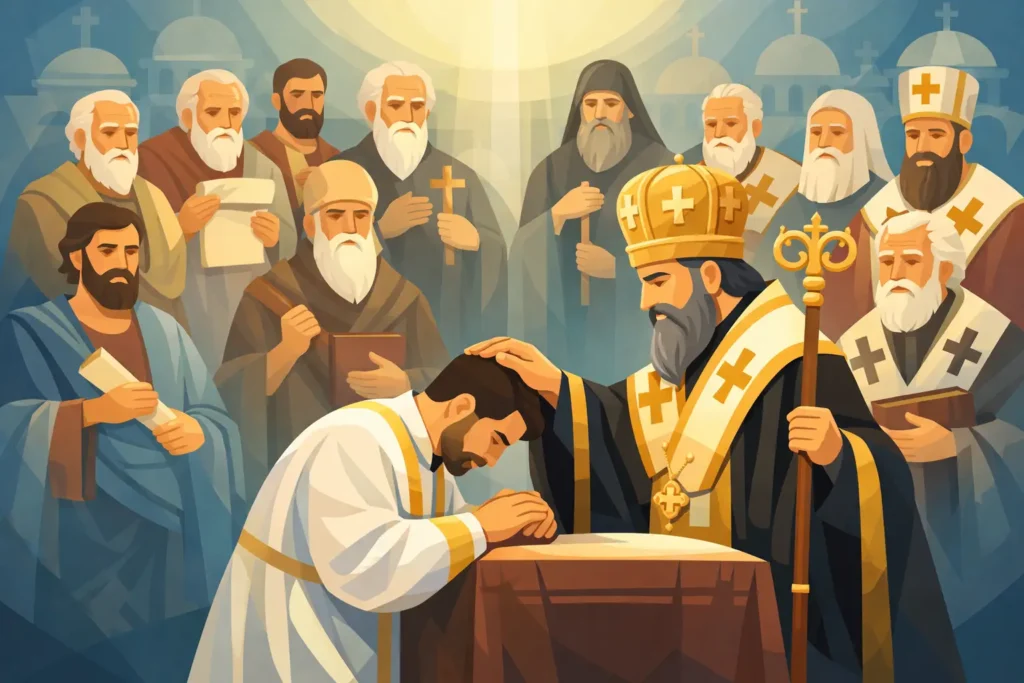
In the Orthodox Church, a bishop is consecrated through the laying on of hands by other canonical Orthodox bishops. This ordinarily takes place with several bishops present, showing that no bishop invents his own ministry or rules as an isolated religious leader. He receives his office within the communion of the Church.
A priest does not appoint himself. His bishop ordains him and assigns him to serve a particular parish or ministry. When an Orthodox priest celebrates the Divine Liturgy, baptizes, hears confession, or prepares a family for marriage, he does so as a priest of the Church under his bishop’s blessing. This protects the parish from becoming a private ministry built around one man’s preferences.
That visible order is not bureaucracy for its own sake. It gives concrete expression to a spiritual truth: Christ is the true High Priest, and all ordained ministry serves His Church. The bishop is not a replacement for Christ. He is accountable to Christ, to the faith received from the Apostles, and to the communion of the Orthodox Church.
An Unbroken Line Is Not Enough
Some discussions of succession make it sound mechanical: if one can trace a line of hands back through history, everything is settled. The Orthodox Church does not see matters so narrowly. Historical continuity matters greatly, but succession cannot be separated from faith and communion.
A bishop must confess the Orthodox faith. He must receive the Holy Scriptures as the Church has received them, uphold the Ecumenical Councils, preserve the sacraments, and remain in communion with the canonical Orthodox Church. The Church has known bishops who fell into heresy or broke communion. Their office did not give error the power to become truth.
This is one reason Orthodox Christians speak not only of apostolic succession but also of Holy Tradition. Tradition is not a pile of old customs. It is the life of the Holy Spirit in the Church, faithfully preserving what Christ gave through His Apostles. Scripture stands at the heart of that Tradition, read and proclaimed within the worshipping Church that received it.
The opposite error also needs to be avoided. Orthodoxy does not teach that grace depends on the personal virtue of every clergyman. Priests and bishops must pursue repentance and holiness, and clergy can fail grievously. Yet the sacraments belong to Christ, not to the private moral accomplishments of the minister. The Church does not ask the faithful to place their hope in a man’s personality. She directs them to Christ, who acts in His Church.
Why This Questions Modern Christianity
Many Christians have inherited a different picture of ministry. A congregation may call a pastor because of education, preaching ability, a vote, or personal conviction. Those qualities can be valuable, but Orthodox Christians ask a prior question: who sent him? The New Testament repeatedly joins preaching with being sent.
This question is not meant as a weapon against sincere Christians outside the Orthodox Church. Many people love Christ deeply and have never been taught why apostolic continuity matters. Some have encountered churches marked by confusion, instability, or shallow teaching and are now searching for the ancient Christian faith. They deserve an honest answer rather than a slogan.
The Orthodox answer is direct: the Church is not recreated whenever believers gather around a Bible. The Church is the Body of Christ, visibly present across time and place. Her bishops, clergy, worship, and doctrine are not optional decorations. They are part of the life Christ established for the salvation and formation of His people.
Roman Catholics also claim apostolic succession, and the question of the relationship between the Orthodox and Roman Catholic Churches requires care, historical honesty, and theological precision. It should not be reduced to internet arguments or treated as a contest of institutional claims. The Orthodox Church confesses that the fullness of the apostolic faith and sacramental life abides in the Orthodox Church, while the restoration of full communion remains a serious matter of truth, unity, and repentance. The Orthodox Church remains what it was a thousand years ago and more. The Roman Catholic church is not even the same church or celebrating the same services it was 50 years ago.
What Apostolic Succession Means for Your Parish Life
For a person considering Orthodoxy, apostolic succession becomes real long before it becomes an abstract theological subject. You see it in the Divine Liturgy, where the priest prays for his bishop. You see it when a catechumen receives careful instruction before baptism or chrismation. You see it in confession, in the blessing of marriages, in pastoral counsel, and in the Church’s refusal to alter her faith whenever the surrounding culture demands it.
It also gives a parish stability. A parish does not belong to its priest, its founding families, its donor base, or its most outspoken members. It belongs to Christ. The priest serves within a larger sacramental and doctrinal communion, and the people learn to live as members of the Church rather than consumers of religious services.
This stability does not eliminate hard questions. Orthodox parishes have imperfect people, clergy carry heavy responsibilities, and every community must practice patience and repentance. But the answer to human weakness is not to abandon the Church’s God-given order. It is to seek Christ more faithfully within it.
Examine the Claim With Reverence and Honesty
If you are exploring Orthodox Christianity, do not settle the question of apostolic succession by reading arguments alone. Attend the services. Listen to the prayers. Notice whether the faith preached from the pulpit accords with the Scriptures and the worship of the historic Church. Ask how clergy are ordained, who their bishop is, and what it means to enter the Church through catechism, baptism, or chrismation.
Give yourself time. A sincere inquirer does not need to pretend certainty before he has received instruction. But neither should he treat the Church as one option among many religious products. The claim of Orthodoxy is substantial: this is the same Church founded by Christ and entrusted to the Apostles, still calling sinners to repentance, healing, and communion with God.
If you live in the west Phoenix area, All Saints of North America Orthodox Church welcomes serious inquirers to come, pray, learn, and ask these questions in the life of the Church. The path into Orthodoxy is not a hurried decision. It is a return to the apostolic faith, received with humility and lived with the whole people of God. Welcome home.