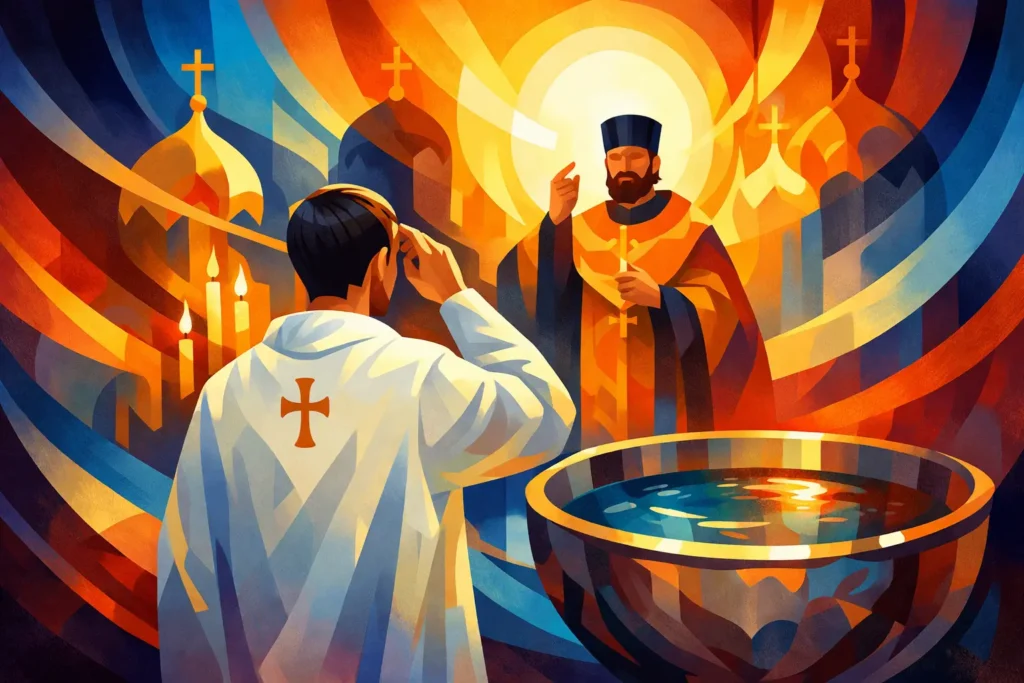
Baptism is not a religious photo opportunity. It is death and resurrection with Christ, entry into His Church, and the beginning of a life of repentance, worship, and obedience. That is why orthodox baptism preparation classes matter. They are not bureaucratic hurdles placed in front of a sacrament. They are part of the Church’s care for souls.
Many people come to Orthodoxy after years of confusion, shallow teaching, or spiritual instability. Some were raised Christian but never received clear doctrinal formation. Others are coming from evangelical, Roman Catholic, or non-denominational backgrounds and have sincere questions about what baptism means, why the Church prepares people carefully, and what changes afterward. The preparation process exists precisely for this reason. The Church does not treat baptism as an isolated event. She receives persons into a way of life.
What Orthodox baptism preparation classes are for
At the most basic level, orthodox baptism preparation classes prepare a person to be baptized into the Holy Orthodox Church with understanding, reverence, and accountability. That preparation includes doctrine, but it is not only doctrinal. It also includes worship, prayer, repentance, moral formation, and relationship to the parish.
In other words, the goal is not simply that someone can explain Orthodox teaching on paper. The goal is that he or she begins to live as an Orthodox Christian. That means learning how the Church prays, what the Church teaches, how one confesses sin, why the sacraments matter, and what it means to belong to a real parish under real pastoral care.
This is one reason the process can feel slower than some people expect. In a culture trained to want immediate access, the Church insists on formation before reception. That can be frustrating for the impatient. It is also merciful. A rushed baptism may satisfy emotion in the moment while leaving a person unprepared for the demands of Christian life.
What is usually covered in baptism preparation
The exact structure varies by parish and priest, but most orthodox baptism preparation classes cover a core set of realities that every candidate needs to understand.
The Gospel and the meaning of salvation
Preparation begins with Christ Himself. What has He done in His incarnation, crucifixion, resurrection, and ascension? What does it mean to be saved? Orthodoxy does not reduce salvation to a single moment of decision. Salvation is life in Christ, participation in His victory over death, and continuing union with Him in the Church.
That distinction matters, especially for those coming from traditions that emphasize a one-time public profession without much sacramental or ecclesial depth. Baptism is not merely a symbol of something already complete. It is a sacrament in which God truly acts.
Baptism, Chrismation, and the Eucharist
Candidates are usually taught how these mysteries belong together. In Orthodox practice, baptism is not treated as a stand-alone rite disconnected from the rest of the Christian life. One is baptized, chrismated, and brought to Holy Communion as a member of Christ’s Body.
This helps correct a common misunderstanding. People sometimes ask whether baptism alone is enough while postponing real commitment to worship or parish life. The Orthodox answer is that initiation into the Church is ordered toward full participation in the sacramental life.
The Creed and basic doctrine
A serious preparation process will include the Nicene Creed, the Holy Trinity, the person of Christ, the Church, the saints, icons, Scripture, and Holy Tradition. This is not academic padding. A person entering the Church should know what the Church confesses.
There is also pastoral wisdom here. Some inquirers arrive with strong opinions formed by books, internet debates, or previous church experiences. Good preparation helps separate genuine Orthodox teaching from personal assumptions and imported theology.
Christian life and repentance
Orthodox baptism preparation classes also address the shape of daily Christian living. Prayer at home, fasting, confession, attendance at the divine services, marriage and family life, sexual morality, stewardship, and spiritual discipline all matter.
This is often where the seriousness of Orthodoxy becomes most clear. People may be attracted by beauty, history, and liturgy, but the Church also calls them to repentance. If someone wants Orthodoxy as an aesthetic identity without submitting to Christ’s commandments, preparation classes should expose that tension early.
Why the Church prepares adults and families carefully
Some people hear about preparation and worry that they are being tested for worthiness. That is the wrong way to think about it. No one earns baptism. The Church prepares people because baptism is holy, and because souls need shepherding.
For adults, preparation helps establish doctrinal clarity and spiritual stability. For families, it also creates unity in the home. If parents are bringing children for baptism, they must understand the obligations involved. The Church does not baptize children so that parents can remain spectators. Parents are expected to raise their children in the faith, bring them to services, teach them to pray, and form their lives around Christ and His Church.
That is one place where the conversation can become very practical. A priest may need to ask whether a family is actually ready to live an Orthodox life rather than simply host a religious ceremony. Those are not harsh questions. They are loving questions.
What to expect from the process
Instruction is usually personal and pastoral
In healthy parishes, preparation is not reduced to a generic class detached from real people. There may be formal lessons, assigned readings, or catechism sessions, but there should also be direct pastoral guidance. Every person comes with a history, previous church background, particular sins, and particular questions.
That means timelines can differ. One person may move steadily through instruction and reception. Another may need more time because of marriage questions, prior baptisms, family circumstances, or unresolved doctrinal confusion. Faster is not always better. Faithful is better.
Attendance and participation matter
You should expect to attend services consistently. Orthodoxy is learned not only by explanation but by worship. A person who wants baptism without entering the rhythm of the Church’s life is asking for too little. The liturgy, feasts, fasts, and prayers of the Church shape the heart as much as formal instruction shapes the mind.
This is especially important for those coming from traditions where teaching is almost entirely sermon-based. In Orthodoxy, doctrine is embodied in worship. If you do not pray with the Church, you will not understand the Church as deeply as you think.
Sponsors and readiness may be discussed
In many cases, preparation includes guidance regarding sponsors or godparents, practical planning for the baptism, and questions about readiness for confession and Communion. These are not side issues. They help connect the sacrament to real parish life and ongoing accountability.
A faithful sponsor is not a ceremonial extra. He or she should be an Orthodox Christian in good standing who can support the newly illumined person’s life in the Church.
Common misunderstandings about orthodox baptism preparation classes
One misunderstanding is that classes exist to keep people out. In reality, they exist to bring people in rightly. Another is that online learning alone is enough. Digital resources can be extremely helpful, especially for those in places like Surprise, Peoria, Glendale, Buckeye, Litchfield Park, or Waddell who may be seeking a serious Orthodox parish home with structured teaching. But online instruction should lead toward sacramental life, not replace it.
A third misunderstanding is that once baptism happens, the hard part is over. In truth, baptism is a beginning. The temptations do not disappear. The need for confession does not disappear. The obligation to forgive, pray, fast, and remain faithful does not disappear. Preparation classes are meant to start habits that continue long after the day of baptism.
How to approach baptism preparation well
Come honestly. If you have doubts, say so. If you have sins that weigh on you, do not hide behind religious language. If your previous church background shaped your assumptions, be willing to have those assumptions corrected.
Come patiently as well. Some people want a fixed schedule and a guaranteed date immediately. Sometimes that is possible. Sometimes it is not. The Church is dealing with human souls, not processing paperwork.
It also helps to come with a willingness to be taught. Orthodoxy is not self-invented Christianity. You are not being invited to customize the faith, but to receive it. That humility is not a loss of dignity. It is the beginning of wisdom.
For those seeking a parish that takes formation seriously, All Saints of North America Orthodox Church has made that seriousness plain through structured catechism, pastoral guidance, and a clear path for those preparing for baptism or chrismation. That kind of clarity is a gift in a confused age.
If you are considering baptism, do not ask only how soon it can happen. Ask whether you are ready to be formed by the truth, corrected by the Church, and joined to a life that belongs entirely to Christ. That is where real preparation begins.