An evangelical pastor may spend decades preaching Scripture, leading prayer, baptizing believers, counseling families, and calling people to repentance, yet still come to a difficult realization: the Church Christ founded is more ancient, sacramental, and visible than he had been taught to expect. When evangelical pastors become Orthodox priests, the change is rarely a rejection of Christ or the Bible. More often, it is a costly act of obedience to the Christ they have sought to serve.
This path can surprise congregations, friends, and even the pastors themselves. It may look like a dramatic change in worship, vestments, vocabulary, and church government. But beneath those visible changes stands a serious question: where is the apostolic Church, and what does it mean to minister within her life?
Why Evangelical Pastors Become Orthodox Priests
No single story explains every conversion. Some pastors begin with questions about the authority of Scripture and discover that the Bible arose within the worshiping life of the Church. Others become unsettled by the endless multiplication of denominations, each claiming biblical fidelity while disagreeing on baptism, Communion, salvation, church authority, and moral teaching.
Many find themselves reading the early Church Fathers and recognizing a Christianity that is unmistakably biblical but not recognizably modern evangelical. The Fathers speak of bishops, Eucharistic sacrifice, baptismal regeneration, fasting, confession, saints, and a Church that receives and guards the faith handed down by the apostles. These are not later decorations added to an otherwise invisible religion. They belong to the Church’s ordinary life from the beginning.
For an evangelical pastor, that discovery carries particular weight. A pastor is not merely evaluating a new worship preference. He is asking whether his own ministry has stood within the fullness of the Church’s sacramental and apostolic order. That question should never be answered casually.
The search for a Church, not a religious upgrade
Some people imagine that a pastor enters Orthodoxy because ancient liturgy feels more reverent or because Orthodox aesthetics are compelling. Beauty can open the door, and Orthodox worship is indeed beautiful because it is ordered toward the worship of the living God. But beauty alone does not sustain conversion when it requires public humility, theological reexamination, and the surrender of familiar ministerial authority.
The deeper issue is ecclesial. Orthodox Christianity does not present itself as one denominational option among many. It confesses itself to be the one, holy, catholic, and apostolic Church proclaimed in the Creed. This claim is not triumphalism. It is a confession that Christ did not leave His people with a collection of competing interpretations, but with a Body, a faith, a sacramental life, and shepherds accountable to the apostolic tradition.
Evangelical Pastors who come to accept that claim often find both rest and responsibility. They no longer bear the burden of inventing a church’s doctrine, choosing which practices are essential, or making private judgment the final authority. They receive, as does every Orthodox priest, what the Church has preserved: Holy Scripture read in its proper home, the dogmatic faith of the councils, the Divine Liturgy, the mysteries, the fasts, and the communion of saints.
Scripture Leads Many Evangelical Pastors Toward Orthodoxy
Evangelical pastors commonly love the Bible deeply. That love often becomes the very road by which they encounter Orthodoxy. They see in Acts a Church devoted to teaching, fellowship, prayers, and the breaking of bread. They see baptism joined to forgiveness and new life. They see elders and bishops appointed for the care of local churches. They see the Eucharist treated not as a casual symbol, but as a holy participation that demands repentance and discernment.
They also encounter passages that resist an individualistic account of Christianity. The Church is the body of Christ and the pillar and ground of the truth. Christians are commanded to hold fast to the traditions received both in writing and by word. The faith is delivered to the saints, not continually reinvented by each generation.
Orthodoxy does not ask Christians to set Scripture aside for tradition. It rejects that false choice. The Church receives Holy Tradition as the life of the Holy Spirit in the Church, with Scripture at its heart. The Bible is not diminished by this setting. It is heard more fully, proclaimed in worship, prayed in the Psalms, interpreted with the saints, and obeyed within a people who belong to one another.
The Eucharist changes the question
For many former evangelical pastors, the Eucharist becomes a decisive matter. If Christ truly gives His Body and Blood in the Holy Mysteries, then Communion cannot remain an occasional memorial shaped chiefly by local custom. It must stand at the center of the Church’s worship and pastoral care.
This conviction does not make evangelical Christians insincere or their desire for Christ unreal. Orthodox Christians should speak with gratitude for every sincere confession of Jesus Christ, every act of mercy, and every genuine hunger for God’s Word. Yet sincerity does not settle every theological question. The Church calls all of us to receive the fullness of what Christ gives, not merely the portion we have inherited.
Becoming Orthodox Does Not Automatically Mean Becoming an Orthodox Priest
This point requires clarity. An evangelical protestant pastor who is received into the Orthodox Church does not automatically become an Orthodox priest. Reception into the Church and ordination to the priesthood are distinct matters. A man may become Orthodox through the pastoral process appropriate to his circumstances, then live faithfully as a layman, perhaps serving the Church in many meaningful ways.
Ordination belongs to the bishop and the Church. It involves discernment of a man’s faith, character, family life, formation, health, canonical situation, and the actual needs of the diocese contribute to the decision to make him an Orthodox priest. Previous pastoral experience may be valuable, but it does not function as a transferable credential. Orthodox priesthood is not a career move, nor is it a reward for theological knowledge.
In some cases, after substantial formation and discernment, a bishop may receive a former Evangelical Protestant minister for Orthodox ordination. In other cases, he may not. The faithful response is obedience. This can be one of the most searching parts of a pastor’s conversion: learning that ministry is received from the Church rather than claimed as a personal possession.
That humility is not a demotion. It is freedom. A man who has preached, built ministries, and carried the expectations of a congregation may now learn to stand quietly among the faithful, confess his sins, keep the fasts, attend the services, and receive instruction. Before anyone can shepherd in the Orthodox Church, he must learn anew to be a sheep of Christ’s flock.
What This Journey Costs – and Gives
The cost can be real. A pastor may lose employment, friendships, denominational standing, and the confidence of people he loves. His spouse and children also bear the weight of the transition. For that reason, a pastor should not force his family into a rushed decision or treat conversion as a theological project conducted in isolation. The household needs patient prayer, honest conversation, steady worship, and pastoral care.
There are practical sacrifices as well. Orthodoxy asks Christians to enter a disciplined rhythm: fasting, confession, sacramental preparation, obedience to the Church’s calendar, and regular participation in the Divine Liturgy. Much more so for an Orthodox priest. The transition can feel especially demanding for those formed in communities where personal spontaneity was treated as the measure of spiritual vitality.
Yet many converts discover that discipline does not extinguish life in Christ. It trains desire. The fast teaches that the body belongs to God. Confession exposes sin without despair. The liturgical year forms memory around Christ’s saving work. The prayers of the Church give words to sorrow, gratitude, fear, repentance, and hope when private words run thin.
A Word to Evangelical Pastors and Their Families
If you are an evangelical pastor asking these questions, do not begin by trying to settle every issue in a week. Begin with prayer and truthfulness. Attend the Divine Liturgy consistently. Listen before you argue. Read the Scriptures with the early Church. Bring your hardest questions into a serious catechetical setting, where they can receive careful answers rather than slogans.
Do not hide the journey from your wife if you are married, and do not treat your children as an afterthought. Conversion is personal, but it is never merely private. Seek counsel from an Orthodox priest who understands the gravity of pastoral transition and will not flatter you with easy assurances.
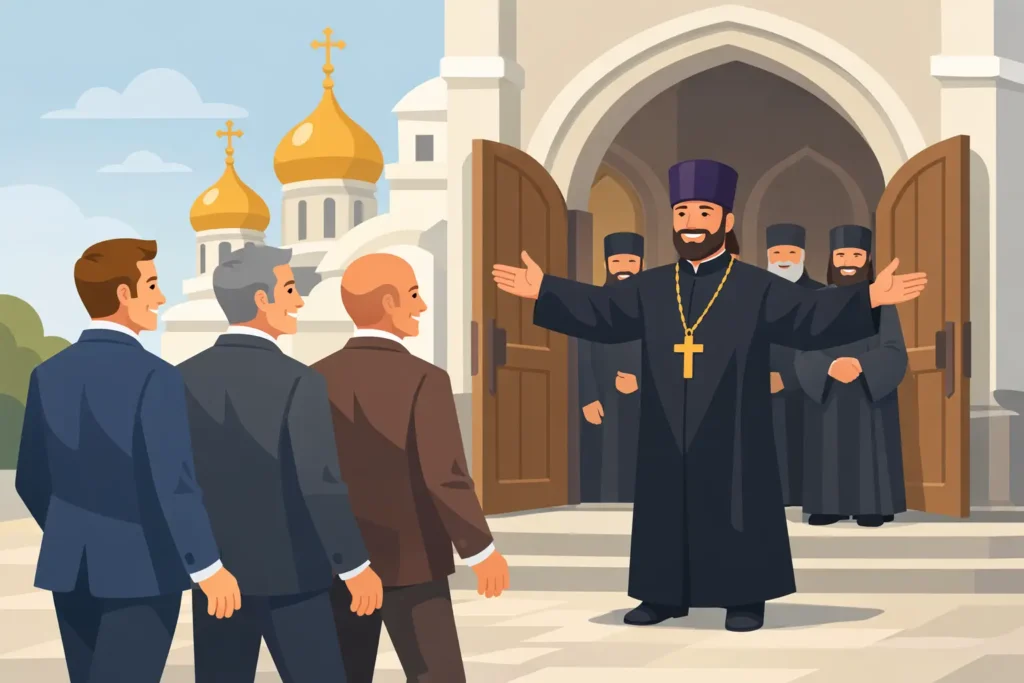
At All Saints of North America Orthodox Church, inquirers from Surprise, Peoria, Sun City, Buckeye, and the wider west Phoenix area can enter a deliberate path of worship, catechesis, and pastoral conversation. You do not need to arrive with every question resolved. You do need to come willing to seek the truth in repentance, patience, and love.
Christ does not call His servants to preserve a religious identity at all costs. He calls them to follow Him. For some evangelical pastors, that faithful following leads them to the Orthodox Church, where the ancient faith is not a museum piece but the living worship and sacramental life of Christ’s people. Welcome home.