A question about chrismation vs baptism Orthodox often begins with a personal history: “I was baptized as a child. Do I need to be baptized again?” Or perhaps, “Why was my friend received by Chrismation while someone else entered through Baptism?” These are not merely administrative questions. They concern how a person is received into the one, holy, catholic, and apostolic Church, and how he begins a life of repentance, worship, and communion in Christ.
The Orthodox Church does not treat Baptism and Chrismation as competing options. Both are holy mysteries given by Christ to His Church. Yet they are distinct mysteries, with distinct meanings, and the way a convert is received requires pastoral judgment and fidelity to the Church’s canonical tradition.
What Is Holy Baptism?
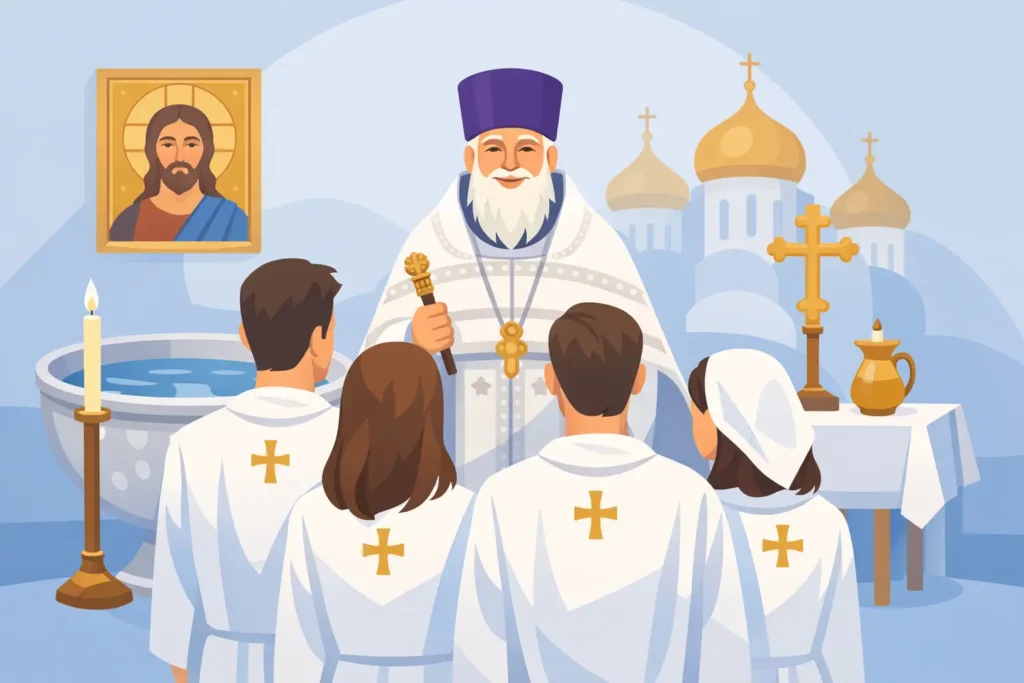
Holy Baptism is the new birth in Christ. In it, the person being baptized is united to the Lord’s death and resurrection. He renounces Satan, confesses the Orthodox faith, and is immersed three times in water in the name of the Father, the Son, and the Holy Spirit.
St. Paul teaches that those baptized into Christ Jesus are baptized into His death, so that they may walk “in newness of life.” Baptism is not only a public profession of faith or a symbolic act of obedience. It is a sacramental entrance into Christ’s Body. The baptized person dies to the old life and receives a new life of grace.
For this reason, Orthodox Baptism is normally performed by threefold immersion. The action visibly proclaims the Gospel: burial with Christ, resurrection with Christ, and incorporation into His Church. Infants are baptized because salvation is the gift of God before it is our accomplishment. Adults are baptized after a period of instruction, repentance, and preparation.
Following Baptism, the newly illumined Christian is Chrismated and receives Holy Communion. In the normal Orthodox order, these mysteries belong together. One is born into Christ through Baptism, sealed with the Holy Spirit through Chrismation, and nourished at the Eucharistic Table.
What Is Holy Chrismation?
Chrismation is the mystery in which the baptized person is sealed with the gift of the Holy Spirit. The priest anoints the person with holy chrism on the forehead, eyes, nostrils, mouth, ears, breast, hands, and feet, saying, “The seal of the gift of the Holy Spirit.”
The holy chrism is consecrated by a bishop, expressing that the newly received Christian enters not a private spiritual project but the visible communion of the Orthodox Church. Chrismation is connected with the apostolic laying on of hands and the gift of Pentecost. The Christian is equipped to live faithfully in Christ, to confess the faith, and to grow in holiness.
For those baptized in the Orthodox Church, Chrismation ordinarily follows immediately after Baptism. This differs from the common Western practice of separating confirmation from infant baptism by many years. Orthodoxy recognizes that a child, as fully as an adult, needs the grace of the Holy Spirit and participation in the Church’s sacramental life.
Chrismation vs. Baptism Orthodox: Why Converts May Be Received Differently
The question becomes more complex when someone has already received a baptism outside the Orthodox Church. Orthodox Christians confess one Baptism for the remission of sins. At the same time, the Church has historically had to address how to receive those coming from communities separated from her communion.
In some cases, a person is received by Holy Baptism. In other cases, a person with a Trinitarian baptism may be received by Chrismation after a confession of the Orthodox faith. This is not because Chrismation replaces Baptism or because the Church considers the two mysteries identical. Rather, it reflects the Church’s pastoral authority to receive converts according to her canons, her liturgical tradition, and the judgment of the bishop.
There is no responsible one-sentence formula that can settle every case. A prior baptism may lack the Trinitarian confession, may have been performed in a manner far removed from Christian baptism, or may arise from a community whose teaching about Christ and the Holy Trinity is fundamentally distorted. Such circumstances matter.
Even where a prior baptism is recognized for purposes of reception, the person is not simply “joining a new denomination.” Through Chrismation, he confesses the Orthodox faith, is reconciled to the Church, and receives the seal of the Holy Spirit within her sacramental communion.
Why Orthodox Practice Can Differ
Inquirers sometimes encounter different practices among Orthodox jurisdictions or hear strong opinions online. The existence of pastoral variation can be unsettling, especially for those seeking clarity after years of denominational confusion. But the answer is not to appoint oneself judge over the Church’s mysteries.
Orthodox pastoral practice has long involved both strictness and merciful accommodation. The Church calls this discernment akribeia and economia. Akribeia is careful adherence to the full canonical norm. Economia is the Church’s pastoral stewardship, applied not to weaken the faith but to bring people into the fullness of the Church in a way that serves their salvation.
This discernment belongs to the bishop and the clergy acting under him. It is not a matter of personal preference, internet debate, or selecting the reception method one finds most emotionally satisfying. A priest will ask about the person’s prior Christian background, the form of baptism received, his understanding of the faith, and his readiness to enter a life of Orthodox obedience.
That final point matters greatly. A person may be deeply concerned about whether he will be baptized or Chrismated, while giving too little attention to whether he is prepared to pray, fast, confess sins, attend the divine services, receive instruction, and remain faithful after reception. The mystery is not a finish line. It is the beginning of a life offered to Christ.
What Converts Should Expect
A serious Orthodox parish will not rush a sincere inquirer through a sacramental process merely to produce a quick result. Catechism gives time to learn the Scriptures, the Creed, the feasts, the sacramental life, Orthodox moral teaching, and the habits of prayer that sustain Christian faithfulness.
During this period, be honest about your background. Bring records or details of any prior baptism if they are available. Explain what community performed it, what words were used, and whether water was used. Do not conceal concerns or assume that your previous experience automatically answers the question.
Just as importantly, receive the guidance of the Church with humility. If the bishop directs Baptism, receive it with gratitude, not as an accusation that God has been absent from every part of your previous life. If you are directed toward reception by Chrismation, do not regard it as a lesser entrance into Orthodoxy. In either case, you are being received into the same Church, confessing the same Lord, and entering the same Eucharistic communion.
Baptism Is Not a Denial of God’s Providence
Some Christians fear that being baptized in the Orthodox Church would mean denying every sincere prayer, act of repentance, or work of grace that came before. That is not the Church’s teaching. God is merciful, and He draws people to Himself in ways beyond our calculation.
But God’s providence in leading someone to seek Orthodoxy is precisely a reason to receive the Church’s sacramental life seriously. The question is not whether God has been at work in your past. The question is whether you are now willing to receive the fullness of life He gives in His Church.
For an adult convert, Baptism is a joyous and solemn crossing from the old life into a new one. It calls for repentance and faith. For the person received through Chrismation, the same surrender is required. Neither path permits a casual approach to Christ or to His Church.
The Goal Is Life in the Church
The deeper issue in chrismation vs baptism Orthodox is not which rite seems more impressive, nor which answer wins an argument. The goal is communion with Christ in His Church. Baptism, Chrismation, and Holy Communion draw a person into a concrete life of worship, discipline, forgiveness, and service.
If you are exploring Orthodoxy in the west Phoenix area, do not let uncertainty about your reception keep you at a distance. Begin attending the services, speak with a priest, and enter catechism with patience. The Church receives those who come in faith, and she calls every newly received Christian to remain, grow, and become a faithful member of the household of God.