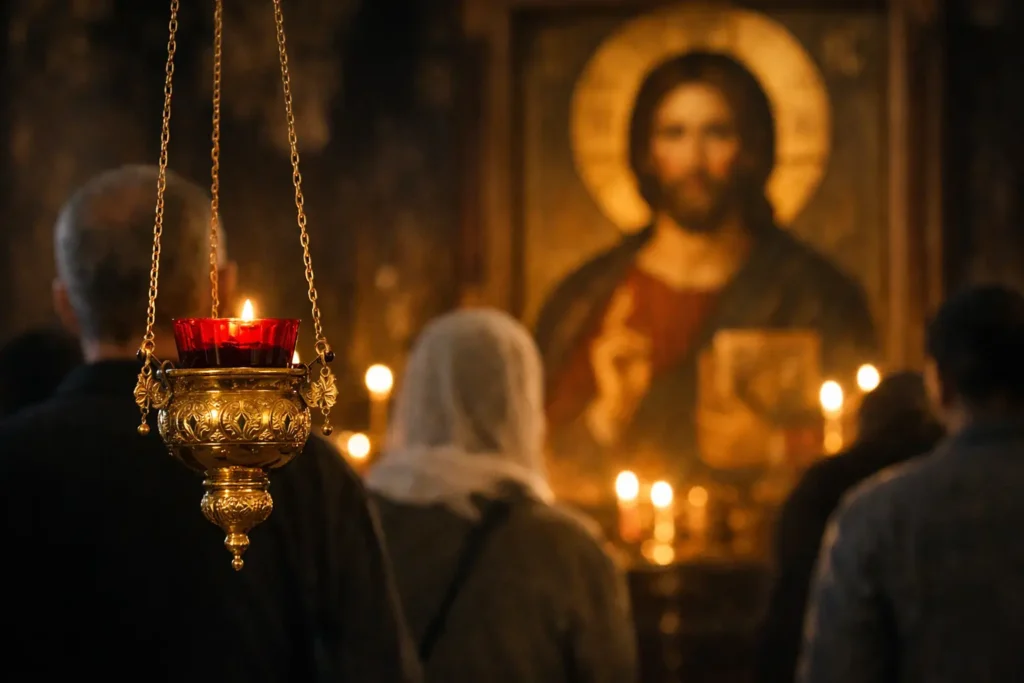
The first thing many visitors notice when participating in Orthodox Vespers is that no one is trying to fill every quiet moment. Lamps burn before the icons. Incense rises. Psalms and hymns carry the congregation into prayer. The Church does not gather merely to hear about God. She gathers to stand before Him.
For Christians formed in a setting where worship is centered on a sermon, Vespers can feel unfamiliar at first. That is not a defect. It is an invitation to receive the Church’s ancient rhythm of prayer with patience, attention, and humility. You do not need to understand every word on your first visit in order to pray. You only need to come honestly, listen carefully, and let the services teach you.
What Orthodox Vespers Is
Vespers is the Church’s evening service. It marks the beginning of a new liturgical day, because the biblical understanding of time begins with evening: “And there was evening and there was morning.” When Vespers is served on Saturday evening, the celebration of the Lord’s Day has already begun.
This matters because Orthodox worship does not treat Sunday as a brief event squeezed between the pressures of the week. The Church prepares for the feast before it arrives. At Vespers, we step out of the noise and fragmentation of ordinary life and enter the scriptural story of creation, fall, repentance, salvation, and the coming Kingdom of God.
The service often begins with Psalm 103, a great hymn of praise for God’s creation. We hear prayers of peace, psalms of repentance, hymns for the feast or saint of the day, and the ancient evening hymn, O Gladsome Light. The service moves from the creation of the world toward the light of Christ, who has come into the world and who will come again in glory.
On Saturday evenings and major feasts, a parish may serve Great Vespers, which includes additional hymns, litanies, and ceremonial actions. A weekday service may be simpler. The form varies with the day and season, but the purpose remains the same: the people of God offer evening praise and prepare to meet Christ.
Participating in Orthodox Vespers Without Pretending
A visitor does not need to perform Orthodoxy. You are not expected to know when to make the sign of the cross, when to bow, or how to sing every response. Trying to imitate everything immediately can become distracting. Prayer is not a test of liturgical agility.
Begin by standing attentively when you are able. Orthodox Christians traditionally stand for worship as a sign of reverence and readiness before God, but those who are elderly, injured, ill, pregnant, or physically limited should sit as needed. The Church does not ask you to prove devotion through pain. If you need a chair, use one without embarrassment.
Follow the service book or printed text if one is available, but do not become anxious about keeping your place. Let your eyes rest on the icons, the cross, the altar, or the words being sung. When a phrase returns, such as “Lord, have mercy,” join it when you can. These repeated petitions are not empty repetition. They train the heart to ask God for mercy with sincerity and perseverance.
You may see faithful Orthodox Christians crossing themselves, bowing, lighting candles, or venerating icons. These actions belong to the Church’s embodied confession of faith. They are not theater, and newcomers should never feel pressured to copy them. Watch, learn, and ask questions afterward. In time, as faith becomes understanding and understanding becomes prayer, the body naturally joins the soul in worship.
What to Expect When You Arrive
Arrive a few minutes early, especially if this is your first Orthodox service. Vespers generally begins promptly, and coming early gives you time to enter quietly, settle your children, and become familiar with the space. In a parish temple, the nave is a place of prayer, not a lobby. Speak softly and save extended conversation for the fellowship that follows.
Dress modestly and respectfully. There is no need to purchase a special wardrobe for one visit. Clean, ordinary clothing that honors the holiness of worship is appropriate. At many Orthodox parishes, men remove hats inside the church. Some women wear head coverings, while others do not. Customs differ, so visitors should not feel singled out either way.
If you are unsure where to stand, choose a place toward the back or side where you can see and hear well. Families with children belong in the service. Children may wiggle, whisper, or need to step out briefly. This is not a failure of reverence. They are learning to belong to the worshiping body of Christ, just as adults are.
You may light a candle if candles are available, but you are not required to do so. A candle is a small offering of prayer, not a fee for attendance or a spiritual purchase. If you would like to venerate an icon but do not know the parish custom, wait and ask. Reverence should be offered freely, never under social pressure.
Listen for the Gospel in the Hymns
The hymns of Vespers are rich with Scripture. The Psalms are sung rather than merely discussed. Old Testament images are fulfilled in Christ. The saints are remembered not as distant religious celebrities, but as living witnesses to the same Lord who calls us to holiness.
This is one reason the service can feel dense to people accustomed to worship built around a few familiar songs. Orthodoxy does not reduce the faith to a handful of themes. It gives us the whole counsel of God over time. At first, you may catch only a line or two: God’s mercy, Christ’s victory over death, the prayers of the Mother of God, or the joy of the Resurrection. Receive that line and carry it with you.
The Church’s worship also corrects a common modern assumption: that prayer is mainly self-expression. At Vespers, we receive words before we offer our own. We learn to desire what the Church desires – peace for the world, unity among Christians, repentance for our sins, healing for the sick, and salvation for all.
Do Not Rush Toward What You Have Not Yet Received
Visitors are welcome at Vespers, including those who are not Orthodox, are exploring Christianity, or are returning after many years away. No one needs to be Orthodox in order to stand, listen, pray, and seek the Lord.
At the same time, Orthodox worship has boundaries that protect the unity of the Church. Holy Communion is reserved for baptized and chrismated Orthodox Christians who have prepared through prayer, fasting, confession when needed, and reconciliation with others. Vespers ordinarily does not include Communion, but this principle is worth understanding from the beginning. The Eucharist is not an expression of private spiritual preference. It is the sacramental confession that we share one faith and one life in the Church.
If you are exploring Orthodoxy, do not let that boundary discourage you. Let it show you that the Church takes union with Christ seriously. There is a real path of inquiry, catechism, repentance, baptism or chrismation, and lifelong growth. No one is asked to rush, but no one is invited to remain a spectator forever.
Let Vespers Shape the Rest of Your Week
For Orthodox Christians, Vespers is not simply a preliminary service before Sunday Liturgy. It teaches us how to live. We begin the new day by blessing God for creation, confessing our need for mercy, and preparing for the Kingdom. That pattern challenges the habit of ending each day with exhaustion, distraction, and anxiety.
If you come to Vespers after a difficult week, bring that difficulty honestly. You may arrive distracted by work, grief, family conflict, illness, or uncertainty about faith. The Church does not require you to manufacture a religious feeling at the door. Stand before God as you are, and allow the prayers of the Church to bear you when your own words are weak.
At All Saints of North America Orthodox Church, those coming from Surprise, Peoria, Sun City, Glendale, Buckeye, and surrounding communities are invited to come early, pray attentively, and speak with the clergy or faithful afterward. Questions are welcome. Serious seekers deserve clear answers, patient guidance, and a parish home where worship and doctrine belong together.
Come to Vespers not to consume an experience, but to offer your attention to God. The evening light fades, the Church sings, and Christ meets His people. Return often enough, and the prayers that first seemed unfamiliar may become the words by which your own heart learns to speak.