If you are learning how to pray with icons, the first thing to understand is simple: an icon is not a decorative background for prayer. It is not a religious mood-setter. In the Orthodox Church, the icon is a witness to the Incarnation. Christ truly took flesh. The saints truly live in Him. Matter can truly be sanctified. So when you stand before an icon, you are not engaging in fantasy or empty symbolism. You are praying in the presence of the holy persons depicted, offering worship to God and honor to His saints.
This matters because many Christians come to Orthodoxy after years of suspicion about images. Others have the opposite problem. They are comfortable with religious art but have never learned reverence. Orthodox prayer with icons avoids both errors. We do not worship wood and paint, and we do not treat holy images casually. We approach them with faith, sobriety, and love.
What an icon is – and what it is not
An icon is a sacred image of Christ, His Mother, the angels, the saints, or a feast of the Church. It teaches the faith visually, but it does more than instruct. It also draws the believer into prayer. The icon sets before your eyes the reality of the Kingdom and reminds you that the Church is larger than what can be seen at the moment.
Still, an icon is not magical. It does not force spiritual feelings. It is not a shortcut around repentance, attention, or obedience. A person can own beautiful icons and remain spiritually inattentive. Another person can pray before a very simple icon with deep compunction. The grace is from God, not from technique.
This is one reason Orthodox Christians bless icons, venerate them, and use them in prayer, but never treat them as talismans. The icon serves communion with God. It does not replace it.
How to pray with icons in an Orthodox home
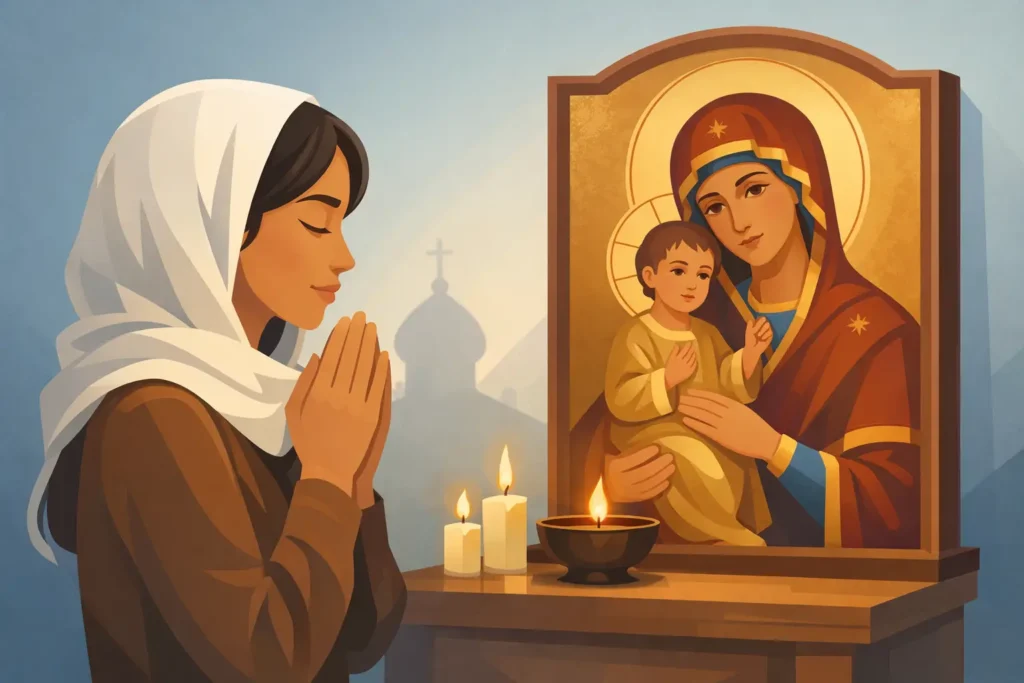
The normal place to begin is not with complexity but with regularity. Set aside a place for prayer in your home. If possible, keep a small prayer corner with an icon of Christ and an icon of the Theotokos. Many Orthodox Christians also keep a cross, a lamp or candle, and perhaps icons of a patron saint or feast. The point is not to create an impressive display. The point is to establish a place where your body learns to stand before God.
When you come to pray, stand quietly for a moment. Make the sign of the cross. If it is your custom, make a bow. Some kiss the icons before beginning. This is not sentimentality. It is an act of reverence, much like kissing the Gospel book or the cross. You are showing honor to Christ and to those glorified in Him.
Then begin with the prayers of the Church. For most people, especially beginners, this is wiser than trying to invent prayers from scratch. Use your morning prayers, evening prayers, the Trisagion prayers, the Jesus Prayer, the Psalms, or other prayers given by the Church. Icons support this prayer. They focus the attention, steady the senses, and help guard the mind from wandering.
It is also good to speak to God in your own words, but even this should grow out of the life of the Church rather than out of pure spontaneity. Ask for mercy. Confess sins. Give thanks. Pray for your spouse, your children, your enemies, the sick, the departed, and those in need. The icon corner becomes a place where private prayer is joined to the prayer of the whole Church.
Praying before an icon of Christ
When you stand before an icon of Christ, direct your prayer to Him plainly and personally. He is not an idea. He is the risen Lord. If you do not know what to say, start with very simple words: “Lord Jesus Christ, Son of God, have mercy on me, a sinner.” Pray it slowly. Pray it attentively. Do not rush to produce emotion.
An icon of Christ helps correct one common problem in prayer: vagueness. People often say they believe in God, but in prayer they drift into abstraction. Before the icon of Christ, you are reminded that the God to whom you pray has a face, a name, and a human nature united to His divinity without confusion. Christian prayer is not addressed to a distant force. It is addressed to the living Christ.
If your mind wanders, bring it back without drama. If you feel dry, continue anyway. Prayer is not measured by emotional intensity. Fidelity matters more than religious excitement.
Praying before icons of the Theotokos and the saints
Some inquirers hesitate here. They understand praying to God, but they are unsure what it means to pray before icons of the Theotokos or the saints. The Orthodox answer is clear. We do not worship the saints. We ask for their intercessions, because they are alive in Christ and because the Church on earth is not cut off from the Church in heaven.
Before an icon of the Theotokos, you may ask her prayers as the Mother of God, the one who bore Christ in the flesh and who continually intercedes for the faithful. Before the icon of a saint, you may ask that saint to pray for you, to strengthen you in a particular struggle, or to help you imitate his or her faithfulness.
This must be done with right order. All salvation is from God. All grace is from God. The saints do not compete with Christ. Their holiness reveals His work in them. The more truly one honors the saints, the more clearly one sees the glory of Christ.
Learning reverence with the body
Orthodox prayer is not only mental. We stand, bow, cross ourselves, and sometimes kneel. We kiss icons. These are not theatrical gestures. They train the whole person in humility and worship.
This can feel unfamiliar to those coming from traditions where prayer is mostly internal or verbal. But the body is not incidental to spiritual life. We are embodied souls, and our habits either assist prayer or weaken it. Reverence with the body helps gather a distracted heart.
There is still a need for discretion. If physical actions become exaggerated or self-conscious, they can distract rather than help. The aim is not performance. The aim is sincere prayer offered with the whole person.
Common mistakes when learning how to pray with icons
One mistake is treating icons as aesthetic objects more than holy objects. It is possible to admire iconography while failing to pray. Another mistake is expecting immediate mystical experiences. That expectation usually produces either disappointment or delusion.
A third mistake is overcomplicating everything. A new Orthodox Christian does not need a large icon wall, many devotional accessories, and a custom prayer rule on day one. Start with faithfulness in small things. A few prayers said daily before a few icons are better than elaborate intentions that collapse after one week.
There is also the opposite error – reducing icons to mere teaching tools. They do teach, but in Orthodox life they are also liturgical and devotional. They belong to the worshiping life of the Church. If you separate them from confession, fasting, Scripture, the divine services, and the sacraments, you will misunderstand them.
When prayer feels difficult
There will be days when prayer before icons feels natural, and days when it feels heavy. Both belong to real Christian life. The icon does not exist to make every prayer time emotionally satisfying. It stands as a call to perseverance.
On difficult days, shorten your rule if needed, but do not abandon it. Light the candle. Make the sign of the cross. Read one psalm. Say the Jesus Prayer with attention for a few minutes. Ask Christ for mercy. Ask the Theotokos and your patron saint to pray for you. Small acts of faithfulness, repeated over time, shape the soul.
If you are still learning, it is wise to ask your priest for guidance. The prayer life should not be built on private preference alone. In a serious parish, prayer is taught, corrected, and deepened within the life of the Church. That is one reason a parish home matters. We do not train ourselves in isolation.
Icons and the life of repentance
The truest way to pray with icons is not merely to stand before them, but to let their witness judge and instruct your life. The icon of Christ calls you to obey Him. The icon of His Mother calls you to humility. The icons of the martyrs call you to courage. The icons of the ascetics call you to vigilance. The icons of the feasts call you to dwell in the mighty acts of God.
So do not ask only, “How do I use an icon during prayer?” Ask also, “Am I living in a way that honors what this icon proclaims?” That question is where reverence becomes discipleship.
If you are beginning, begin simply and begin now. Stand before Christ. Make the sign of the cross. Pray the prayers of the Church. Ask for mercy. Keep going. Over time, the icon corner will become what it is meant to be: not a religious decoration in your house, but a place where your home learns to face the Kingdom.