A man may preach a sermon, teach a Bible class, lead a charity, or offer wise counsel without being a priest. The Orthodox priesthood is something more specific: a sacred ministry established by Christ, handed down through the apostles, and exercised within the life of the Church. It does not exist to create religious celebrities or private spiritual advisers. It exists so that Christ’s people may be gathered, taught, healed, and nourished in Him.
For those coming from evangelical, Roman Catholic, Mormon, Muslim, or secular backgrounds, the priesthood often raises immediate questions. Why confess sins to a priest? Why call a priest “Father”? What authority does he have? Is he a mediator between God and man? Clear answers matter, because the Orthodox Church does not treat the priesthood as a mere church office or a matter of personal preference.
The Orthodox Priesthood Serves Christ’s Church
Jesus Christ is the one true High Priest. He alone offers the perfect sacrifice, conquers death, forgives sins, and reconciles humanity to the Father. No Orthodox priest replaces Christ, competes with Christ, or stands between Christ and His people as though God were inaccessible without him.
Rather, a priest serves as an icon and steward of Christ’s own pastoral care. He acts by grace and by the authority entrusted to the Church. When he proclaims the Gospel, blesses the people, hears confession, baptizes, anoints the sick, or serves the Divine Liturgy, he does not perform private religious acts. He serves Christ’s Body in obedience to the bishop and according to the received faith of the apostles.
This is why Orthodox Christians do not understand priesthood as an individual career path. A priest belongs to a local Church. He receives a particular assignment from his bishop, serves a particular flock, and remains accountable to the Church’s doctrine, worship, and discipline. His authority is real, but it is never self-created.
Bishops, Priests, and Deacons
The Church’s ordained ministry has three orders: bishops, priests, and deacons. The bishop is the chief shepherd of a local Church, standing in apostolic succession and guarding the faith received from the apostles. The priesthood serves as his co-workers, ordinarily caring for parish communities and offering the sacraments with his blessing. Deacons assist in the liturgical and charitable work of the Church.
A priest, then, is not an independent pastor who builds his own ministry around his personality or preferences. He receives and preserves what he has been given. He cannot alter the Faith to fit the spirit of the age, invent sacraments, or make doctrine answer to popular opinion.
That restraint is not a weakness. In a time of doctrinal confusion and constant religious reinvention, it is a protection for the faithful.
What a Priest Actually Does
Many people first notice a priest at the Divine Liturgy, standing before the holy altar in vestments and leading the prayers of the Church. That visible ministry matters greatly. The Divine Liturgy is not a religious presentation. It is the Church’s participation in the worship of heaven, centered on the Eucharist, the Body and Blood of Christ.
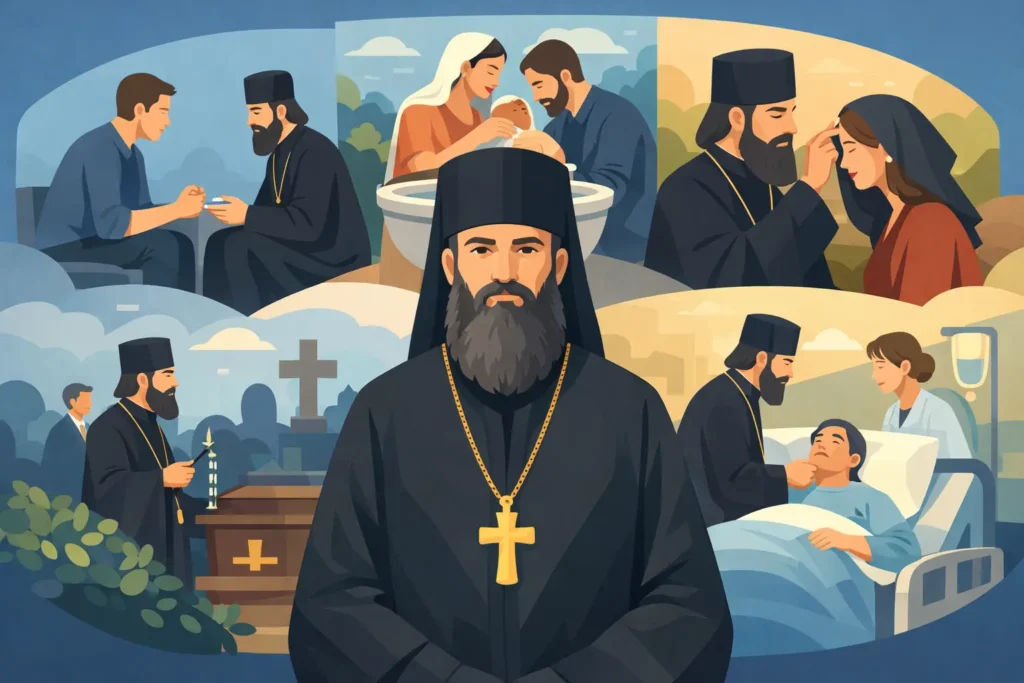
Yet the work of the priest continues well beyond Sunday morning. He prepares catechumens for baptism or chrismation, receives confessions, visits the sick, blesses marriages, counsels families, teaches the Faith, buries the departed, and prays with those carrying grief, temptation, fear, or uncertainty. He helps parents raise children in the Church and calls parishioners back to repentance when they wander.
This work requires more than friendliness or public speaking ability. A priest must know the Scriptures, the services of the Church, the teachings of the Fathers, and the needs of his people. He must also learn humility. A priest who seeks control instead of service can wound souls. A priest who avoids difficult truths for the sake of being liked can leave souls without the medicine they need.
Faithful pastoral care holds together truth and mercy. It does not flatter sin, but neither does it treat a repentant person with contempt.
Why Orthodox Christians Confess to a Priest
Confession can feel unfamiliar, especially to Christians formed by the idea that sin should remain entirely private. Orthodox Christians certainly confess directly to God. Every prayer of repentance is offered to Him. But Christ also gave His apostles authority to forgive and retain sins, and the Church has preserved confession as a sacramental encounter of repentance, healing, and restoration.
In confession, the priest is a witness and a servant of Christ’s mercy. He listens, offers spiritual counsel when needed, and pronounces absolution through the grace given to the Church. He is not there to satisfy curiosity, collect information, or exercise domination. The seal of confession is absolute.
Confession also resists self-deception. Left alone, people often excuse their sins, rename them, blame others, or forget the damage they have done. Speaking truthfully before God in the presence of a priest brings sin into the light. That can be difficult, but repentance is not humiliation for its own sake. It is the path toward freedom.
Married Priests and Celibate Priests in the Priesthood
A common misconception is that Orthodox priests must all be celibate. In fact, the Orthodox Church ordains both married men and celibate men to the priesthood. A man who is already married may be ordained, provided his marriage meets the Church’s requirements. Once ordained, however, he does not marry or remarry if his wife dies. Bishops are chosen from celibate clergy.
Neither marriage nor celibacy makes a man automatically holier or better suited for ministry. Both demand sacrifice, discipline, and fidelity. A married priest bears the responsibilities of family life alongside parish service. A celibate priest gives himself to the Church in a different manner. The Church honors both paths without treating either as a spiritual shortcut.
What the Priesthood Is Not
The priesthood can be misunderstood when people bring expectations shaped by modern religious culture. An Orthodox priest is not a motivational speaker, a therapist, a political spokesman, or a personal guru. He may offer encouragement, counseling, and practical guidance, but these are not the center of his calling.
Nor is he the only person responsible for the spiritual health of a parish. Every baptized Orthodox Christian is called to pray, fast, forgive, give generously, learn the Faith, and serve others. The priest leads and guards the flock, but the whole parish must live as the Body of Christ.
This also means that a healthy relationship with a priest is neither distant nor dependent. Parishioners should honor their priest, seek counsel, receive correction with humility, and pray for him. They should not demand that he solve every problem or treat his personal opinions as infallible. The priest himself remains a man under repentance, dependent on God’s mercy and accountable to his bishop.
How to Approach a Priest as a Newcomer
If you are visiting an Orthodox parish, you do not need to understand every custom before you arrive. Come reverently, observe the service, and let the prayers speak. If you meet the priest afterward, introduce yourself plainly and share where you are coming from. Honest questions are welcome.
Do not rush into receiving Holy Communion or assume that a single visit answers every question. Orthodoxy forms Christians patiently through worship, instruction, prayer, and sacramental life. Those preparing to enter the Church ordinarily receive catechism over time, not simply a brief orientation.
At All Saints of North America Orthodox Church, adults and families from the west side of the Phoenix area can find a serious path of inquiry, catechesis, and parish life. The goal is not to pressure anyone into a decision. It is to place the apostolic Faith before them clearly, then invite them to live it.
The priesthood becomes clearest when seen where it belongs: at the altar, in the confessional, beside the hospital bed, in the classroom, and among a people learning to repent and rejoice together. If you seek Christ and His Church, begin by coming to worship, praying honestly, and allowing the Church to teach you what faithful life under Christ’s care looks like.