If you want to understand Orthodoxy in this land, do not begin with abstractions. Begin with holy men and women who prayed here, suffered here, preached here, and kept the faith here. The saints of North America Orthodox Christians honor are not decorative figures from a distant religious past. They are living witnesses that the Orthodox Church is not foreign to this continent, nor is holiness confined to another age.
For many inquirers, that matters more than they first realize. A person may accept that Orthodoxy is ancient, beautiful, and doctrinally serious, yet still wonder whether it can truly become home in America. The answer is found, in part, in the saints. They show that the Gospel has already borne fruit on this soil.
Why the saints of North America Orthodox faithful honor matter
Orthodox Christianity is historical in the deepest sense. We do not invent the faith for each generation. We receive what has been handed down, and we enter the life of the Church through worship, doctrine, repentance, and sacramental communion. Yet this faith is not museum religion. It is alive. The saints prove that the same grace that sanctified the ancient martyrs and ascetics also sanctified missionaries in Alaska, bishops in San Francisco, monks in the northern wilderness, and righteous pastors in modern cities.
This is especially important for people coming from fragmented Christian backgrounds. Many have lived through doctrinal instability, shifting moral standards, and church life built more on personality than truth. When they encounter the saints of North America, they encounter something steadier. Here are people whose lives were shaped not by trends but by obedience to Christ in His Church.
There is also a practical point. The saints teach us how Orthodoxy is lived in the actual conditions of this continent. They navigated mission work, cultural conflict, persecution, immigration, poverty, isolation, and the challenge of building faithful communities far from the old Orthodox heartlands. That makes them especially relevant for American families trying to raise children in the faith now.
Who are the saints of North America in Orthodox tradition?
The phrase can be used broadly or more strictly. Broadly, it refers to those canonized saints who lived and labored in North America or whose witness is closely tied to the Church on this continent. More strictly, some people use it to refer to saints formally commemorated together as North American saints. In either case, the point is not regional pride. The point is ecclesial memory.
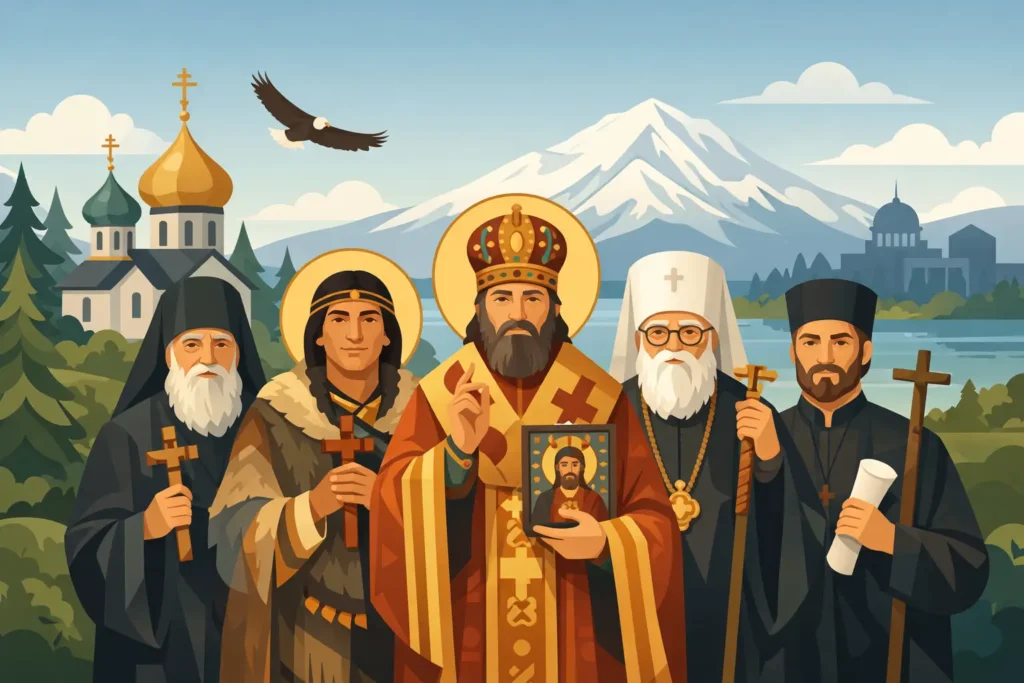
Among the best known is St. Herman of Alaska, whose quiet holiness, love for the oppressed, and steadfast prayer remain a standard for Christian life. St. Innocent, the great missionary and translator, showed that fidelity to Orthodox truth does not require contempt for local people or cultures. St. Tikhon helped guide the Church in North America with pastoral wisdom and breadth of vision. St. Raphael of Brooklyn labored tirelessly to shepherd scattered Orthodox believers. St. John of Shanghai and San Francisco, though not native to this land, became one of its great saints through his sacrificial archpastoral ministry.
Others are less known to the average newcomer, and that is a loss. The Church in North America was not built by one personality or one ethnic stream. It was shaped by missionaries, bishops, priests, monastics, martyrs, confessors, mothers, fathers, and faithful laypeople. Some served in frontier conditions. Some endured hardship in immigrant communities. Some were mocked, ignored, or opposed. Holiness often advances quietly.
What these saints correct in modern religious thinking
Many people approach Christianity as consumers. They ask where they feel comfortable, where the music suits them, where programs are convenient, or where preaching matches their preferences. Orthodoxy begins elsewhere. It begins with truth, repentance, worship, and communion with the living God. The saints of North America call us away from a self-directed spirituality and back to the narrow path.
They also correct the common assumption that American life must always set the terms for Christian faithfulness. It does not. The saints lived here, but they did not baptize every local habit or modern instinct. They adapted where adaptation served the Gospel, and they resisted where compromise would betray it. That distinction still matters.
This is where discernment is needed. Not every old custom is sacred, and not every new development is corrupt. Orthodoxy has always distinguished between Holy Tradition and temporary cultural forms. The saints help us make that distinction because they were neither rootless innovators nor rigid antiquarians. They were obedient Christians.
Saints of North America Orthodox families should know
For families, the saints are not merely subjects for classes or names on a calendar. They become companions in formation. Children need examples of courage, prayer, chastity, generosity, and endurance that are concrete and believable. Adults need the same.
A child who learns about St. Herman sees that gentleness is not weakness. A convert who studies St. Innocent sees that serious doctrine and missionary love belong together. A parishioner who reads about St. John of San Francisco sees what self-denial looks like in practice. A priest or father who considers St. Raphael encounters pastoral labor without vanity.
This is one reason Orthodox parishes should teach the saints carefully. If saints are presented only as distant miracle workers, people may admire them without imitating them. If they are reduced to moral examples, the supernatural reality of sanctity is lost. The Church holds both together. The saints are glorified by God, and their lives call us to repentance.
For those exploring parish life, this has immediate consequences. The right question is not, “Which saint do I find interesting?” but “What do these holy ones reveal about life in Christ?” That question reshapes how a person attends services, prepares for confession, approaches fasting, and orders family life.
Why North American saints matter for inquirers and converts
Many inquirers carry real burdens into the Church. Some are leaving evangelical instability. Some are weary of thin teaching. Some come from Roman Catholic backgrounds and are trying to understand the claims of the historic Church more clearly. Others have no strong church background at all, but they know they are spiritually homeless.
The saints meet all of these people with the same message: Orthodoxy is not an idea to sample. It is a life to enter.
That can feel demanding, because it is. To become Orthodox is not to collect information until one feels intellectually satisfied. It is to submit to the Church’s worship, doctrine, sacramental life, and discipline. The saints make this plain. They did not flirt with holiness. They gave themselves to Christ.
At the same time, their witness is deeply consoling. They remind seekers that sanctity is possible in weakness. Some were scholars and leaders. Others were hidden strugglers. Some preached publicly. Others endured quietly. The grace of God sanctified each according to his or her calling.
In that sense, the saints of North America answer a quiet fear many people carry: “Can I really live this faith where I am?” Yes, by God’s mercy you can. Not perfectly, not instantly, and not without struggle. But the path is real, and others have walked it before you.
Learning the saints within parish life
Reading about the saints is good. Learning to honor them within the liturgical and sacramental life of the Church is better. Their feast days, hymns, icons, and commemorations teach us to know them as members of the one Body of Christ, not as historical curiosities.
This is why serious parish life matters. A person can gather facts alone, but Orthodoxy is learned in worship, in confession, in fasting, in catechism, and in submission to the Church’s life. For those in the western Phoenix area who are seeking a stable Orthodox home, All Saints of North America Orthodox Church exists for exactly that kind of formation – not casual religious browsing, but a life of discipleship rooted in truth.
Still, patience is necessary. Some newcomers want immediate mastery of Orthodox history, doctrine, saints, services, and customs. That is not realistic. Better to begin faithfully. Attend the services. Ask good questions. Read with humility. Keep the prayers of the Church. Let the saints become familiar over time.
There is a difference between information and inheritance. Information is collected. Inheritance is received with gratitude and responsibility. The saints belong to the inheritance of the Church.
If you are drawn to Orthodoxy, start there. Learn their names. Hear their hymns. Ask what repentance looked like in their lives. Then bring that question to your own soul. The saints of North America are not relics of a completed past. They stand as proof that Christ is still raising up His people here, and that the way home remains open.