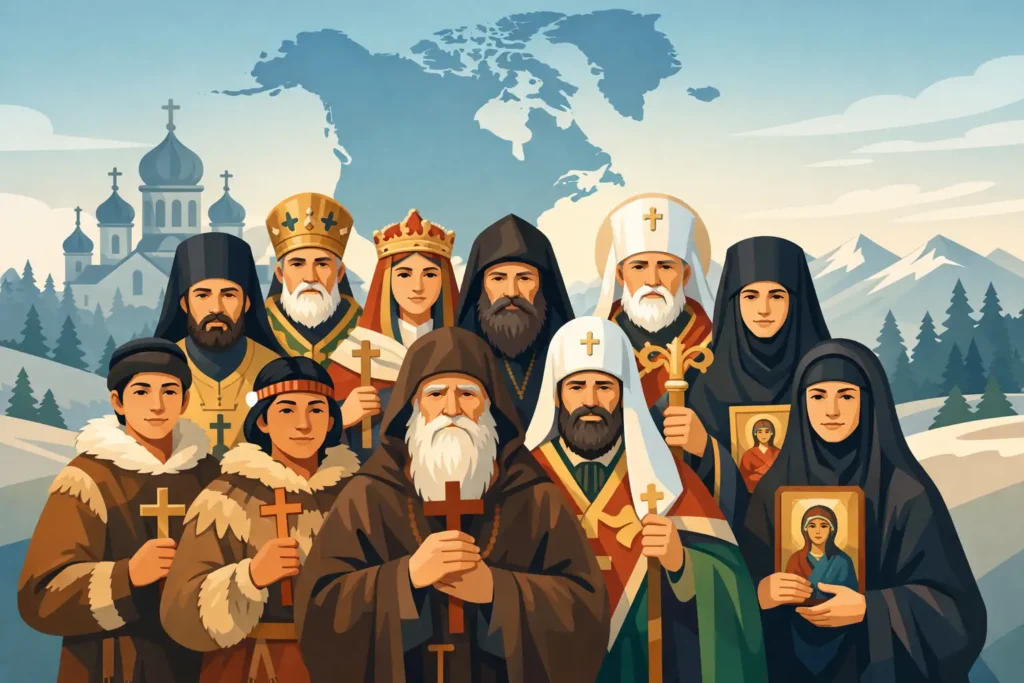
The phrase saints of North America explained may sound like a history lesson, but it is first a confession of faith. The Church in North America is not merely an outpost of ancient Christianity. By the grace of God, she has borne holy men, women, missionaries, martyrs, pastors, mothers, and confessors on this land. Their lives show that the Orthodox faith is not foreign to America, nor confined to a distant past. It is the life of Christ, received and lived wherever people repent, pray, and remain faithful.
For those entering Orthodoxy, the saints of this continent can be especially encouraging. They did not live in an imagined Christian civilization. Many served amid isolation, poverty, prejudice, cultural upheaval, division, and indifference. Their holiness was not sentimental. It was costly, concrete, and rooted in the worship of the Church.
What Does the Church Mean by “Saints”?
A saint is not simply a good religious person or a spiritual hero selected for admiration. A saint is one who has been united to Christ and revealed the fruit of that union in a life of faith, repentance, love, and endurance. The saints are alive in Christ. The Church honors them because God has glorified them, and because their lives bear trustworthy witness to the Gospel.
Orthodox Christians do not worship saints. Worship belongs to the Holy Trinity alone. We honor the saints as faithful servants of God and ask for their prayers, just as we ask living Christians to pray for us. This is not a detour around Christ. It is the confession that Christ has conquered death and that His Church is one family in heaven and on earth.
When the Church formally recognizes a saint, she does not make an ordinary person holy by decree. Rather, she publicly recognizes what God has already revealed through the person’s life, their enduring veneration among the faithful, and often through signs of God’s grace connected with them. This recognition is sometimes called glorification or canonization.
Saints of North America Explained: One Church, Many Peoples
“Saints of North America” is not a single, uniform category. It includes saints who labored among Indigenous peoples, immigrants, settlers, and newly formed Orthodox communities. Some were born here. Others arrived from Alaska, Russia, the Middle East, Serbia, Greece, or elsewhere and gave their lives in service to the Church on this continent.
Their different backgrounds matter. Orthodoxy does not erase peoples or force Christians into one cultural mold. The Gospel enters a people’s real language, history, suffering, and daily life. At the same time, the saints call every people to repentance and faithfulness to Christ. They are neither mascots for an ethnic identity nor symbols for a political cause. They belong to the whole Church.
The earliest Orthodox mission in North America took deep root in Alaska. There, missionaries preached Christ, baptized converts, translated prayers and Scripture, defended the vulnerable, and built communities that endured severe hardship. Later saints served Orthodox immigrants throughout the United States and Canada, helping scattered believers remain within the fullness of the faith rather than becoming absorbed into the religious confusion of their age.
St. Herman of Alaska: Holiness Without Comfort
St. Herman of Alaska is perhaps the best-known North American saint. A monk from Valaam Monastery, he came to Alaska as part of the Orthodox mission in the late eighteenth century. He lived simply, prayed deeply, cared for orphaned children, and defended the native Alaskan people when they were mistreated by colonial trading interests.
His life corrects a common misunderstanding of holiness. St. Herman was not influential because he held public power or built a personal platform. He was influential because he belonged wholly to Christ. His compassion did not soften the truth, and his ascetic life did not make him indifferent to human suffering. He prayed, served, taught, and endured.
His famous exhortation remains direct: “From this day, from this hour, from this minute, let us love God above all.” That is not religious decoration. It is the first commandment placed before every Orthodox Christian.
St. Innocent and St. Jacob: The Gospel in the People’s Language
St. Innocent of Alaska, first known as Fr. John Veniaminov, served as a missionary, pastor, teacher, translator, and later bishop. He learned local languages and labored to give the people a faithful Orthodox vocabulary for prayer and instruction. He did not treat those he served as a project. He treated them as persons made in the image of God and called into the same Church.
St. Jacob (Yakov) Netsvetov continued this labor as the first Orthodox priest of Native Alaskan heritage. His ministry required long journeys, physical hardship, pastoral patience, and care for people who were often neglected. His life reminds the Church that missionary work is not merely preaching to strangers. It is the long obedience of teaching, baptizing, hearing confessions, burying the dead, strengthening families, and remaining with the flock.
These saints also challenge modern assumptions about evangelism. Christian mission is not the marketing of a religious preference. It is the proclamation of Christ crucified and risen, joined to the patient work of forming people in the sacramental life of the Church.
St. Raphael, St. Alexis, and the Care of Scattered People
As Orthodox Christians from many lands settled across North America, they often found themselves without priests, churches, or stable parish life. St. Raphael of Brooklyn traveled extensively to serve Arabic-speaking Orthodox Christians and help establish parishes. He understood that a scattered flock needs more than occasional encouragement. It needs the Divine Liturgy, sound teaching, pastoral oversight, and a durable church home.
St. Alexis Toth ministered to Eastern Christians who faced rejection and pressure after arriving in America. His response was not bitterness or compromise. He helped lead many back into communion with the Orthodox Church, where they could receive the fullness of the faith handed down by the apostles.
Their witness remains relevant in a country where many Christians feel spiritually displaced. People may have strong opinions about Christianity while lacking a sacramental life, spiritual fatherhood, or a parish community that can sustain them through suffering and repentance. The saints point beyond private belief toward a life within the Church.
Why Their Lives Matter Now
North American saints do not tell us that America is automatically Christian. Nor do they permit despair about the Church’s future. They teach a more demanding lesson: holiness is possible here, and faithfulness is required here.
For a family in the Phoenix area, this may look ordinary at first. It means coming to the Divine Liturgy even when life is crowded. It means learning to pray at home, fasting with humility, confessing sins honestly, raising children within the life of the Church, and refusing to make peace with the passions. It means choosing a parish not as a religious service provider, but as the place where one is formed for salvation.
The saints also teach that Orthodox Christianity cannot be reduced to heritage. A person may have Orthodox ancestors and still need repentance. Another may come from evangelical Protestantism, Roman Catholicism, or no Christian background at all and become deeply rooted in the Orthodox faith. What matters is not possessing an identity label. What matters is receiving the life of Christ in His Church.
How to Honor the Saints Faithfully
The right response to the saints is not curiosity alone. Learn their lives, keep their feast days where possible, ask their prayers, and imitate the virtues God revealed in them. Yet imitation must be sober. Few people are called to the exact outward circumstances of St. Herman’s solitude or St. Innocent’s missionary travels. Every Christian, however, is called to prayer, obedience, mercy, courage, and perseverance.
There is also a necessary caution. We should not turn saints into inspirational quotes detached from Orthodox doctrine and worship. Their holiness grew from the same life the Church still gives: the Scriptures, the Divine Liturgy, fasting, confession, Holy Communion, almsgiving, and submission to Christ. To honor the saints while rejecting the Church that formed them is to miss their witness.
If you are seeking an Orthodox home, begin by attending the services and learning patiently. Ask serious questions. Receive instruction rather than rushing to adopt religious language or customs. At All Saints of North America Orthodox Church, seekers and families are invited to encounter this same living faith through worship, catechism, and the steady life of a parish.
The saints of this land stand as proof that no place is beyond the reach of Christ. Their prayers call us away from spiritual rootlessness and toward the narrow, joyful path of faithfulness. Welcome their witness not as distant history, but as an invitation to repent, believe, and become holy where God has placed you.