An evangelical to Orthodox conversion story rarely begins with a rejection of the Bible, a loss of zeal for Christ, or a desire for religious novelty. More often, it begins when a faithful Christian starts asking questions that have become impossible to ignore: Where did the Church come from? Who has authority to interpret Scripture? Why does Christian worship look so different from the worship described in the ancient Church?
For many evangelicals, these questions arise in the middle of an otherwise sincere Christian life. They may have loved Bible study, served faithfully, prayed earnestly, and brought others to Christ. Yet they have also felt the weight of denominational division, shifting doctrines, isolated Christianity, and worship that seems increasingly shaped by consumer preference. The road to Orthodoxy is often not an escape from Christianity. It is a search for the Church Christ established.
The First Turning Point: Scripture and the Church
An evangelical usually comes to Orthodoxy with a deep reverence for Holy Scripture. That reverence is not a barrier to conversion. It can become the very reason the person begins looking more closely at the early Church. Going from Evangelical to Orthodox in this case is very comforting!
The question is not whether the Bible is true. Orthodox Christians confess that the Scriptures are the inspired Word of God. The deeper question is how the Bible belongs to the life of the Church. The New Testament did not descend from heaven into a world of independent congregations. It was written within the Church, received by the Church, read in the Church, and recognized as Scripture by the Church.
This realization can be unsettling. An evangelical may have been taught that Scripture alone is the final authority, yet find that Scripture itself points repeatedly to the apostolic community, to bishops and elders, to received teaching, to baptism, Eucharistic communion, confession, fasting, and a visible body accountable to Christ.
The Orthodox claim is not that tradition stands over the Bible. Rather, Holy Tradition is the life of the Holy Spirit in the Church, of which the Bible is the central and inspired witness. Scripture is not diminished by this claim. It is protected from becoming a private project, reshaped by every new teacher or movement.
What an Evangelical to Orthodox Conversion Story Often Includes
There is no single conversion pattern. Some people arrive through studying the Church Fathers. Others are drawn first by the Divine Liturgy. Some begin with an intellectual concern about authority and remain because they encounter repentance, prayer, and a sacramental life they had not known. Many experience all of these over time.
The discovery of historic Christianity
A common moment comes when an inquirer reads the Christians closest to the apostles. St. Ignatius of Antioch wrote about bishops, the Eucharist, and the visible unity of the Church early in the second century. St. Irenaeus spoke of apostolic succession and the public faith handed down in the churches. The early Church did not look like modern evangelicalism, Roman Catholicism as later defined, or a loose collection of self-governing Bible churches.
This does not mean every historical question is simple. It does mean that history places serious demands on every Christian who claims to care about the faith once delivered to the saints. The Orthodox Church does not present herself as a restored version of early Christianity. She confesses that she is the same Church, still worshiping, teaching, baptizing, and receiving the Eucharist through the centuries.
The encounter with worship
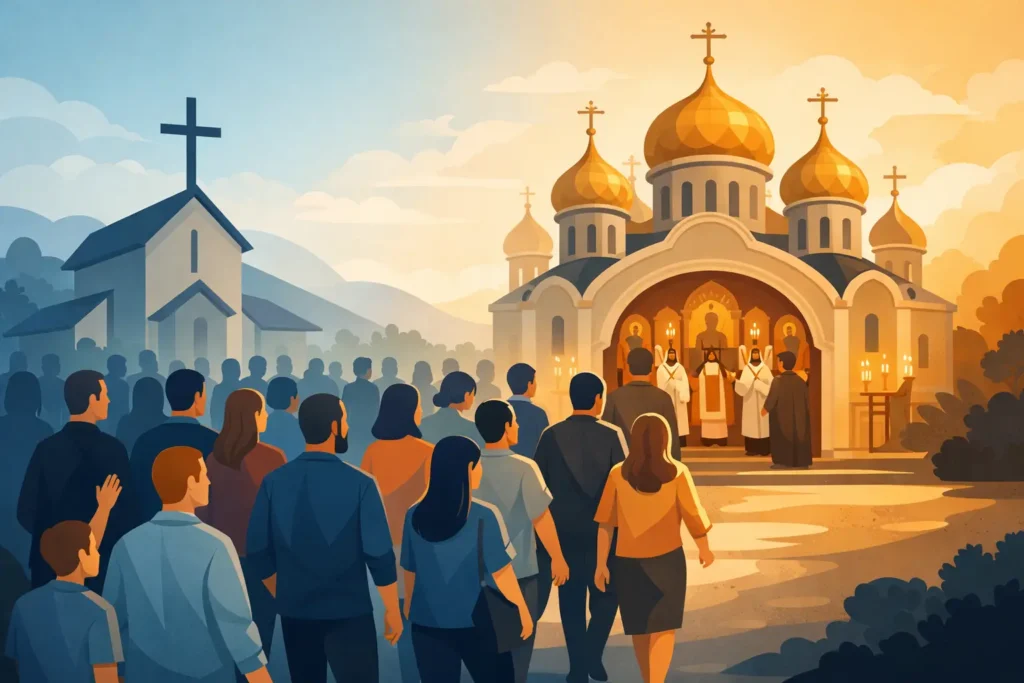
For some, the first Orthodox service is difficult. It is longer than expected. Going from Evangelical to Orthodox is a process of growth and increasing depth. There are icons, incense, chanting, standing, repeated prayers, and language unfamiliar to someone formed by a sermon-centered service. The visitor may not know when to cross himself or what book to use. That is normal.
Yet many also recognize something arresting: worship is directed toward God, not arranged around the preferences of the audience. The Divine Liturgy is not a performance. It is the gathered Church entering the worship of heaven. Scripture saturates it. The Psalms are prayed. Christ is proclaimed. The saints are remembered. The faithful repent, confess the Creed, receive the Word, and prepare to receive the Holy Gifts.
A person should not confuse emotional unfamiliarity with theological error. The first service may feel strange precisely because it is asking more than passive attendance. It calls the whole person – body, voice, attention, memory, and heart – to worship God.
The question of salvation
Many evangelicals worry that Orthodoxy teaches salvation by works. This concern deserves a direct answer. Orthodox Christians are not saved by earning God’s favor. We are saved by the grace of God in Jesus Christ. No fast, prayer rule, charitable act, confession, or outward discipline can purchase salvation.
But grace is not merely a legal declaration that leaves the human person unchanged. Grace heals, restores, and unites us to Christ. The Orthodox life of prayer, fasting, almsgiving, confession, and sacramental participation is not an attempt to impress God. It is the medicine of repentance. We cooperate with grace because God does not save us as passive objects. He calls us to take up the cross and follow Him.
This is a major shift for many converts. Salvation is not reduced to a past moment of decision, though a sincere confession of faith matters deeply. It is a life in Christ: being united to Him in baptism, nourished by His Body and Blood, forgiven in repentance, and transformed into His likeness.
Conversion Is Not a Change of Religious Aesthetics
It is possible to admire Orthodox architecture, chant, icons, or ancient prayers without becoming Orthodox. Beauty can open the door, but it cannot carry the weight of conversion by itself. To enter the Orthodox Church is to receive her faith, submit to her sacramental life, accept pastoral guidance, and learn to repent in a concrete community.
That means the process should not be rushed. A person coming from evangelicalism may need time to address real questions about Mary, the saints, icons, baptism, the Eucharist, confession, and the role of bishops. These are not minor details. They belong to the fullness of Orthodox faith.
It also means a potential convert should not treat the Orthodox Church as a collection of ideas to customize. We do not join the Church while reserving the right to redefine her teaching. We do not go from Evangelical to Orthodox to make it less Orthodox. Conversion involves humility. It is the willingness to be taught, corrected, and formed.
A Faithful Path Into the Orthodox Church
The normal path is patient and pastoral. Begin by attending the services faithfully, especially the Divine Liturgy. Do not worry about knowing every response at first. Stand where you are able, observe with reverence, and allow the prayers to become familiar.
Then speak with a priest. A good first conversation is not an examination to pass. It is an opportunity to explain your background, ask honest questions, and receive direction suited to your circumstances. Marital history, prior baptism, family responsibilities, and spiritual struggles all matter, because conversion is personal rather than mechanical.
Catechism follows. This is not merely an information course. It is a period of learning the Orthodox faith and beginning to live it. An inquirer learns the Creed, the Scriptures, the sacraments, the commandments, the saints, the liturgical year, and the disciplines of prayer and fasting. Just as importantly, he or she learns that Christianity is lived with others, under spiritual care, in a parish.
The reception of a convert through baptism or chrismation is determined by the Church’s pastoral order and the direction of the bishop and priest. No one should assume the outcome based on internet arguments or another person’s experience. The goal is not to win a debate about procedure. The goal is to be received faithfully into the one Church of Christ.
The Work Begins After Reception
One of the most hopeful parts of a genuine conversion story is what comes after baptism or chrismation. The Church does not receive someone at the end of a spiritual journey. She receives them at the beginning of a lifelong life of repentance.
Those who have gone from Evangelical to Orthodox need mystagogy – continued instruction in the mysteries they have received. They need to learn how to pray at home, keep a manageable prayer rule, prepare for confession, fast with discernment, serve their parish, and remain steady when early enthusiasm gives way to ordinary struggles. The Church is not asking converts to become experts overnight. She calls them to faithfulness.
This is especially important for evangelicals accustomed to evaluating faith primarily by personal certainty or spiritual intensity. Orthodoxy teaches steadfastness. There will be seasons of consolation and seasons of dryness. There will be questions that take time to answer. There will be sins that require repeated repentance. Christ remains faithful, and the Church gives us a concrete way to remain near Him.
For those in Surprise, Peoria, Glendale, Sun City, Buckeye, and the wider west Phoenix area, All Saints of North America Orthodox Church offers a serious and guided place to begin this work. Come to worship. Speak with the clergy. Enter the catechetical process with honesty and patience.
If you recognize your own questions in this story, do not demand that every answer arrive at once. Begin with the next faithful step: stand in the prayers of the Church, ask for wisdom, and let Christ lead you into the life He has preserved for His people.