A person who has loved Christ sincerely in an Evangelical church may still find himself asking a difficult, hopeful question: can Evangelicals become Orthodox? The answer is yes. Evangelicals can and o enter the Orthodox Church, not by abandoning Christ, but by coming more fully into the Church He established, with her apostolic faith, sacramental life, worship, and communion.
This is not usually a quick decision. It should not be. Entering Orthodoxy is not choosing a different worship style or adding ancient practices to an existing private faith. It is a return to the fullness of the historic Church, received through patient catechism, prayer, repentance, and the guidance of a priest.
Can Evangelicals Become Orthodox Without Denying Their Past?
Many Evangelical inquirers fear that becoming Orthodox requires them to say that every part of their previous Christian life was false. The Church does not ask for that. A person may have encountered the Scriptures, learned to pray, come to repentance, developed a love for Christ, and received real moral formation in an Evangelical setting. Those gifts should be received with gratitude.
At the same time, conversion requires honesty. Orthodoxy is not Evangelical Christianity with icons, incense, and a longer service. The Orthodox Church confesses a different understanding of what the Church is, how authority is received, what salvation means, how the sacraments work, and how Christians are formed over a lifetime.
The question is not merely, “Do I agree with Orthodox ideas?” It is, “Am I willing to be received into the life of the Church, to be taught, corrected, healed, and formed within her?” That is a deeper and more demanding question. It is also a liberating one.
What Usually Draws Evangelicals to Orthodoxy
Evangelicals often begin their inquiry because they are tired of doctrinal instability. They have watched churches divide over personalities, programs, politics, or changing interpretations of Scripture. They may have heard confident sermons that contradict one another and wondered where Christ gave His people a stable rule of faith.
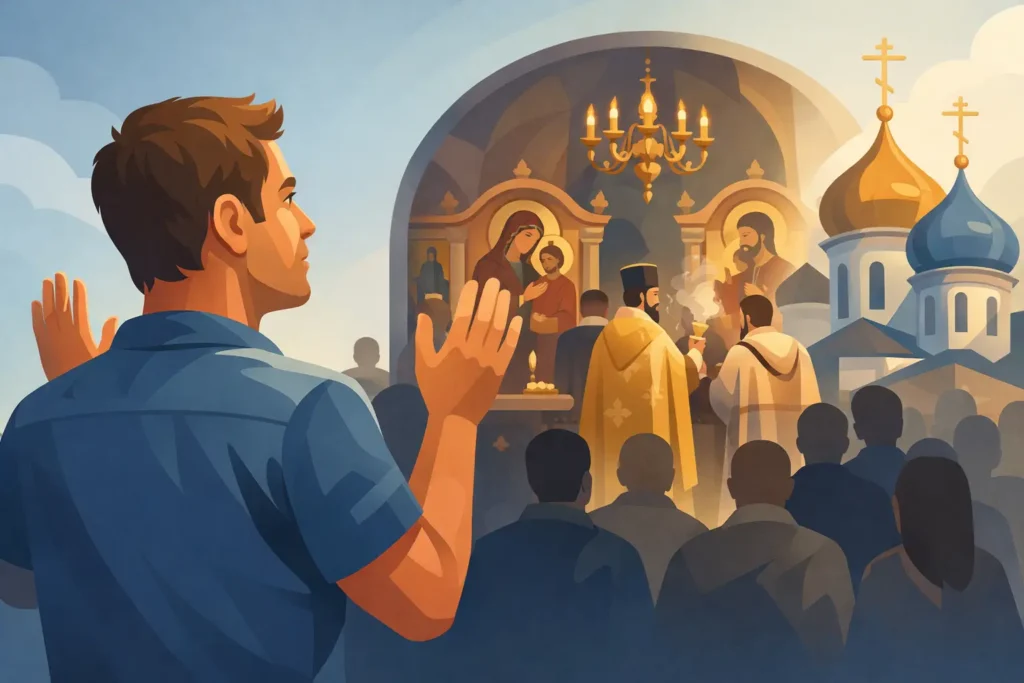
Others are drawn by the worship of the Church. The Divine Liturgy is not built around the preferences of a congregation or the charisma of a speaker. It is received worship, shaped by Scripture and handed down through the centuries. The prayers are not performances. They are the Church praying as the Body of Christ.
For some, the turning point is the discovery that the early Christians were sacramental, liturgical, episcopal, and deeply connected to the communion of saints. The Orthodox faith does not treat the first centuries of Christianity as a distant museum. It receives the faith of the apostles as a living inheritance.
This does not mean that every Evangelical will be persuaded by the same concern. Some first come because of the Eucharist. Others because they are searching for a coherent Christian moral life, a serious approach to confession, or a spiritual home where children can be raised in the faith rather than entertained near it.
The Differences That Must Be Taken Seriously
An Evangelical considering Orthodoxy will need to reckon with more than unfamiliar customs. The differences are theological and ecclesial.
Most Evangelical traditions place the final authority for Christian doctrine in Scripture interpreted by the individual believer, pastor, or local congregation. Orthodoxy reveres Holy Scripture as the inspired Word of God, but Scripture belongs within Holy Tradition: the received life of the Church expressed in worship, the ecumenical councils, the Church Fathers, the saints, and the apostolic succession of bishops.
The Orthodox Church also understands salvation as more than a legal declaration. Christ truly forgives sins, but He also heals and transforms the human person. Salvation is union with God by grace, a life of repentance and participation in Christ. Faith is never reduced to intellectual agreement or a single past decision. It is lived through prayer, fasting, almsgiving, confession, forgiveness, and participation in the Holy Mysteries.
The sacraments can be especially challenging for Evangelicals. Orthodoxy confesses that baptism is not merely a public symbol, that the Eucharist is truly the Body and Blood of Christ, and that confession to a priest is a genuine means of reconciliation and healing. These teachings are not later additions. They arise from the faith and worship of the ancient Church.
None of this should be rushed. A good catechumenate gives people room to ask hard questions without pretending that the answers are always simple. It also asks the inquirer to move beyond comparing arguments and begin living the questions through prayer and worship.
What the Path Into Orthodoxy Looks Like
There is no self-directed conversion to Orthodoxy. A person is received by the Church under the care of a priest and with the blessing of the bishop. The process may vary somewhat according to a person’s background and the practice of a particular Orthodox jurisdiction, but its purpose remains the same: a real entrance into the Church, not a religious transaction.
The first step is usually simple: attend the Divine Liturgy regularly. Come as you are, observe attentively, and resist the urge to make a final judgment after one visit. Orthodox worship can feel unfamiliar, particularly for those formed by sermon-centered or contemporary services. Its meaning unfolds through repetition.
Next comes conversation with a priest and participation in catechism. Catechism is not a test to pass. It is instruction in the Creed, the Scriptures, the Holy Trinity, the incarnation of Christ, the Church, the sacraments, prayer, the saints, and the Christian moral life. It is also an opportunity to address personal circumstances, including marriage, prior baptism, family concerns, and the practical changes that may accompany conversion.
After a period of preparation, a person may be received through baptism or chrismation, according to the Church’s pastoral practice and the bishop’s direction. This is not a matter for internet debates or personal preference. It is a pastoral and sacramental decision made within the Church’s order.
At All Saints of North America Orthodox Church, inquirers are invited into this process patiently and seriously. The goal is not to collect attendees. It is to help people become faithful Orthodox Christians who can stand in worship, receive the sacraments, grow in prayer, and belong to a parish family.
Challenges Evangelical Converts Should Expect
The beauty of Orthodoxy does not remove the cost of conversion. A former Evangelical may need to learn how to pray when prayer is not spontaneous, how to honor the saints without confusing honor with worship, and how to trust the Church when he is accustomed to deciding doctrine for himself.
Family relationships can also be painful. Loved ones may misunderstand the decision, believing that Orthodoxy is Catholic, foreign, overly ritualistic, or opposed to the Bible. The most persuasive response is not argument for its own sake. It is patience, humility, clarity, and a visibly deepening life in Christ. Do not make conversion an occasion for pride or contempt toward those who have loved you and prayed for you.
There is also the challenge of parish life. Orthodoxy is communal. It asks Christians to be present, to serve, to forgive, to confess, to learn, and to remain faithful when personalities disappoint them. A person seeking a perfect parish will not find one. He can, however, find the Church Christ has given for his salvation.
How to Begin With Honesty and Patience
If you are an Evangelical drawn to Orthodoxy, begin by praying plainly: “Lord Jesus Christ, lead me into Your truth, and give me the humility to follow.” Read the Gospels carefully. Attend the services. Speak with a priest rather than relying on social media arguments or conversion stories alone.
Do not feel pressured to manufacture certainty overnight. But do not remain indefinitely at a safe distance either. The Orthodox faith is known from within: in the rhythm of worship, the discipline of fasting, the reading of Scripture with the Church, the repentance of confession, and the joy of receiving Christ in the Eucharist.
Christ does not call His people to a private, self-made Christianity. He calls them into His Body. If you are being drawn toward that Body, take the next faithful step: come, pray, ask, and allow the Church to teach you how to come home.