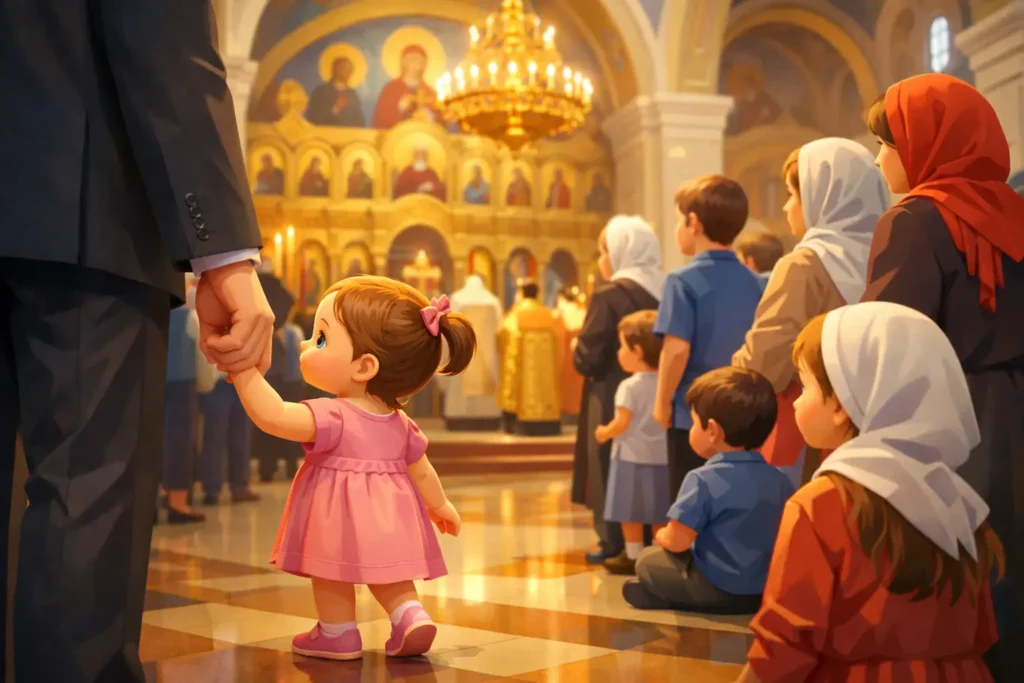
A child’s small voice, restless feet, or sudden tears do not place him outside the worshiping life of the Church. Can children attend Orthodox services? Yes. Children belong in the Divine Liturgy and the daily worship of the Church, not merely in a separate program designed to occupy them while adults pray.
Orthodox Christianity receives children as full members of the household of faith. Through Baptism and Chrismation, Orthodox children are united to Christ and His Church. They are brought to Holy Communion, taught to make the sign of the Cross, and formed gradually by the prayers, hymns, icons, fasting seasons, and sacramental life of the parish. Their understanding grows over time, but their place in worship begins now.
For a family visiting an Orthodox parish for the first time, this may be both encouraging and intimidating. Orthodox services can be longer than many modern church gatherings. They involve standing, chanting, incense, processions, repeated prayers, and moments of deep silence. A child may not absorb every word. Neither does every adult. Yet faithful participation forms the soul long before a child can explain what he has received.
Can Children Attend Orthodox Services at Any Age?
Yes. There is no minimum age for attending an Orthodox service. Infants are welcome. Toddlers are welcome. School-age children and teenagers are welcome. Parents should not feel that they must wait until their children are perfectly quiet, fully attentive, or able to stand through an entire Liturgy before bringing them to church.
At the same time, parents exercise discernment. A newborn may need feeding or a quiet moment outside the nave. A toddler may need a brief walk in the parish hall or narthex when he is overwhelmed. A child who is ill should rest at home, both for his own sake and for the health of others. These are not failures in church attendance. They are part of the patient work of raising a child within the Church.
The goal is not to demand adult behavior from a young child. The goal is to teach, little by little, that church is a holy place where the family comes before God together. Children learn reverence by being present with reverent adults. They learn the rhythm of worship by hearing it week after week.
Children Are Not Spectators in the Divine Liturgy
The Divine Liturgy is not a performance for adults or an educational event that children must first understand before they may enter. It is the worship of the Church before the throne of God. Children participate according to their age and ability.
A very young child may participate by being held quietly, looking at icons, receiving a blessing, and hearing the congregation sing. A preschooler can begin learning simple responses such as “Amen,” “Lord, have mercy,” and “To Thee, O Lord.” An older child can follow the service book, light a candle with parental guidance, sing, help keep a younger sibling settled, and learn why the Church prays as she does.
This formation is not always visible in the moment. Parents may leave a difficult Sunday convinced that nothing was accomplished because their child spent much of the service restless or distracted. But children remember more than parents think. They remember the candlelight, the priest’s blessing, the sound of the choir, the smell of incense, the faces of faithful people praying, and the repeated proclamation that Christ is risen. These impressions become part of a Christian imagination rooted in the life of the Church rather than the instability of the surrounding culture.
What About Holy Communion?
There is an important distinction between attending services and receiving Holy Communion. All are welcome to attend Orthodox worship respectfully. Holy Communion, however, is given to Orthodox Christians who have been baptized and chrismated into the Orthodox Church and who are properly prepared according to the guidance of their priest.
Orthodox infants and children who have received the Mysteries may commune. Parents should follow the parish’s pastoral direction concerning preparation, fasting as children mature, and regular confession for older children. There is no need to impose adult fasting rules mechanically on a young child. The purpose of discipline is to train the heart in repentance and love for Christ, not to burden children beyond their strength.
Visitors who are not Orthodox should not receive Communion, even if they are sincere Christians from another tradition. This is not a judgment of their faith or a lack of hospitality. The Eucharist is the sacramental expression of full unity in the Orthodox faith. Families are welcome to pray with the Church, speak with the priest, and learn what it means to become Orthodox.
How Parents Can Prepare Children for Worship
A family does not need an elaborate system to begin. A calm and consistent pattern usually serves children better than a complicated plan that cannot be sustained. Prepare for Sunday as a family: get enough rest when possible, leave enough time to arrive without panic, and remind children that they are going to meet Christ with His people.
Before entering the temple, give a simple expectation suited to the child’s age. You might say, “We will pray, sing, and listen. If you need help, whisper to me.” Avoid making church sound like a test of silence. Children should understand that worship is serious and holy, but they should not come to associate the Church only with fear of being corrected.
Bringing a small, quiet item for a toddler can be reasonable when it genuinely helps him remain near his parents. Books about saints, a child’s prayer book, or an Orthodox-themed picture book may help. Food, noisy toys, and distractions that turn the service into entertainment are usually less helpful. Parents know their children best, and wisdom is needed. A hungry infant should be fed. A distressed child may need to step out. But the ordinary direction should be toward learning to remain in worship, not away from it.
Teach by Example, Not Constant Commentary
Children notice whether their parents pray. If parents make the sign of the Cross, sing what they can, stand attentively, and approach the holy things with reverence, children receive a clear lesson. Excessive correction, whispered lectures, and visible frustration can make it harder for a child to settle.
Simple explanations at home are often more effective than continual explanations during the service. After Liturgy, parents can ask one gentle question: “What did you notice today?” Then connect one part of the service to the Gospel, a feast day, or the icon the child saw.
Build Stamina Gradually
Some families, especially those with several small children, may need to begin with a realistic portion of the service and grow from there. Arriving for the Gospel reading and staying through Communion may be a faithful beginning for a family in a demanding season. Over time, work toward arriving earlier and remaining longer.
This should not become a permanent retreat from the full life of worship when it is possible to participate more fully. The Church calls us to offer God our time and attention. Yet growth is often gradual. Parents should resist both discouragement and pride. The family beside you may be carrying burdens you cannot see.
A Word to Parents Who Feel Embarrassed
Most faithful parishioners understand that children make noise. A brief cry or a child’s fidgeting is not a scandal. Parents should take reasonable care not to let a continuing disruption prevent others from praying, but they should not interpret every sound as proof that they do not belong.
If you are visiting, it is acceptable to ask where families commonly sit, whether there is a place to step out briefly, and what the parish custom is for children. A serious Orthodox parish will value reverence without treating families as inconveniences. At All Saints of North America Orthodox Church, families from across the west valley are invited to enter the worshiping life of the Church with humility, patience, and a desire to be formed in Christ.
The presence of children also calls the whole parish to responsibility. Older members can encourage parents with kindness rather than scrutiny. Singles and couples without children can remember that the Church is not only preserving a tradition but handing down the faith. Parents, in turn, can teach their children that the people around them have come to pray and deserve consideration.
When a Child Resists Church
Resistance does not always mean rebellion, and it should not automatically be met with harshness. A child may be tired, anxious, sensitive to sound or crowds, or struggling with an unfamiliar environment. Listen carefully, ask what is difficult, and seek pastoral counsel when the problem persists.
Still, parents should not surrender the conviction that worship is necessary. Children are not asked whether they would like to attend school, visit the doctor, or come home for dinner. In the same way, Sunday worship is not simply one preference among many family activities. It is part of the Christian household’s ordered life.
The answer is neither coercion without compassion nor permission without direction. It is steady, loving leadership. Bring children to church. Pray with them at home. Speak truthfully about sin, forgiveness, death, and resurrection. Let them see that Christ is not an accessory to family life, but its Lord.
A child may not remember every sermon or hymn, but he can grow up knowing where his family stood when it sought God. Week by week, that faithful presence becomes an inheritance no passing activity can provide.