Scripture can seem familiar while remaining unread in its true depth. Many Christians know beloved verses, memorable stories, and moral lessons from the Bible, yet still struggle to see how the Law, the Prophets, the Gospels, and the Apostolic writings belong to one revelation. Bible survey lessons Orthodox Christians need address that problem directly. They teach us to receive the Bible as the Church’s book: a unified witness to Jesus Christ, read in worship and interpreted within Holy Tradition.
For an inquirer, this is often a turning point. The Orthodox Church does not place Scripture on one side and Tradition on the other, as if a Christian must choose between them. The same Holy Spirit who inspired the Scriptures formed the Church, guided the preaching of the Apostles, and preserved the Church’s worship and confession of faith. To read the Bible rightly is to read it with the Church that received it.
What an Orthodox Bible Survey Is For
A Bible survey is not meant to replace careful reading, prayer, or study of particular books. It gives the reader a map. Without a map, Genesis can feel remote, Leviticus can feel inaccessible, the prophets can appear repetitive, and Revelation can become a field for speculation. With a sound survey, the reader sees the movement of salvation history: creation, fall, covenant, Israel’s calling, the promise of the Messiah, Christ’s incarnation, His death and resurrection, and the life of the Church until His return.
The purpose is not merely information. A person can memorize dates, kings, and places while remaining untouched by the Word of God. Orthodox study seeks repentance, faith, obedience, and communion with Christ. Scripture reveals not only what happened long ago, but who God is, who man is, what sin has done, and how the Lord restores us.
This is why an Orthodox survey will not treat the Bible as a collection of disconnected religious documents. It will ask how each book bears witness to Christ. After His resurrection, the Lord opened the Scriptures to His disciples and showed them what was written concerning Him. That remains the Church’s pattern of interpretation.
Bible Survey Lessons Orthodox Readers Need
Begin with the Bible’s center: Jesus Christ
The Old Testament is not a preliminary religion discarded once the New Testament begins. It is the preparation, promise, image, and prophecy of Christ. Adam points toward the new Adam. The ark speaks of salvation. Passover reveals the Lamb of God. The exodus forms the pattern of deliverance from bondage. The Temple, priesthood, sacrifices, kingdom, and prophetic promises all find their fulfillment in the incarnate Son of God, Jesus Christ.
This does not mean every detail should be forced into an imaginative allegory. Orthodox interpretation is reverent, not careless. Historical events truly occurred, commandments truly instructed Israel, and the prophets addressed real people in real crises. Yet history itself was being directed toward Christ. The Church reads the Old Testament both according to its immediate setting and according to its fulfillment in the Lord.
The New Testament then announces that fulfillment. The four Gospels proclaim one Christ from four complementary witnesses. Acts shows the risen Lord continuing His work through the Holy Spirit in the Church. The epistles instruct baptized believers in faithfulness, worship, holiness, and perseverance. Revelation strengthens suffering Christians with the certainty that Christ reigns and will judge the world in righteousness.
Learn the shape of salvation history in the Bible
A good survey should help a student recognize the major movements of the biblical story rather than becoming lost in isolated episodes. Genesis establishes the goodness of creation, the dignity of man made in God’s image, the tragedy of the fall, and God’s mercy toward a rebellious world. The calling of Abraham narrows the story without making it smaller: through his seed, all nations will be blessed.
Exodus through Deuteronomy show Israel being delivered and formed as a covenant people. The historical books reveal both God’s faithfulness and Israel’s repeated instability. The wisdom books teach fear of the Lord, endurance, prayer, and the difficult work of living faithfully amid suffering. The prophets call the people back to covenant faithfulness while proclaiming a coming redemption beyond the failures of earthly rulers.
The Gospels are therefore not a sudden beginning. They are the arrival of the One for whom Israel’s Scriptures have been preparing the faithful. This framework protects readers from two common errors: treating the Old Testament as irrelevant, or reading it as though Christ had not come.
Read the Bible with the Church, not as a private judge
Every reader brings assumptions to the text. The question is not whether we interpret, but whether our interpretation is formed by the mind of the Church. Private interpretation can easily turn difficult passages into proof texts for ideas we already hold. The result is confusion, division, or a Bible reduced to personal preference.
Orthodox Christians receive Scripture in the life of the Church. We hear it proclaimed in the Divine Liturgy and the daily services. We learn from the Fathers, whose teaching was tested in the Church’s worship and doctrinal life. We pay attention to how feasts, hymns, icons, and lectionary readings illuminate biblical events. This is not an addition placed over the Bible. It is the living context in which the Bible has been prayed and confessed from the beginning.
At the same time, reading with the Church does not excuse passivity. Each Christian should hear the Scriptures, read them regularly, ask honest questions, and submit his own opinions to the apostolic faith. Humility is not intellectual laziness. It is the willingness to be taught.
How to Use a Bible Survey Well
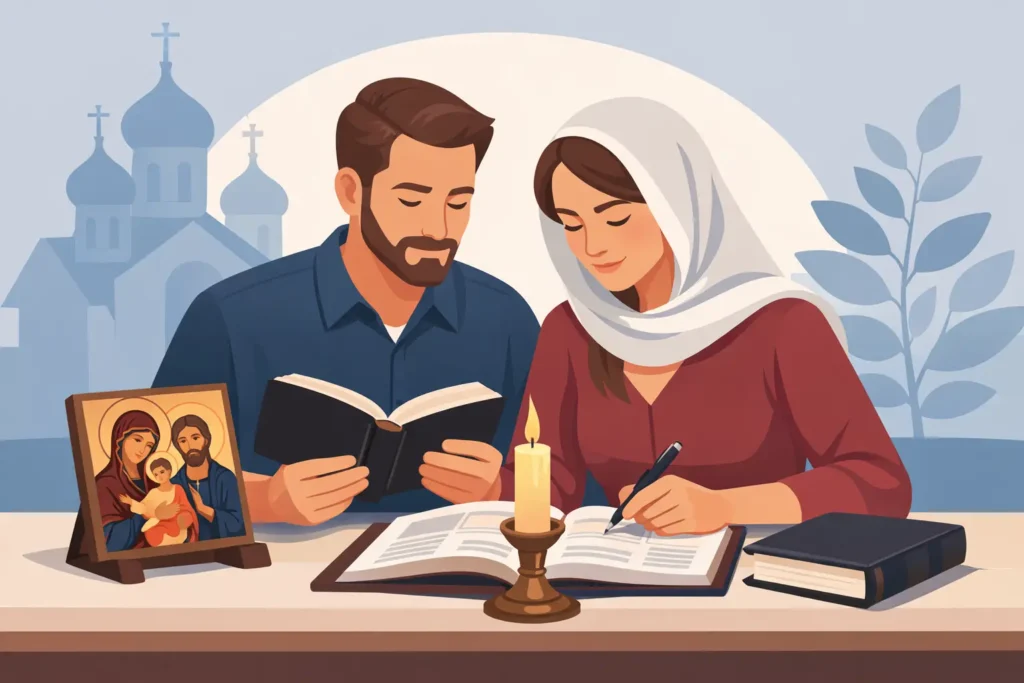
Bible surveys are most fruitful when they support a steady rule of reading rather than becoming another course completed and forgotten. Read the assigned passages themselves. Keep a Bible open during the lesson. Notice repeated words, covenant themes, promises, and connections to Christ’s life, death, resurrection, and Church.
When a passage is difficult, resist two temptations. Do not assume that it has no value because it is unfamiliar, and do not rush to a confident explanation based on a single verse. Some passages yield their meaning slowly. Genealogies, laws, prophetic judgments, and apocalyptic images require patience. Their place in the whole story of the Bible matters.
Prayer must also accompany study. Before reading, ask God to grant attention, repentance, and a heart ready to obey. After reading, do not ask only, “What did I learn?” Ask, “What does this reveal about Christ?” and “How must I live in response?” Scripture is not given simply to make us more informed. It calls us to become faithful.
For families, a Bible survey can establish a healthier pattern than random religious discussion. Parents do not need to possess every answer. They can read a passage with their children, identify where it belongs in the story, and bring difficult questions to clergy or a trusted class. Children who learn that the Bible is one coherent account of God’s saving work receive a foundation that will serve them for years.
The Difference Between Study and Speculation
Some Bible study approaches center on hidden codes, end-times charts, or arguments designed to defeat other Christians. Orthodox Bible study is more sober. Prophecy matters, Christ’s return is certain, and doctrine must be confessed clearly. But curiosity about disputed details cannot replace repentance, sacramental life, and love of God and neighbor.
Revelation is a useful example. It is a book of profound hope, worship, judgment, and victory in Christ. It should not be handled as a timetable for identifying every current event. The Church calls believers to vigilance, but vigilance means faithfulness. We prepare for the Lord’s coming through prayer, confession, mercy, and perseverance.
This sobriety also helps converts who have been formed by conflicting Bible interpretations. They need not pretend their questions disappeared overnight. But they can begin to receive Scripture within a stable and ancient pattern of worship and doctrine, where Christ rather than controversy remains at the center.
Study That Leads to Church Life
The Bible is heard most fully where it is prayed. A survey class, recorded lesson, or personal reading plan can be a real help, especially for those beginning to explore Orthodoxy. Still, Christian formation cannot remain online or merely academic. The Scriptures call us into the worshiping people of God.
At All Saints of North America Orthodox Church, Bible instruction belongs within that larger life of prayer, catechism, pastoral guidance, and participation in the services. For those in Surprise, Peoria, Glendale, Buckeye, Litchfield Park, Waddell, and nearby communities, a serious course of study can become a first step toward a serious Orthodox life.
Open the Scriptures with reverence, but do not read alone in spirit. Come with your questions, bring the difficult passages, and let the Church teach you to recognize the voice of Christ throughout the whole Bible. The goal is not simply to finish a survey. It is to hear the Word of God, worship the Word made flesh, and be changed by Him.