For many Christians, Evangelical to Orthodox conversion does not begin with a rejection of Jesus Christ. It begins with a deepening love for Him, followed by uncomfortable questions. Why does the New Testament describe a Church with bishops, sacraments, fasting, and fixed worship, while much of modern Protestant life feels comparatively recent, informal, and divided?
That question is not theoretical. It often comes after years of sincere Bible study, faithful church attendance, and real devotion. Many who begin to explore Orthodoxy are not running from Christianity. They are trying to find its fullness.
Why Evangelical to Orthodox conversion happens
Most Evangelicals who start looking seriously at Orthodoxy do so for a few related reasons. They notice that private interpretation does not, by itself, produce unity. They begin to see that doctrines once treated as obvious are often disputed, revised, or downplayed from one congregation to another. And they start to ask whether the Christianity of the apostles looked more like a modern non-denominational service or more like the historic, sacramental, liturgical Church.
Usually this change is gradual. A person may begin by studying the early Church Fathers, the canon of Scripture, or the history of doctrine. He may discover that Christians in the earliest centuries spoke plainly about baptismal regeneration, the real presence of Christ in the Eucharist, apostolic succession, prayers for the departed, and the authority of bishops. At first, this can feel surprising. Then it becomes difficult to dismiss.
For others, the issue is not only doctrine but formation. Many evangelicals have known sincere faith and earnest preaching, yet still feel spiritually undernourished. They may have learned how to have a quiet time, but not how to fast. They may have heard many sermons on grace, but had little experience of confession, repentance as a way of life, or worship shaped by the whole Church rather than by the preferences of a local ministry team.
None of this means evangelical churches contain no truth or no genuine believers. It means some Christians come to see that sincerity alone is not the same as fullness, and zeal alone is not the same as continuity with the apostolic Church.
What usually changes in an Evangelical to Orthodox conversion
The biggest change is not style. It is authority.
In evangelical life, the Bible is often treated as the sole authority, but in practice the believer, pastor, or denomination becomes the interpreter. That does not remove tradition. It simply creates competing traditions with no final, binding, living continuity. In Orthodoxy, Scripture is honored as the inspired word of God within the life of the Church that received, preserved, proclaimed, and rightly interprets it.
This shift can be difficult. Many inquirers first assume Orthodoxy adds human traditions to biblical faith. Over time, they may come to see the matter differently. The Orthodox claim is not that tradition competes with Scripture. It is that Scripture belongs within Holy Tradition, the life of the Church guided by the Holy Spirit.
Worship also changes. Evangelical services often center on the sermon as the primary event. Orthodox worship centers on the living God, approached with reverence, prayer, repentance, and sacramental participation. The liturgy is not built around novelty or personal taste. It is received, guarded, and offered.
That takes adjustment. If someone is used to evaluating church by how engaging the music is or how practical the sermon feels, the Divine Liturgy may seem foreign at first. But what first feels repetitive often proves to be stable, deep, and scriptural. Orthodoxy does not ask whether worship is entertaining. It asks whether worship is true.
Then there is the Christian life itself. In many evangelical settings, discipleship can become heavily mental – study, sermon notes, discussion groups, and personal application. These things have value. But Orthodoxy insists that the faith is lived with the whole person. We pray with the body, fast with the body, receive the sacraments with the body, bow, stand, keep feasts, endure fasts, confess sins aloud, and learn obedience in concrete ways.
Common struggles for Evangelicals entering Orthodoxy
The first struggle is often emotional. Some converts feel grief, not just excitement. They may love many people in their former churches. They may owe much to parents, pastors, and friends who taught them to love Christ and honor Scripture. An honest evangelical to orthodox conversion does not require mockery of the past. Gratitude and clarity can exist together.
A second struggle is the saints and the Mother of God. Evangelicals are often taught to fear that any honor shown to Mary or the saints must be a denial of Christ’s unique mediatorship. The Orthodox Church teaches no such thing. Christ alone saves. Christ alone is the God-man. Yet because He has truly conquered death, those united to Him are alive in Him. Asking the saints to pray is not replacing Christ, but confessing His victory.
A third struggle is sacramental realism. Many evangelicals are comfortable with symbols, memorials, and inward experiences. Orthodoxy speaks more concretely. Baptism is not only a public statement. It is new birth. The Eucharist is not merely a reminder. It is true communion in the Body and Blood of Christ. Confession is not only therapeutic relief. It is sacramental repentance before God in the presence of the Church.
There is also the challenge of patience. Some people discover Orthodoxy and want to be received immediately. But the Church is wise to move carefully. Conversion is not a consumer choice or a content preference. It is a reordering of life under Christ in His Church. That requires time, instruction, humility, and testing.
What Evangelicals should do before converting
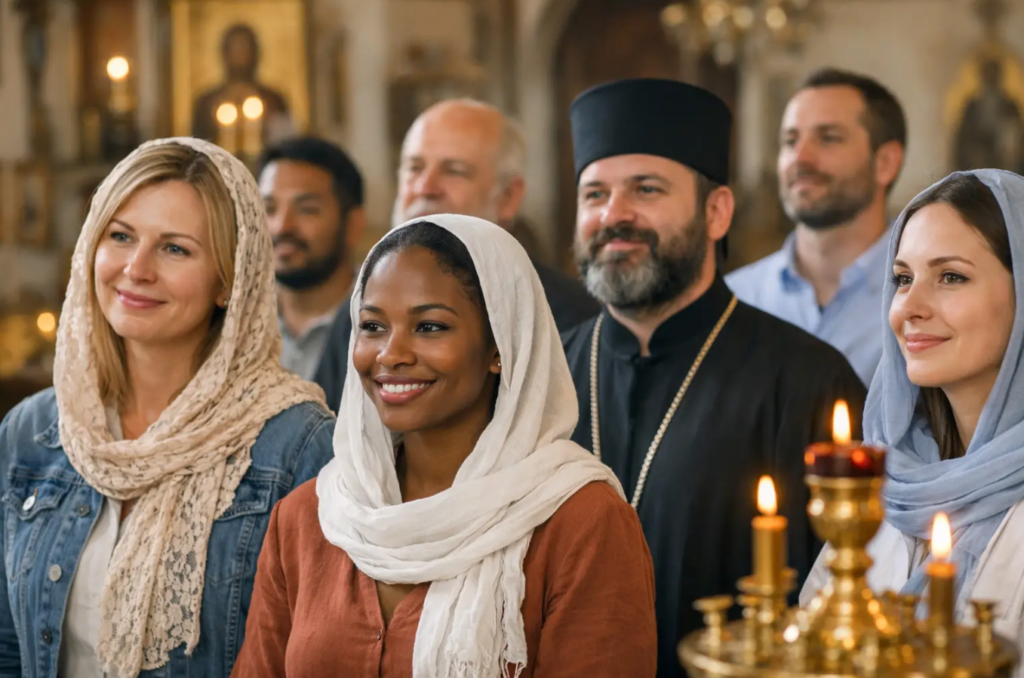
Begin with worship, not debate alone. Read, certainly. Ask hard questions. Compare doctrines carefully. But also stand through the services, listen to the prayers, and let the liturgical life of the Church teach you. Orthodoxy is not understood fully from the outside.
Find a priest who will answer questions plainly and pastorally. Internet research can help, but it also confuses. A person can spend months consuming arguments while avoiding submission, prayer, and actual parish life. Conversion should happen in the Church, not only in podcasts, books, or online comment threads.
Expect some cherished assumptions to be challenged. That is not a reason for fear. It is often a sign that real examination is taking place. The aim is not to preserve every inherited framework. The aim is to follow the truth wherever it leads, even when that demands repentance.
At the same time, do not rush into romanticism. Some inquirers imagine Orthodoxy will remove every disappointment, solve every parish problem, or answer every spiritual struggle overnight. It will not. The Orthodox Church is holy, but every parish is filled with sinners in need of mercy. The truth of the Church does not depend on an idealized convert fantasy.
What reception into the Church means
To become Orthodox is not merely to agree with a better theological system. It is to be joined to the visible, sacramental, apostolic life of the Church. That means learning to pray as the Church prays, confess as the Church teaches, fast as the Church appoints, and receive the holy mysteries with fear of God, faith, and love.
It also means belonging to a real parish. Christianity is not lived faithfully as an isolated researcher. The convert must become a worshiper, a learner, a servant, and a member of a spiritual household. This is why a serious parish does more than offer information. It offers a path of catechism, preparation, accountability, and ongoing formation.
For those in the western Phoenix area who are asking these questions in earnest, a parish such as All Saints of North America exists to make that path clear, careful, and pastoral. The goal is not pressure. The goal is to help inquirers move from curiosity to conviction, and from conviction to a life rooted in the Church.
A word to the serious inquirer
If you are considering evangelical to orthodox conversion, be honest about what is drawing you. If it is merely aesthetics, that will not sustain you. If it is intellectual novelty, that will fade. But if you are coming because you believe Christ founded one Church, that the faith has been handed down and not reinvented, and that you must submit yourself to that reality, then keep going.
The road into Orthodoxy is often slower than people expect, but that slowness is a mercy. The Church is not trying to win an argument. She is receiving souls. Welcome that patience, ask your questions without posturing, and learn to stand before God with reverence. Home is not found by sampling religious options. It is found by entering, remaining, and being changed.